
Save time and money with our discounts!
In cart {{totalProductsCount}} item(s)
Your cart is empty
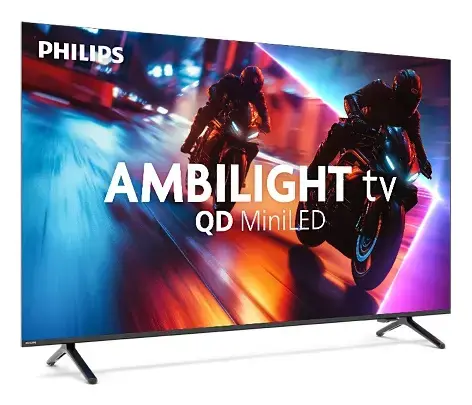
Television Philips 65MLED920 65" OLED 3840 x 2160
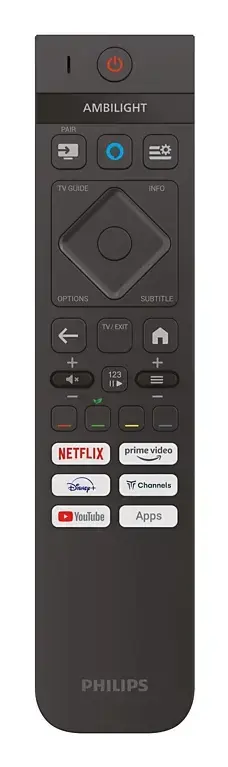
The Philips 65MLED920 is a 65" Mini‑LED Ambilight TV with OLED display and 3840 x 2160 resolution, designed for immersive home entertainment. Quantum Dot MiniLED technology and the Philips P5 processing engine deliver vivid colours, strong contrast and detailed images. Ambilight adds an adaptive halo of backlight that follows the on‑screen content to enhance perceived screen size and immersion. Built‑in support for Dolby Vision, Dolby Atmos and DTS:X improves picture and sound quality across movies, games and sports. The TV runs Titan OS for easy navigation, supports Wi‑Fi and Ethernet connectivity, and integrates with smart home systems via Matter, Alexa, Google and Apple AirPlay. Energy classes: SDR F, HDR G.
Quantum Dot MiniLED combined with the P5 engine produces brighter highlights, deeper blacks and a wide colour gamut for lifelike images. Ambilight increases immersion by projecting colours from the screen onto the wall behind the TV. Dolby Vision and HDR formats preserve director-intended brightness and detail, while Dolby Atmos and DTS:X provide immersive multi‑channel sound. A fast 120 Hz native refresh rate, HDMI 2.1, low input lag and Game Bar 2.0 make the set suitable for gaming. Titan OS offers a straightforward smart TV interface and the TV supports common voice assistants and Matter smart home connectivity.
Place the TV on a stable stand or wall mount at eye level for comfortable viewing. Connect set‑top boxes, consoles or players via HDMI 2.1 ports; use the network settings to join your Wi‑Fi or Ethernet network and sign in to streaming services on Titan OS. Enable Ambilight in the TV settings to let the LED backlight react to screen content. For gaming, select the appropriate Game Mode and enable HDMI 2.1 features on both console and TV. To use voice control, link your preferred assistant in the smart home or voice settings.
Position the TV so the Ambilight projection falls on a lightly coloured wall for the best halo effect; update firmware regularly and use the TV's energy settings to balance picture performance and power consumption.
{{highlightedFeature.featureTitle}}:
{{getProductFeatureValueById(product, highlightedFeature.featureId)}}
{{ productComparisonGenerationError }}
Device manufacturer code
Device manufacturer
Power consumption in switched-on state expressed in W.
Energy efficiency class is a standard classification that is used all over Europe and which is understandable at first sight. Products can be efficiently compared according to classes, starting from A (the most energy efficient class), and ending with G (the most energy-intensive class). The classification of energy efficiency is based on annual energy consumption which is being calculated on the basis of several different parameters.
Technology which allows separation of conditional access functionality from a digital TV receiver-decoder (Host) into a removable conditional access module (CAM). It is also referenced as DVB-CI for Digital Video Broadcast - Common Interface. The host is responsible for tuning to pay TV channels and demodulation of the RF signal, while CAM is responsible for CA descrambling. The Common Interface allows them to communicate with each other.
An Ethernet LAN (Local Area Network) interface is present, for a wired conection via a cable.
The type of radio tuner e.g. analog, digital.
The number of distinct pixels in each dimension that can be displayed. It is usually quoted as width × height, with the units in pixels: for example, "1024 × 768" means the width is 1024 pixels and the height is 768 pixels. The higher the number of pixels, the sharper the image.
The technology used in the display e.g. plasma, LED.
Size of the display for this product, measured diagonally, usually in inches.
The colour e.g. red, blue, green, black, white.