Powerful EcoFlow stations for energy anywhere!

{{ totalProductsCount }}
In cart {{totalProductsCount}} item(s)
In cart {{totalProductsCount}} item(s)
Total:
{{sum | formatAmount}}
Your cart is empty
Markdown Smart Sensors
Open box
Avatto
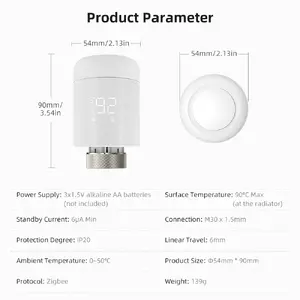
Thermostatic radiator valve Avatto ZigBee with LCD indicator, battery-powered (3x AA), for TUYA — boxed
Delivery: Thursday
28.49 €
Open box

somfy
Rain sensor Somfy Ondeis 24V DC model 9016344 for awnings and blinds
Delivery: 24.11.2026
107.99 €
Smart sensors are electronic devices that detect physical, chemical or biological parameters and convert them into digital signals with embedded processing or communication capabilities. These sensors combine sensing elements with microcontrollers, signal conditioning, and network interfaces to provide calibrated measurements, diagnostics, and data output suitable for automation systems, IoT platforms, and monitoring applications. They are selected when users need accurate, real-time data, remote access, or integration with control systems in environments such as buildings, industrial sites, vehicles, and environmental monitoring. Smart sensors can reduce manual reading, enable predictive maintenance, and support data-driven decision making by delivering filtered, timestamped, and often networked measurements. Typical form factors include compact modules, wired or wireless nodes, and integrated sensor arrays designed for installation in specific locations or equipment. When choosing smart sensors, users consider factors such as measurement range, accuracy, communication protocol, power consumption, environmental protection, and compatibility with existing systems.
Types of Smart sensors
Common categories of smart sensors are grouped by the parameter they measure and by interface capability.
- Temperature and humidity sensors — measure air or surface temperature and relative humidity; often used with digital outputs and onboard compensation.
- Pressure and flow sensors — include differential, absolute, and gauge pressure sensors and flow meters with signal linearization and digital interfaces.
- Motion and position sensors — accelerometers, gyroscopes, magnetometers, proximity sensors, and encoders that provide orientation, movement, or distance data.
- Gas and chemical sensors — detect specific gases or volatile compounds and provide calibrated concentration readings or threshold alerts.
- Optical and light sensors — ambient light, color, and photometric sensors with digital outputs for lighting control and monitoring.
- Environmental and soil sensors — measure parameters like CO2, VOCs, soil moisture, and pH with integrated signal processing for agriculture and indoor air quality.
- Integrated multisensor modules — combine several sensing elements (e.g., temperature, humidity, motion) and present fused or separate data streams.
What are Smart sensors used for?
Smart sensors are used wherever automated measurement, monitoring, or control is required. They provide real-time data to building management systems, industrial control systems (PLC/SCADA), and IoT platforms for tasks such as climate control, energy management, asset tracking, and safety monitoring. In industry, they support process control, machine condition monitoring, and predictive maintenance by supplying processed signals and diagnostic information. In consumer and commercial spaces, they enable smart lighting, HVAC optimization, occupancy detection, and environmental quality monitoring. In agriculture and environmental monitoring, smart sensors collect data on soil conditions, weather variables, and pollutant levels to support resource management and regulatory reporting.
Key Differences between Smart sensors
Smart sensors differ by measurement principle, interface, performance, and intended application.
- Measurement principle — sensors use physical, chemical, optical, or MEMS principles affecting response time, accuracy, and suitability for specific media.
- Accuracy and range — specified measurement uncertainty and operating range determine fit for precision tasks or general monitoring.
- Signal processing — onboard calibration, filtering, and compensation reduce raw noise and simplify integration.
- Communication protocols — wired (I2C, SPI, Modbus, 4–20 mA) or wireless (Wi‑Fi, Bluetooth, Zigbee, LoRaWAN) options affect network design and power use.
- Power and autonomy — battery-powered or mains-powered designs influence deployment, maintenance frequency, and energy-harvesting options.
- Environmental protection and certifications — IP rating, temperature tolerance, and industry certifications determine suitability for outdoor, industrial, or hazardous locations.
- Form factor and mounting — compact modules, DIN-rail, in-line, or probe-style sensors dictate installation methods and retrofit capability.
How to Choose Smart sensors?
Selecting a smart sensor requires matching technical specifications and system requirements to the application environment.
- Define the measured parameter, required accuracy, resolution, and measurement range based on process or monitoring needs.
- Check communication compatibility with existing controllers, gateways, or IoT platforms and prefer standard protocols for interoperability.
- Consider power supply options, expected battery life, and whether energy-saving modes or external power are available.
- Verify environmental ratings (IP, temperature, chemical resistance) and any industry-specific certifications required for the installation site.
- Evaluate onboard processing features like calibration, filtering, threshold alarms, and diagnostic outputs that reduce integration effort.
- Assess form factor, mounting options, and physical protection to ensure practical installation and maintenance access.
- Review long-term support, firmware update mechanisms, and documentation for calibration and integration procedures.
Which markdown smart sensors are the most popular and affordable in 2026?
The full list of popular models at affordable prices is available on this page. In 2026, the following models show high demand and an excellent price-to-quality ratio:
- Door/Window Contact Sensor Eura MA-05A3 with Built-in Siren (MA-05A3) for 5.99€
- Meross MSH400HK-EU Smart Wi-Fi Gateway for Smart Home Sensors for 18.99€
- Ledvance Osram SMART+ WiFi Motion Sensor White USB Type-C compatible with Amazon Alexa and Google Home for 21.49€
- MOES ZSS-QY-GL-U ZigBee Gas Sensor for 25.49€
- Smart Wi‑Fi Presence Sensor Meross MS600MA‑EU (Matter) — MS600MA‑EU(N) for 26.49€
Why is it worth buying markdown smart sensors at AiO.lv?
At the AiO.lv online store, you can place an order at a great price with delivery across Latvia — to Riga, Daugavpils, Liepaja, Jurmala, Ventspils, and other cities, as well as throughout Europe. We offer products from leading manufacturers: Panasonic, WENTRONIC, OEM, ATEN, UMAX, EMOS, TP-LINK, HUAWEI, ABUS, Hikvision, SATEL, H-TRONIC, UBIQUITI, GTV, ALPINA, QOLTEC, Datalogic, Ultron, Elgato, Olympia. When you shop with us, you get:
- official warranty and guaranteed quality;
- convenient payment options (including installment and credit);
- fast and reliable delivery across Latvia and to any EU country.
FAQ
Where can you find a markdown smart sensors with cheap prices?
You can buy cheaper at the AiO.lv online store. We offer competitive prices and regular discounts, so you always have the chance to find a great deal.
What is the delivery time for markdown smart sensors?
If you place your order today, delivery will take between 1 and 5 business days depending on the chosen method.
How long is the warranty period for markdown smart sensors?
Our store provides an official manufacturer’s warranty ranging from 12 to 36 months, depending on the model and brand. If needed, you can always contact our customer service department or the manufacturer’s authorized service center for support.
Are markdown smart sensors purchasable with leasing?
Yes, if the selected product costs more than €50. You can learn more about installment purchase options and the terms of application on the Payment page.
Can markdown smart sensors be purchased for a company (with VAT)?
Yes. AiO.lv works with legal entities in Latvia and throughout Europe. All product prices are shown with VAT included. In certain cases, a 0% VAT rate may apply — for example, when purchasing from other EU countries with a valid VAT number. We issue an invoice immediately after the order is placed, support BIS electronic invoices, and automatically generate all required accounting documents. To complete a purchase for a company, simply select the company profile during checkout.


