Save time and money with our discounts!

{{ totalProductsCount }}
In cart {{totalProductsCount}} item(s)
In cart {{totalProductsCount}} item(s)
Total:
{{sum | formatAmount}}
Your cart is empty
Markdown Sound Cards
Demo
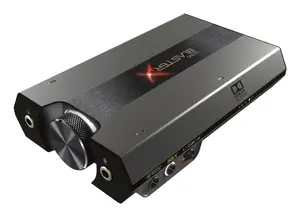
Sound cards are hardware components or external devices that process audio signals for computers and other digital systems. They convert analog audio inputs to digital signals and digital audio to analog outputs, provide input/output connectors, and often include signal processing features such as mixing, equalization, and effects. These products are used to improve audio quality, add multiple inputs or outputs, or enable low-latency audio for recording and playback. Sound cards are chosen for desktop PCs, workstations, and mobile recording rigs when onboard audio or basic interfaces do not meet specific performance, connectivity, or monitoring needs. Typical buyers select sound cards for tasks that require better signal-to-noise ratio, higher sample rates, or specialized ports such as MIDI, optical S/PDIF, or balanced TRS outputs.
Types of sound cards
Sound cards are available in several form factors and feature sets to match different use cases.
- Internal PCIe cards: installed inside desktop computers, offering multiple analog and digital inputs/outputs and low-latency performance.
- External USB audio interfaces: portable units that connect via USB, Thunderbolt, or FireWire for laptops and mobile setups.
- Professional rackmount interfaces: multi-channel units designed for studio and live environments with extensive I/O and clocking options.
- External DACs and headphone amplifiers: focused on high-quality playback, often used by listeners and mastering engineers.
- Integrated onboard audio (motherboard audio): built into motherboards and sufficient for basic playback and communication tasks.
What are sound cards used for?
Sound cards serve multiple practical functions across consumer, professional, and hobbyist workflows.
- Audio recording: capturing microphones and instruments with preamps and analog-to-digital converters for DAW use.
- Audio playback and monitoring: delivering high-quality output to speakers and headphones with digital-to-analog converters and amplification.
- Music production: providing low-latency monitoring, multiple simultaneous inputs, and routing for mixing and effects processing.
- Multichannel and surround sound: decoding and outputting multiple speaker channels for gaming, film, and VR applications.
- Digital connectivity: transferring audio over S/PDIF, ADAT, AES/EBU, or network protocols for synchronization and multi-device setups.
Key Differences between sound cards
Several technical and practical factors distinguish sound card models and determine suitability for particular tasks.
- Converters and dynamic range: quality of ADCs and DACs affects noise floor, accuracy, and headroom.
- Latency and drivers: driver performance and interface type influence round-trip latency important for live monitoring and tracking.
- I/O count and types: number and variety of analog and digital connectors determine connectivity with microphones, instruments, speakers, and other equipment.
- Preamp quality and phantom power: built-in mic preamps and 48V phantom power are necessary for condenser microphones and affect gain and noise.
- Sample rate and bit depth: supported sampling frequencies and bit depths impact recording fidelity and compatibility with studio workflows.
How to choose sound cards?
Selecting a sound card requires matching technical features to your intended workflow and system constraints.
- Identify your primary use: recording, mixing, playback, gaming, or streaming to determine required I/O and features.
- Check compatibility: ensure operating system support and driver availability for low-latency operation on your platform.
- Consider connectivity: choose between internal PCIe, external USB/Thunderbolt, or rackmount devices based on portability and expansion needs.
- Evaluate audio specs: compare ADC/DAC quality, sample rates, bit depth, dynamic range, and signal-to-noise ratio for desired fidelity.
- Plan for future expansion: select interfaces with ADAT, word clock, or digital ports if you may add preamps or additional converters later.
- Assess monitoring needs: look for direct monitoring, headphone amps, and balanced outputs if accurate playback and low-latency monitoring are required.
Why is it worth buying markdown sound cards at AiO.lv?
At the AiO.lv online store, you can place an order at a great price with delivery across Latvia — to Riga, Daugavpils, Liepaja, Jurmala, Ventspils, and other cities, as well as throughout Europe. We offer products from leading manufacturers: ADATA, creative labs, HAMA, HP, SANDBERG, Asus, LOGILINK, OEM, one for all, GEMBIRD, Speedlink, MEDIA-TECH, GOOBAY, YAMAHA, Kurzweil, TerraTec, 2direct, DELTACO, MANHATTAN, DELOCK. When you shop with us, you get:
- official warranty and guaranteed quality;
- convenient payment options (including installment and credit);
- fast and reliable delivery across Latvia and to any EU country.
FAQ
Where can you find a markdown sound cards with cheap prices?
You can buy cheaper at the AiO.lv online store. We offer competitive prices and regular discounts, so you always have the chance to find a great deal.
What is the delivery time for markdown sound cards?
If you place your order today, delivery will take between 1 and 5 business days depending on the chosen method.
How long is the warranty period for markdown sound cards?
Our store provides an official manufacturer’s warranty ranging from 12 to 36 months, depending on the model and brand. If needed, you can always contact our customer service department or the manufacturer’s authorized service center for support.
Are markdown sound cards purchasable with leasing?
Yes, if the selected product costs more than €50. You can learn more about installment purchase options and the terms of application on the Payment page.
Can markdown sound cards be purchased for a company (with VAT)?
Yes. AiO.lv works with legal entities in Latvia and throughout Europe. All product prices are shown with VAT included. In certain cases, a 0% VAT rate may apply — for example, when purchasing from other EU countries with a valid VAT number. We issue an invoice immediately after the order is placed, support BIS electronic invoices, and automatically generate all required accounting documents. To complete a purchase for a company, simply select the company profile during checkout.


