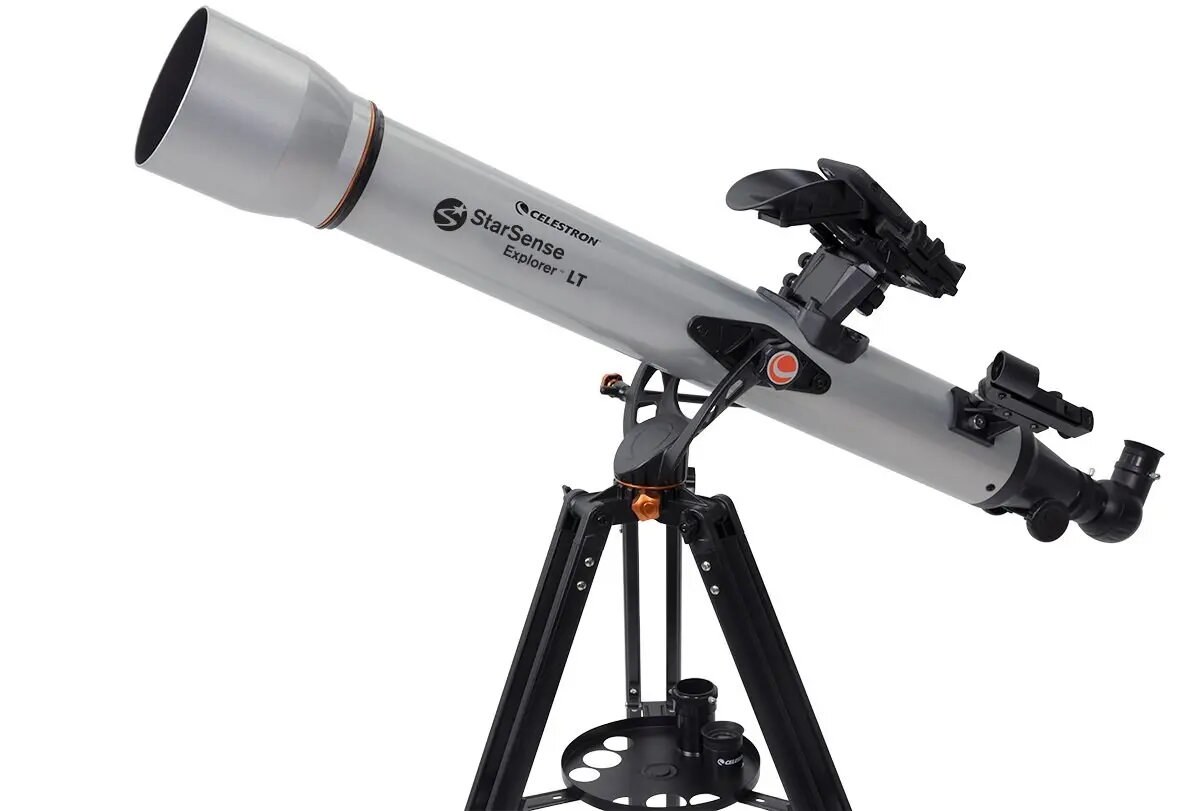
The Celestron StarSense Explorer LT 80AZ is an 80 mm aperture refractor telescope on an easy-to-use altazimuth mount, intended for beginner and recreational stargazers. This compact optical tube delivers clear views of the Moon, planets and brighter deep-sky objects while remaining portable enough for casual observing sessions and terrestrial viewing. The model supports smartphone-assisted StarSense alignment to simplify locating celestial targets, pairing modern convenience with a straightforward mechanical mount.
Advantages
The 80 mm objective provides a balance between light-gathering capability and compact size, producing crisp lunar and planetary detail and acceptable views of brighter deep-sky objects. The altazimuth mount offers intuitive up/down and left/right motion that makes pointing and basic tracking easy for new users. Compatibility with StarSense smartphone alignment reduces time spent on manual alignment and helps users find targets by translating phone star-field images into pointing guidance. The overall package is lightweight and suited for carry-out trips or quick setup in a backyard.
Suitable for
- Beginner astronomers learning to identify the Moon and planets
- Casual night-sky observers seeking a portable, easy-to-use instrument
- Terrestrial viewing such as landscape and distant landmarks
- Short observing sessions from suburban or semi-dark sites
When it may not be suitable
This telescope is not optimized for deep-sky astrophotography or imaging faint nebulae and galaxies due to its modest 80 mm aperture and the limitations of an altazimuth mount for long-exposure tracking. Users seeking high-magnification planetary imaging or detailed deep-sky photography should consider larger apertures and equatorial tracking systems.
Key specifications
- Aperture: 80 mm
- Optical design: Refractor (achromatic)
- Mount type: Altazimuth mount with manual controls
- Focal length: Suitable for low- to medium-power viewing (model configured for general observing)
- Portability: Compact optical tube and lightweight mount for field use
- Smartphone compatibility: Works with StarSense smartphone alignment system
How to use
Set the telescope on a stable surface and secure the altazimuth mount. Attach the optical tube and balance as instructed by the manufacturer. Insert an eyepiece of moderate focal length for initial alignment, then use the StarSense smartphone app to perform the alignment procedure: launch the app, center the telescope on the indicated calibration stars and follow on-screen prompts. Once aligned, use the mount’s manual slow-motion controls or simple push-to movement to center objects in the field of view. Start with low magnification eyepieces to locate targets, then switch to higher magnification for closer views of the Moon or planets.
What to consider before purchase
- Your observing goals: visual casual observing versus astrophotography
- Portability needs and whether you require a lightweight setup
- Compatibility with your smartphone for StarSense alignment
- Expected observing sites: suburban light-polluted areas versus darker skies
Usage recommendations
For best results, begin observing the Moon and bright planets during stable seeing conditions and use low-power eyepieces for wider fields. Bring a star-chart app or use the StarSense system to build familiarity with constellations and common targets. When transporting the instrument, protect the optics and mount with suitable cases or padded bags to preserve alignment and condition.