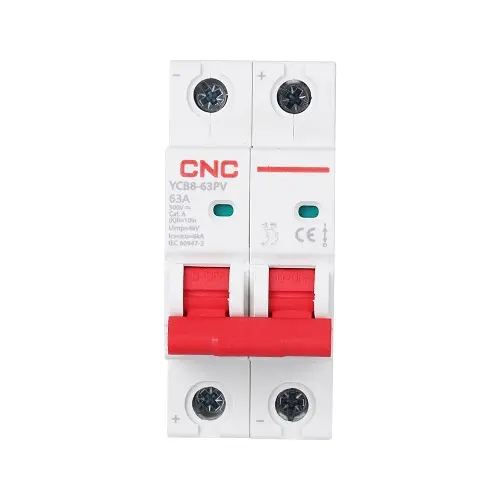
Choosing the right circuit breaker depends on the specific requirements of your electrical network, whether it is standard alternating current distribution or specialized direct current systems. The main product, CNC NV821662 DC Miniature Circuit Breaker, 2P, 63A, Cat.A, 500VDC, 6kA, is engineered to provide reliable protection for direct current electrical systems operating at up to 500VDC. In this comparison, it is evaluated alongside other CNC brand devices, including models for up to 1000VDC, residual current protection options, and standard residential or commercial solutions with different current ratings or pole configurations.
⚙️ The table below compares the electrical current type, voltage, pole count, rated current, breaking capacity, and intended application of each device to highlight their key engineering differences.
| Comparison parameter | CNC NV821662 DC 2P 63A 500VDC | CNC NV821679 DC 4-Pole 63A 1000V DC | CNC NV821914 2-Pole 63A 30mA RCBO | CNC NV821655 4-Pole 63A C Curve | CNC NV821501 2-Pole 20A C Curve | CNC NV821518 2-Pole 25A Class C | Practical significance |
|---|
| Current type and purpose | Direct Current (DC), solar systems and storage | Direct Current (DC), high-voltage solar setups | Alternating Current, earth leakage protection (RCBO) | Alternating Current, distribution networks | Alternating Current, residential and commercial | Alternating Current, residential and commercial | Products are divided between high-voltage direct current and standard alternating current with varied protective functions |
| Voltage | 500VDC | Up to 1000V DC | Standard mains voltage | Standard mains voltage | Standard mains voltage | Standard mains voltage | Determines compatibility with solar photovoltaic arrays or standard building wiring |
| Pole count | 2-Pole | 4-Pole | 2-Pole | 4-Pole | 2-Pole | 2-Pole | Affects wiring configuration for single-phase, two-phase, or multi-phase lines |
| Rated current | 63A | 63A | 63A | 63A | 20A | 25A | 63A ratings suit main incoming lines, while 20A and 25A are designed for branch circuits and outlets |
| Breaking capacity | 6kA | 6kA | 6kA | 6kA | 6kA | 6kA | All compared models share the same fault current interruption capacity |
◎ The suitability table below helps identify which product best matches your specific operating conditions and safety requirements.
| Use case | Recommended product | Why |
|---|
| Solar power plants and energy storage up to 500V | CNC NV821662 DC Miniature Circuit Breaker, 2P, 63A, Cat.A, 500VDC, 6kA | Designed specifically for direct current systems operating up to 500VDC |
| High-power solar and industrial DC systems up to 1000V | CNC NV821679 DC Miniature Circuit Breaker, 4-Pole, 63A, 1000V DC, 6kA Breaking Capacity, Category A | Provides four-pole direct current switching and protection for higher voltage setups |
| Electrical installations requiring earth leakage protection | CNC NV821914 Residual Current Breaker with Over-Current 2-Pole 63A C-Curve 30mA 6kA | Combines overload, short-circuit, and residual current protection in a single unit |
| General power networks requiring four-pole switching | CNC NV821655 Miniature Circuit Breaker, 4-Pole, 63A Current Rating, C Curve, 6kA Breaking Capacity | Suitable for safeguarding multi-pole alternating current distribution lines |
| Protection of household outlets and standard loads | Miniature Circuit Breaker CNC NV821501 2-Pole 20 Ampere Curve C 6kA Breaking Capacity | A 20A rating is optimal for protecting wiring in socket outlet circuits |
| Circuits with heavier household appliance loads | CNC NV821518 2-Pole 25A Miniature Circuit Breaker Class C 6kA | A 25A rating supports residential circuits with higher energy demands |
The main product, CNC NV821662 DC Miniature Circuit Breaker, 2P, 63A, Cat.A, 500VDC, 6kA, differs from alternative options through its specialized focus on direct current systems operating up to 500VDC, whereas most alternatives are designed for alternating current or higher voltages up to 1000VDC. Choose this model if you are designing or maintaining a photovoltaic system or energy storage setup within this specific voltage class, as it ensures proper switching and safety tailored to a DC environment.