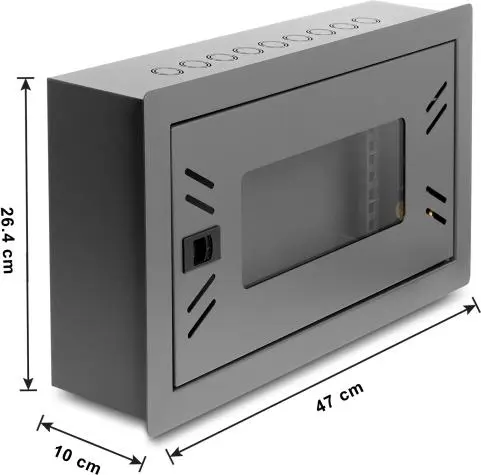
Comparing the Delock 43423 10-inch Network Cabinet Server Rack 4U Black with Removable Front Cover with alternative models Delock 12-inch network cabinet and switch cabinet with removable front cover 6U black 43424, ROLINE 19-inch Network Cabinet Basic 42U Freestanding Rack with Glass Door and Adjustable Feet in Black, ROLINE 19-inch network cabinet Basic 26 U freestanding rack with glass door, black, ROLINE Basic 19-inch Network Cabinet 26U Freestanding Rack with Glass Door and Adjustable Feet Grey, and ROLINE Basic 32 U 19-inch network cabinet freestanding rack with glass door black IP20 600 kg capacity highlights key differences in form factor, capacity, and intended application. The common purpose across all products is the secure organization and housing of network and server equipment. However, the Delock product serves as a compact, space-saving solution for small setups and offices, whereas the ROLINE products are large, freestanding enclosures designed for enterprise server rooms and data center infrastructures.
⚙️ The table below compares characteristics such as mounting standard, capacity, rack construction, front cover or door type, and practical use cases.
| Comparison parameter | Delock 43423 4U | Delock 43424 6U | ROLINE 19-inch 42U | ROLINE 19-inch 26U (Black) | ROLINE Basic 26U (Grey) | ROLINE Basic 32U | Practical significance |
|---|
| Mounting standard | 10-inch | 12-inch | 19-inch | 19-inch | 19-inch | 19-inch | Determines equipment compatibility: smaller sizes suit compact networking components, while the 19-inch standard is required for enterprise servers and standard switches. |
| Capacity | 4U | 6U | 42U | 26U | 26U | 32U | Lower capacity is ideal for small offices and local switches, while high capacities support extensive server arrays and heavy hardware. |
| Construction | Compact / wall-mount | Compact / wall-mount | Freestanding | Freestanding | Freestanding | Freestanding | Compact cabinets save space in office environments, whereas freestanding racks are built to house heavy equipment in dedicated server rooms. |
| Door / Cover | Removable front cover | Removable front cover | Glass door | Glass door | Glass door | Glass door | A removable cover simplifies access for compact setups, while a glass door protects large enclosures and allows visual monitoring. |
◎ The table below evaluates which product is most suitable for different user needs and usage scenarios.
| Use case | Recommended product | Why |
|---|
| Network organization in a small office | Delock 43423 4U | The compact 4U size and 10-inch form factor are ideal for housing a small number of networking devices in restricted spaces. |
| Small network setup with slightly more components | Delock 43424 6U | The increased 6U capacity and 12-inch format provide slightly more room for patch panels and switches while remaining compact. |
| Full-scale data center or server room | ROLINE 19-inch Network Cabinet Basic 42U | The massive 42U capacity and robust freestanding construction are designed to host extensive server fleets and telecommunications hardware. |
| Medium IT infrastructure (black finish) | ROLINE 19-inch network cabinet Basic 26 U | The 26U capacity and sturdy freestanding glass-door enclosure suit enterprise offices and telecommunication rooms. |
| Medium IT infrastructure (grey finish) | ROLINE Basic 19-inch Network Cabinet 26U Grey | Offers the same reliable 26U capacity in a grey finish to match specific room aesthetics. |
| Medium-to-large IT equipment deployment | ROLINE Basic 32 U 19-inch network cabinet | A balanced 32U capacity fits environments where 26U is insufficient and 42U is unnecessary. |
The main difference between the Delock 43423 10-inch Network Cabinet Server Rack 4U Black with Removable Front Cover and the alternative models lies in its ultra-compact 10-inch format and 4U capacity, designed for small-scale local networking. This product is most suitable for small offices, home setups, and confined spaces where large server racks are impractical. A buyer may prefer this option over the alternatives when needing a neat, space-saving enclosure for a minimal number of networking devices, whereas the ROLINE alternatives cater to robust enterprise and data center deployments.