
Leave your address - as soon as the price of the product goes down, you'll know about it right away
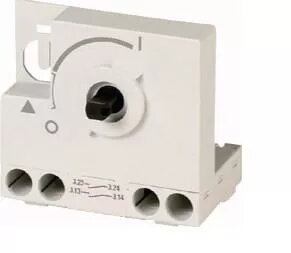
Eaton VHI20-PKZ0 Front-Mounted Auxiliary Contact
In cart {{totalProductsCount}} item(s)
Your cart is empty
Eaton VHI20-PKZ0 Front-Mounted Auxiliary Contact
Leave your address - as soon as the price of the product goes down, you'll know about it right away
Eaton VHI20-PKZ0 Front-Mounted Auxiliary Contact
The Eaton VHI20-PKZ0 is a precision-engineered front-mounted auxiliary contact designed specifically for seamless integration with PKZ0 motor protection circuit breakers. This component serves as a critical interface for industrial control systems, allowing for the monitoring and signaling of the switching status of the main circuit breaker. Built to withstand demanding environments, it ensures consistent performance and reliable electrical connectivity within complex automation setups.
The primary benefit of this auxiliary contact is its compact front-mounted design, which facilitates easy installation without increasing the footprint of the motor protection circuit breaker. By providing two normally open contacts, it offers versatile feedback capabilities for control circuits. Its robust construction allows it to operate effectively across a wide temperature range, ensuring stability in various industrial settings where thermal conditions may fluctuate.
This component is not intended for use with circuit breakers outside of the PKZ0 series, as physical and electrical compatibility is limited to this specific range. It is also not designed for high-power switching applications, as it is strictly an auxiliary signaling device.
The auxiliary contact is installed by attaching it directly to the front face of the compatible PKZ0 motor protection circuit breaker. Ensure the power supply to the main circuit is disconnected before installation. Align the contact module with the designated mounting interface on the breaker and secure it according to the mechanical locking mechanism. Once installed, connect the control wires to the terminal points to integrate the signaling function into your control system.
Regularly inspect the terminal connections for tightness and ensure the contact module remains free of dust or debris to maintain optimal electrical conductivity and signaling accuracy.
{{highlightedFeature.featureTitle}}:
{{getProductFeatureValueById(product, highlightedFeature.featureId)}}