
Leave your address - as soon as the price of the product goes down, you'll know about it right away
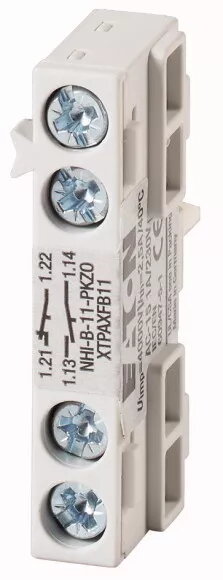
Eaton NHI-B-11-PKZ0 Auxiliary Contact, Side-Mounted, 1NO 1NC
In cart {{totalProductsCount}} item(s)
Your cart is empty
Eaton NHI-B-11-PKZ0 Auxiliary Contact, Side-Mounted, 1NO 1NC
Leave your address - as soon as the price of the product goes down, you'll know about it right away
Eaton NHI-B-11-PKZ0 Auxiliary Contact, Side-Mounted, 1NO 1NC
The Eaton NHI-B-11-PKZ0 is a high-quality side-mounted auxiliary contact module engineered specifically for integration with PKZ0 motor protection circuit breakers. This component serves as a critical interface for monitoring the switching status of the main circuit breaker, providing reliable feedback to control systems or signaling devices. With its compact design and robust construction, it ensures seamless operation within industrial electrical panels and automation setups.
This auxiliary contact offers exceptional reliability and ease of installation, allowing for quick side-mounting onto compatible motor protection circuit breakers without the need for complex tools. The inclusion of both normally open and normally closed contacts provides versatile configuration options for various control logic requirements. Its durable design is built to withstand demanding industrial environments, maintaining consistent performance and accurate status reporting over an extended service life.
This component may not be suitable for applications requiring high-current switching, as it is designed primarily for control and signaling purposes. It is also not compatible with circuit breakers outside the specified PKZ0 series or environments exceeding the defined thermal operating limits.
To install the auxiliary contact, ensure the motor protection circuit breaker is disconnected from the power supply. Align the module with the side of the circuit breaker housing and snap it into place according to the manufacturer's mechanical interface. Once secured, connect the control wiring to the designated terminals, ensuring that all connections are tightened to the specified torque to prevent loose contacts.
For optimal performance and safety, always perform a functional test of the auxiliary contact after installation to verify that the status signaling correctly reflects the position of the main circuit breaker. Regularly inspect terminal connections during routine maintenance to ensure long-term reliability.
{{highlightedFeature.featureTitle}}:
{{getProductFeatureValueById(product, highlightedFeature.featureId)}}