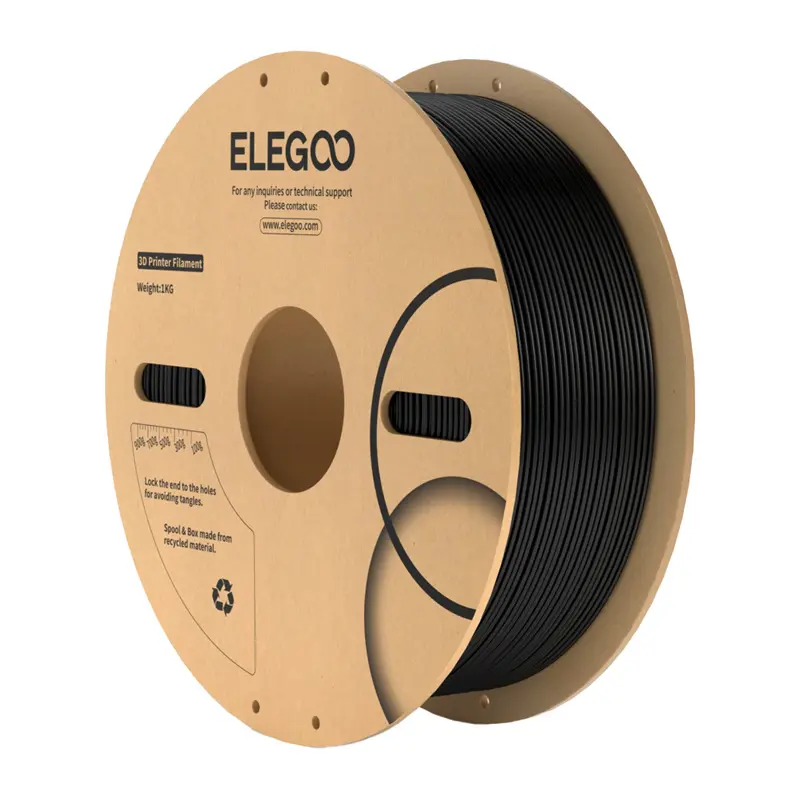
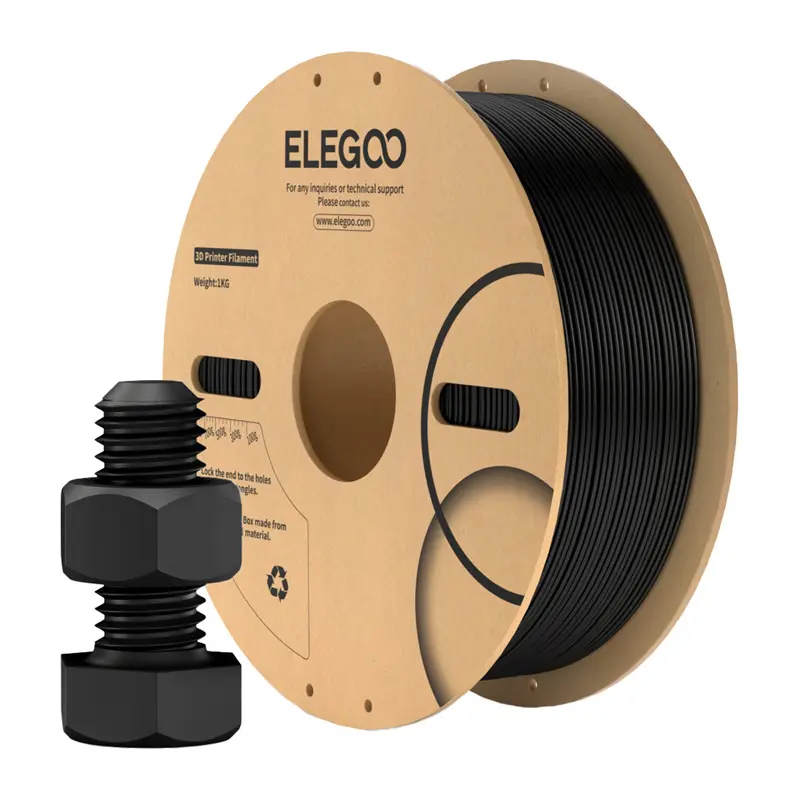
This overview focuses on comparing 3D Printer Filament Elegoo ABS (black) with several alternative 3D printing materials from Elegoo, Creality, The Filament Spectrum, and Powerton. All these materials are designed for creating physical objects using 3D printing technology, but they differ in polymer type, printing technology (FDM/FFF or LCD/DLP photopolymer), and final product properties such as rigidity, heat resistance, and surface finish options.
⚙️ The table below compares key characteristics, including printing technology, material type, color, composition, and practical purpose of each consumable to determine their suitability for various tasks.
| Parameter | 3D Printer Filament Elegoo ABS (black) | 3D Printer Filament Elegoo PETG-CF (grey) | Elegoo Standard 2.0 3D Printer Photopolymer Resin Black | 3D printer filament Creality CR-PETG 1.75 mm 1 kg — Black | PET-G 3D Printer Filament The Filament Spectrum Transparent Red 1.75mm 1kg Spool | 3D printer filament Powerton 3D ECONOMY LINE ABS 1000 g snowy white | Practical significance |
|---|
| Material type | ABS filament | Carbon-fiber reinforced PETG-CF filament | Photopolymer resin | PETG filament | PETG filament | ABS filament | Determines compatibility with a specific 3D printer type (FDM vs photopolymer systems). |
| Printing technology | FDM / FFF | FDM / FFF | LCD / DLP | FDM / FFF | FDM / FFF | FDM / FFF | Influences equipment requirements and model post-processing conditions. |
| Color | Black | Grey | Black | Black | Transparent red | White (snowy white) | Affects aesthetic properties and visualization capabilities. |
| Key features | Strength, rigidity, heat tolerance, ability to be sanded and painted | Increased stiffness and thermal resistance due to carbon fiber | High precision, low shrinkage, smooth surface | Good layer adhesion, chemical and temperature resistance | Glossy light-transmitting finish, stable extrusion | Standard ABS properties for prototyping and enclosures | Balances durability, detail level, and operating conditions for the finished part. |
◎ The table below evaluates product suitability for various usage scenarios to help choose the most appropriate material for specific engineering or creative tasks.
| Use case | Recommended product | Why |
|---|
| Functional prototypes and rigid mechanical parts | 3D Printer Filament Elegoo ABS (black) | The material provides high strength, rigidity, and allows mechanical post-processing like sanding and painting. |
| High-strength engineering components with enhanced stiffness | 3D Printer Filament Elegoo PETG-CF (grey) | Carbon-fiber reinforcement significantly increases stiffness and thermal resistance compared with standard plastics. |
| Detailed miniatures and complex engineering models | Elegoo Standard 2.0 3D Printer Photopolymer Resin Black | Photopolymer resin ensures exceptional detail precision and a smooth surface finish when printed on LCD/DLP printers. |
| Durable consumer goods and mechanical parts without brittleness | 3D printer filament Creality CR-PETG 1.75 mm 1 kg — Black | PETG combines good layer adhesion and impact strength, reducing brittleness in finished prints. |
| Decorative objects and translucent models with a glossy finish | PET-G 3D Printer Filament The Filament Spectrum Transparent Red 1.75mm 1kg Spool | Transparent red plastic creates an impressive glossy appearance with light-transmitting capabilities. |
| Enclosures and general structural mockups | 3D printer filament Powerton 3D ECONOMY LINE ABS 1000 g snowy white | White ABS material is suitable for standard prototyping tasks and device enclosure fabrication. |
Choosing between 3D Printer Filament Elegoo ABS (black) and alternative options depends on your 3D printer type and the requirements for the finished object. The main product is optimally suited for FDM printing of durable mechanical parts and functional prototypes that allow post-processing. If you require maximum rigidity through fiber reinforcement, specialized composites are a better choice, while achieving the highest level of detail for small models requires photopolymer resin on compatible equipment.