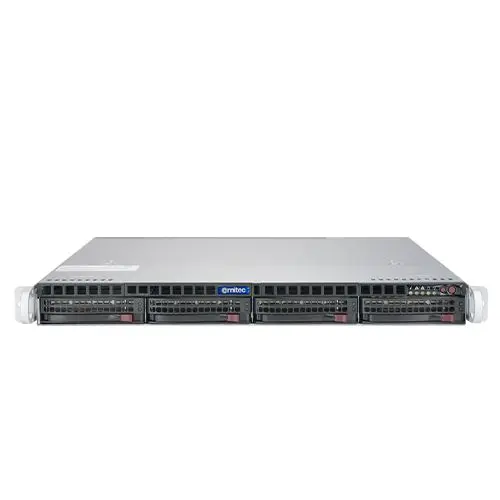
-
HDD capacity:
The maximum storage capacity of the hard disk, usually measured in bytes e.g. GB.
-
500 GB
-
Processor model:
The model number for the processor in a computer.
-
i7-12700
-
Weight:
Weight of the product without packaging (net weight). If possible, the net weight is given including standard accessories and supplies. Please note that sometimes the manufacturer leaves out the weight of accessories and/or supplies.
-
12 kg
-
Internal memory type:
The type of internal memory such as RAM, GDDR5.
-
DDR5-SDRAM
-
Rack mounting:
The type of mounting that can position devices in a shelving system (rack).
-
Yes
-
Remote administration:
-
YES
-
Number of power supply units:
-
1
-
Chassis type:
The type of rigid framework onto which is the hosuing for device components.
-
Rack
-
Package weight:
Weight of the packaged product.
-
17000 g
-
Form factor:
The shape or design of the product.
-
1U
-
Processor manufacturer:
The manufacturer that produced the processor.
-
Intel
-
Power supply:
The way in which the product is powered e.g. rechargeable battery, mains electricity connected via a plug and cable.
-
500 W
-
Ethernet LAN:
An Ethernet LAN (Local Area Network) interface is present, for a wired conection via a cable.
-
Yes
-
Number of drive bays:
-
4
-
Drive bays:
-
4
-
Hot-swap HDD bays:
Hot-swap hard drives are drives that can be removed and replaced during operation. Hot-swap hard drives are placed into hot-swap hard drive bays inside computers.
-
Yes
-
Height:
The measurement of the product from head to foot or from base to top.
-
220 mm
-
RAID controller type:
-
Software RAID
-
ECC:
ECC means Error Correction Code, and it is memory that is able to detect and correct some memory errors without user intervention.
-
No
-
Width:
The measurement or extent of something from side to side.
-
600 mm
-
Depth:
The distance from the front to the back of something.
-
760 mm
-
BIOS type:
The BIOS (Basic Input/Output System) initializes and tests system hardware components, and loads a bootloader or an operating system from a mass memory device. The BIOS additionally provides abstraction layer for the hardware, i.e. a consistent way for application programs and operating systems to interact with the keyboard, display, and other input/output devices. There are several types of BIOS, including the motherboard ROM BIOS, video BIOS, drive controller BIOS, network adapter BIOS, and SCSI adapter BIOS.
-
UEFI
-
Processor family:
A family of processors is a group of processors produced by one company over a short period of time e.g. Intel Pentium processors.
-
Intel Core i7
-
Ethernet LAN (RJ-45) ports:
Number of Ethernet LAN (RJ-45) ports (connecting interfaces) in the device. Ethernet LAN (RJ-45) ports allow a computer to connect to the ethernet.
-
2
-
Processor socket:
Mechanical component(s) that provides mechanical and electrical connections between a microprocessor and a printed circuit board (PCB). This allows the processor to be replaced without soldering.
-
LGA 1700
-
Wake-on-LAN ready:
-
Yes
-
Compatible operating systems:
List of desktop operating systems tested as compatible with this product.
-
Windows 10/11, Windows Server 2022/2025
-
Number of DIMM slots:
The number of places where DIMMs can be connected. A DIMM or dual in-line memory module comprises a series of dynamic random-access memory integrated circuits. These modules are mounted on a printed circuit board and designed for use in personal computers, workstations and servers. DIMMs began to replace SIMMs (single in-line memory modules) as the predominant type of memory module as Intel P5-based Pentium processors began to gain market share.
-
4
-
Number of SATA connectors:
-
4
-
Controller type:
-
Intel SATA SW RAID
-
Memory clock speed:
The frequency at which the memory (e.g. RAM) runs.
-
4400 MHz
-
Mouse included:
A mouse is included with this product.
-
No
-
LAN controller:
-
Intel I225-LM
-
Number of HDDs supported:
The total number of hard drives that can be used in/with this product.
-
4
-
HDMI ports quantity:
The number of sockets (ports) for HDMI connections. HDMI (High-Definition Multimedia Interface) is a compact audio/video interface for transferring uncompressed video data and compressed/uncompressed digital audio data from a HDMI-compliant device ("the source device") to a compatible computer monitor, video projector, digital television, or digital audio device. HDMI is a digital replacement for existing analog video standards.
-
1
-
Trusted Platform Module (TPM):
-
Yes
-
Package depth:
The distance from the front to the back of the packaging.
-
760 mm
-
Package height:
The distance from the top to the bottom of the packaging.
-
220 mm
-
Package width:
The distance from one side of the packaging to the other.
-
600 mm
-
SSD interface:
The type of interface(s) with which the Solid State Drive is connected to other hardware.
-
PCI Express
-
SSD capacity:
-
500 GB
-
Processor cores:
The number of central processing units ('cores') in a processor. Some processors have 1 core, others have 2 (e.g. Intel Core Duo) or more (e.g. the Intel Xeon E7-2850 has 10 cores).
-
12
-
S.M.A.R.T. support:
-
Yes
-
DisplayPorts quantity:
Number of DisplayPorts. A DisplayPort is a digital display interface developed by the Video Electronics Standards Association (VESA). The interface is primarily used to connect a video source to a display device such as a computer monitor, though it can also be used to carry audio, USB, and other forms of data.
-
2
-
Supported HDD sizes:
The size of the hard disk drives which can be used by the device.
-
3.5
-
RAID support:
The device uses RAID, which is a storage technology that combines multiple disk drive components into a logical unit for the purposes of data redundancy and performance improvement. Data is distributed across the drives in one of several ways, referred to as RAID levels, depending on the specific level of redundancy and performance required.
-
Yes
-
Processor threads:
-
20
-
Ethernet interface type:
-
25 Gigabit Ethernet
-
Memory slots (available):
-
2
-
Number of 3.5" bays:
A drive bay is a standard-area for adding hardware to a computer. Most drive bays are fixed to the inside of a case, but some can be removed. A 3.5" drive bay is for floppy disks.
-
4
-
On-site support:
-
No
-
On-board graphics card model:
"Graphic adapter" is the hardware that produces images on a display. "On-board" means that the graphics adapter is intergrated inside the motherboard.
-
Intel UHD Graphics 770
-
Intel® Hyper Threading Technology (Intel® HT Technology):
Improved Performance for Threaded Software
Intel® Hyper-Threading Technology (Intel® HT Technology) makes efficient use of processor resources, enabling multiple threads to run on each core and increasing processor throughput. Available on Intel® Core™ and Intel® Xeon® processors, Intel HT Technology helps run demanding applications simultaneously, protect and manage systems, and provide headroom for business growth.
-
Yes
-
Number of storage drives supported:
How many storage drives can be fit into the product at once.
-
4
-
Intel® Quick Sync Video Technology:
Create, Edit, and Share Video in a Flash
Intel® Quick Sync Video uses the dedicated media processing capabilities of Intel® Graphics Technology to make video encoding tasks—such as creating DVDs or Blu-ray discs, creating and editing 3D videos, converting 2D video files into 3D, and converting video for portable media players and social networking sites—faster and easier.
-
Yes
-
Intel® Smart Cache:
Improve Responsiveness with Faster Data Access
With Intel® Smart Cache on the Intel® Core™ i5 processor, the shared cache is dynamically allocated to each processor core, based on workload. This efficient, dual-core-optimized implementation increases the probability that each core can access data from the fast cache, significantly reducing latency to frequently used data and improving performance.
-
Yes
-
Enhanced Intel SpeedStep Technology:
-
Yes
-
Intel® Virtualization Technology (Intel® VT):
Simplify Virtualization and Reduce Overheads
Intel® Virtualization Technology (Intel® VT) helps make virtualization practical by eliminating performance overheads, reducing complexity, and improving security with hardware assistance. Virtualization allows multiple workloads to share a common set of resources so that a variety of workloads can co-locate while maintaining full isolation from each other.
-
Y
-
Intel® Active Management Technology (Intel® AMT):
Remotely and Automatically Increase Efficiency and Effectiveness
Using integrated platform capabilities and third-party management applications, Intel® Active Management Technology (Intel® AMT) allows IT or managed service providers to remotely monitor networked assets. Even when powered off, devices can be diagnosed and repaired with built-in manageability, receive software and virus updates, or store data for off-hours retrieval, lowering IT support costs.
-
Yes
-
Intel VT-x with Extended Page Tables (EPT):
-
Yes
-
Trusted Platform Module (TPM) version:
-
2.0
-
Rack rails:
-
Yes
-
Integrated BMC with IPMI:
-
Yes
-
Processor frequency:
The speed that the microprocessor executes each instruction or each vibration of the clock. The CPU requires a fixed number of clock ticks, or cycles, to execute each instruction. The faster the clocks rate, the faster the CPU, or the faster it can execute instructions. Clock Speeds are usually determined in MHz, 1 MHz representing 1 million cycles per second, or in GHz, 1 GHz representing 1 thousand million cycles per second. The higher the CPU speed, the better a computer will perform.
-
4.9 GHz
-
Memory layout (slots x size):
The slots and size of the memory for the CPU.
-
2 x 8
-
Internal memory:
A computer's memory which is directly accessible to the CPU.
-
16 GB
-
Number of main power supplies:
The quantity of main power supplies for this product.
-
1
-
Thermal Design Power (TDP):
-
65 W
-
Intel Virtualization Technology for Directed I/O (VT-d):
Simplify Virtualization and Reduce Overheads
Intel® Virtualization Technology (Intel® VT) helps make virtualization practical by eliminating performance overheads, reducing complexity, and improving security with hardware assistance. Virtualization allows multiple workloads to share a common set of resources so that a variety of workloads can co-locate while maintaining full isolation from each other.
-
Yes
-
On-board graphics card 4K support:
-
Yes
-
Processor cache type:
-
Smart Cache
-
Intel Virtualization Technology (VT-x):
Simplify Virtualization and Reduce Overheads
Intel® Virtualization Technology (Intel® VT) helps make virtualization practical by eliminating performance overheads, reducing complexity, and improving security with hardware assistance. Virtualization allows multiple workloads to share a common set of resources so that a variety of workloads can co-locate while maintaining full isolation from each other.
-
Yes
-
3.5" HDD support:
-
4
-
2.5" HDD support:
-
2
-
Supported RAID configuration:
-
RAID0, RAID1, RAID5 & RAID10
-
Processor ARK ID:
-
134591
-
Discrete graphics card:
-
No
-
NVMe:
NVM Express (NVMe) or Non-Volatile Memory Host Controller Interface Specification (NVMHCIS) is an open logical device interface specification for accessing non-volatile storage media attached via a PCI Express (PCIe) bus. NVM Express, as a logical device interface, has been designed to capitalize on the low latency and internal parallelism of solid-state storage devices.
-
Yes
-
Keyboard included:
A keyboard is part of the bundle/set.
-
No
-
Buffered memory type:
-
Unregistered (unbuffered)
-
PCI Express x16 (Gen 4.x) slots:
-
1
-
SSD size:
-
M.2
-
Terabytes written (TBW):
-
300
-
Power cables quantity:
-
1
-
Performance cores:
-
8
-
Performance-core base frequency:
-
2.1 GHz
-
Warranty period:
-
3 year(s)