
Filters you can trust. Pure water every day.
In cart {{totalProductsCount}} item(s)
Your cart is empty
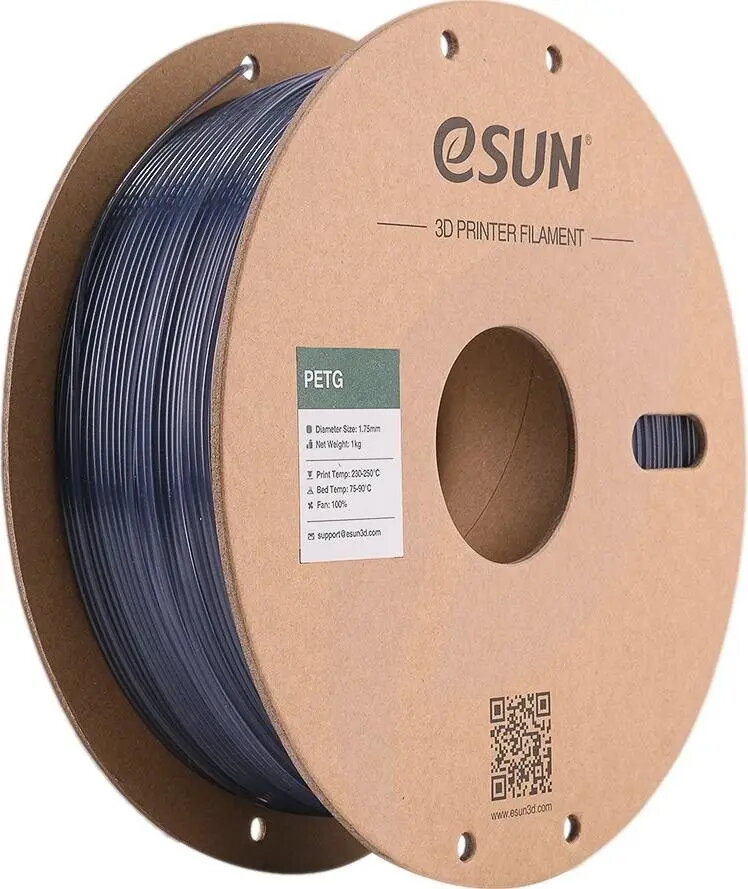
3D printing filament eSun PETG 1.75 mm Translucent Grey, 1 kg spool (PETG175T-H1P1)
eSun PETG 1.75 mm Translucent Grey, 1 kg spool is a PETG filament for FDM/FFF 3D printers that balances mechanical strength, chemical resistance and improved layer adhesion. The translucent grey colour allows partial light transmission, making it suitable for visible prototypes and functional parts where moderate translucency and durability are required. Filament is supplied on a 1 kg spool and is formulated to reduce brittleness compared with PLA while providing reliable extrusion and good interlayer bonding for structural prints.
This PETG filament offers a combination of toughness and ease of printing: it resists impact better than PLA while retaining good dimensional stability and improved layer adhesion. The translucent grey finish provides a neutral aesthetic and partial light diffusion for models that require some translucency without full transparency. The 1.75 mm diameter is a common size for desktop FDM printers, and the 1 kg spool supports extended printing sessions with consistent feed.
PETG is less rigid than some engineering plastics such as ABS or polycarbonate and may not be the best choice for parts requiring very high heat resistance or extreme stiffness. It can be more prone to stringing and oozing than PLA, so fine cosmetic prints with extremely sharp detail may require careful tuning of retraction and print temperature.
Load the 1.75 mm filament into an FDM/FFF 3D printer with a compatible extruder. Typical print temperatures for PETG range higher than PLA; start within the printer manufacturer or filament supplier recommended range and adjust for layer adhesion and surface finish. Use a heated bed to reduce warping and improve first-layer adhesion; common bed temperatures for PETG are above room temperature but below those used for ABS. Ensure proper filament drying and store the spool in low-humidity conditions to avoid moisture-related printing issues.
Start with manufacturer-recommended temperature settings and perform small test prints to fine-tune retraction, print speed and cooling. Use a clean, level build surface and moderate bed adhesion aids if needed. For functional parts, allow adequate infill and layer bonding to achieve the intended mechanical performance.
{{highlightedFeature.featureTitle}}:
{{getProductFeatureValueById(product, highlightedFeature.featureId)}}
{{ productComparisonGenerationError }}