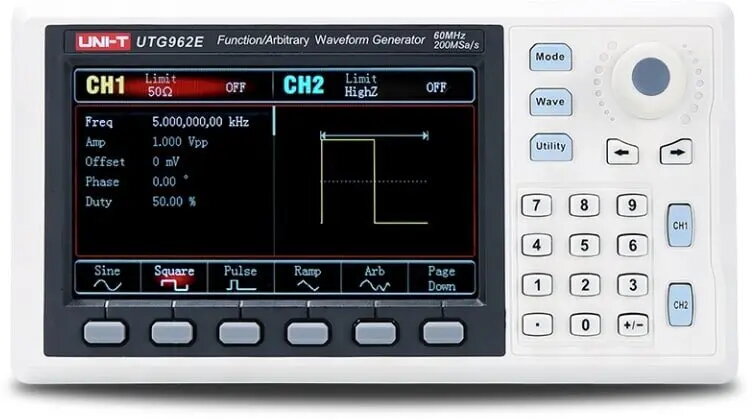
FLUKE UTG962E is a function and arbitrary waveform generator with 60 MHz bandwidth, two independent output channels, 14‑bit digital-to-analog conversion and a maximum sample rate of 200 MSa/s. The instrument includes a 4.3" TFT display that shows waveform shape, parameters and status, and provides on-device editing for both standard and user-defined arbitrary signals. Designed for laboratory testing, device development and signal simulation, the unit delivers precise, low-noise waveforms for verification, troubleshooting and component characterisation.
Advantages
The generator offers dual-channel operation with independent settings for each output, high resolution 14‑bit DAC for improved amplitude fidelity, and a 200 MSa/s sample rate that supports accurate representation of signals within the 60 MHz bandwidth. The integrated 4.3" TFT display simplifies waveform editing and parameter review without requiring a PC. Built-in standard waveforms and the ability to load or program arbitrary waveforms make the device versatile for a wide range of test and development tasks. Compact instrumentation and clear status indicators support efficient bench use.
Suitable for
- Laboratory testing and characterization of analog and mixed‑signal circuits
- Embedded system development and microcontroller input stimulus
- Signal simulation for sensor, amplifier and filter evaluation
- Education and training in electronics and instrumentation
- Repair, troubleshooting and functional verification of electronic assemblies
Key specifications
- Bandwidth: 60 MHz
- Channels: 2 independent outputs
- DAC resolution: 14‑bit
- Maximum sample rate: 200 MSa/s
- Display: 4.3" TFT for waveform viewing and editing
- Waveform types: standard waveforms plus user-defined arbitrary signals
- Output features: independent amplitude and offset control per channel
How to use
Connect the generator outputs to the device under test using appropriate coaxial cables and ensure common ground. Use the front-panel controls and the 4.3" TFT display to select a standard waveform or load an arbitrary waveform from supported input or storage. Adjust amplitude, offset, frequency and phase per channel to match test requirements. When synchronised outputs are needed, configure channel timing and phase relationships via the channel controls. Observe output with an oscilloscope to verify waveform fidelity and make incremental adjustments as necessary.
Usage recommendations
Operate within the specified bandwidth and sample rate limits to avoid distortion. Use proper grounding and shielding to minimise noise. For accurate measurements, verify output with a calibrated oscilloscope and use matched impedance cabling. When generating high-frequency content, keep leads short and apply appropriate termination at the load.