-
Wi-Fi frequency:
-
2.4 GHz
-
Timer:
A feature that measures a time interval and signals its end.
-
Yes
-
Dimmable:
The ability to vary the power output. For example, a light can be 'dimmed' to half power to make it less bright.
-
Yes
-
Placement:
Where the product can be placed e.g. floor, wall.
-
Wall, Ceiling
-
Suitable for indoor use:
-
Yes
-
Suitable location:
Locations in which the product can be used.
-
Universal
-
Suitable for light type:
The type of light (e.g. ambience, orientation) in which this product can be used.
-
Ambience
-
Bulb lifetime:
The length of time that the bulb will last for.
-
25000 h
-
Equivalent bulb power:
More energy-efficient light technologies often require less power than original bulb technology. The equivalent bulb power compares the power of a new bulb with the power for an original bulb to produce the same amount of light.
-
60 W
-
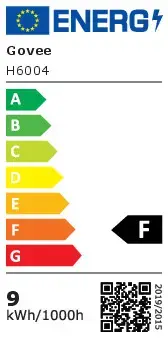
Bulb power:
The power of the lamp, usually measured in watts (W).
-
9 W
-
Color Rendering Index (CRI):
-
80
-
Beam angle (max):
-
360 °
-
Luminous flux:
Luminous flux or luminous power is the measure of the perceived power of light measured in lumen. The luminous flux is a weighted sum of the power at all wavelengths in the visible band.
-
800 lm
-
Colour temperature (max):
-
6500 K
-
Colour temperature (min):
-
2700 K
-
Number of colours:
-
16000000 colours
-
Light colour:
The colour of the light produced by the product.
-
Multi
-
Colour changing:
-
Yes
-
Bulb shape:
-
Pear bulb
-
Fitting/cap type:
The type of fitting (used in pipe plumbing systems to connect straight pipe or tubing sections, to adapt to different sizes or shapes, and for other purposes, such as regulating or measuring fluid flow) or cap (a pipe fitting used to seal the end of a pipe).
-
E27
-
Product colour:
The colour e.g. red, blue, green, black, white.
-
White
-
Bulb type:
The category of bulb used e.g. LED.
-
LED
-
Wi-Fi standards:
The type of wireless local area network (LAN). It can be ad-hoc, where units in a network communicate peer-to-peer, or Infrastructure, where units communicate with each other via an access point A LAN interconnects computers in a small area e.g. home, school or office.
-
Wi-Fi 4 (802.11n), 802.11g, 802.11b
-
Interface:
Interface ports to connect pieces of equipment. USB (Universal Serial Bus) has become the most popular wired interface to connect peripherals. USB 2.0 supports speeds up to 480 Mbit/s (USB 1: 12 Mbit/s). The interface FireWire is also known as the IEEE 1394 standard. Enhanced IDE (EIDE)is sometimes referred to as Fast ATA, Fast IDE or ATA-2.
-
Wi-Fi/Bluetooth
-
Type:
Characteristics of the device.
-
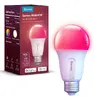
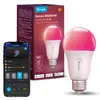
Smart bulb