Save time and money with our discounts!

{{ totalProductsCount }}
In cart {{totalProductsCount}} item(s)
In cart {{totalProductsCount}} item(s)
Total:
{{sum | formatAmount}}
Your cart is empty
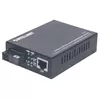 Media Converter Intellinet Fast Ethernet WDM Bi-Directional 10/100Base-Tx to 100Base-Fx
Product specification Media Converter Intellinet Fast Ethernet WDM Bi-Directional 10/100Base-Tx to 100Base-Fx
Manufacturer:
INTELLINET
Category:
Network Media Converters
Description
The Intellinet Fast Ethernet WDM Bi-Directional Media Converter enables seamless conversion from 10/100Base-Tx to 100Base-Fx over single-mode fiber. With a maximum data transfer rate of 100 Mbit/s and a distance of up to 20 km, it supports SC connectors and features a robust metal housing. Ideal for expanding network reach while ensuring reliable connectivity. Certified by FCC Class A and CE, it operates at 5V with a maximum power consumption of 5W.
The Intellinet Fast Ethernet WDM Bi-Directional Media Converter converts 10/100Base-TX copper Ethernet to 100Base-FX single-mode fiber using bi-directional WDM on a single fibre strand (transmit/receive wavelengths 1550/1310 nm). The device is transparent to network protocols and supports both copper and fibre links, enabling network expansion, building-to-building connectivity and extended link distances without running additional fibre strands. It features an RJ-45 10/100Base-TX port, one SC 100Base-FX fibre port, a metal housing and operates from 5 V with a maximum power consumption of 5 W. The converter supports up to 100 Mbit/s data rate and link distances up to 20 km and is certified to FCC Class A and CE standards.
Advantages
The converter uses bi-directional wavelength division multiplexing to transmit and receive over a single fibre strand, saving cabling costs and allowing either two independent connections on two strands or doubling capacity without laying a second cable. It extends network reach between buildings or distant network nodes and integrates with existing copper Ethernet without changing network settings. Its compact metal housing allows desktop, wall-mount or rack-mount chassis installation for flexible deployment.
Suitable for
- Extending Ethernet links between buildings or floors
- Connecting distant networking devices over single-mode fibre up to 20 km
- Integrating fibre segments into existing copper-based networks
- Environments where single-strand fibre use reduces cabling work or cost
Key specifications
- Data rate: 100 Mbit/s (10/100Base-TX)
- Ethernet ports: 1 × RJ-45 (10/100Base-TX)
- Fiber ports: 1 × SC (100Base-FX), single-mode, WDM bi-directional (1550/1310 nm)
- Maximum transfer distance: up to 20,000 m (20 km)
- Power: 5 V, max 5 W
- Certifications: FCC Class A, CE
- Housing: metal, colour: black
- Weight: 0.18 kg
How to use
Install the converter near the network device or at the fibre termination point. Connect the copper Ethernet device to the RJ-45 10/100Base-TX port and terminate the single-mode fibre to the SC fibre port, observing the correct transmit/receive orientation for WDM operation. Power the unit with the specified 5 V supply. Verify link and activity LEDs to confirm connection and data transmission. When deploying multiple units in a rack, use the compatible 19" chassis if available.
Usage recommendations
Use single-mode fibre with appropriate SC connectors and check that paired converters support complementary WDM wavelengths (1550/1310 nm). For reliable long-distance links, follow fibre installation best practices (clean connectors, proper splicing/patching) and ensure power and grounding meet local requirements.
Specifications
Logistics data
- Harmonized System (HS) code:
- 85176990
Certificates
- Certification:
- FCC Class A, CE
Packaging content
- Manual:
- Yes
- AC adapter included:
- Yes
Operational conditions
- Operating relative humidity (H-H):
- 10 - 80
- Storage temperature (T-T): The minimum and maximum temperatures at which the product can be safely stored.
- -20 - 70
- Operating temperature (T-T): The minimum and maximum temperatures at which the product can be safely operated.
- 0 - 50
Weight & dimensions
- Weight: Weight of the product without packaging (net weight). If possible, the net weight is given including standard accessories and supplies. Please note that sometimes the manufacturer leaves out the weight of accessories and/or supplies.
- 0.18 kg
- Height: The measurement of the product from head to foot or from base to top.
- 25 mm
- Depth: The distance from the front to the back of something.
- 105 mm
- Width: The measurement or extent of something from side to side.
- 69 mm
Power
- External power adapter:
- Yes
- Power consumption (max): The maximum amount of power used by the device.
- 5 W
- Output current:
- 1.2 A
- Output voltage:
- 5
Ports & interfaces
- DC-in jack: The socket/plug where the DC electricity supply connects to the device.
- Yes
- Fiber optic connector: This terminates the end of an optical fiber, and enables quicker connection and disconnection than splicing. The connectors mechanically couple and align the cores of fibers so light can pass. Better connectors lose very little light due to reflection or misalignment of the fibers. In all there have been about 100 types of optic fiber connectors produced.
- SC
- Fiber ports quantity: The number of sockets (ports) for fibers (cables).
- 1
- Ethernet LAN (RJ-45) ports: Number of Ethernet LAN (RJ-45) ports (connecting interfaces) in the device. Ethernet LAN (RJ-45) ports allow a computer to connect to the ethernet.
- 1
- Connectivity technology: The technology that enables connectivity of the device, e.g. wired or wireless.
- Wired
Features
- LED indicators:
- Y
- Product colour: The colour e.g. red, blue, green, black, white.
- Black
- Housing material: What the casing of the product is made of.
- Metal
- Internal: The product is built in.
- No
Performance
- Mean time between failures (MTBF): Statistical model used to indicate product/mechanism reliability; expressed in hours and percentage of duty cycle. This number (in hours) does not indicate the mean time before failure for a single unit/mechanism.
- 100000 h
- Sensitivity: A measure of the device's response to slight changes or signals.
- -32 dBmW
- Tx power (max):
- -3 dBmW
- Tx power (min):
- -15 dBmW
- Fiber cable diameters supported (core/cladding):
- 9/125
- Fiber mode structure:
- Single-mode
- Wavelength-division multiplexing (WDM):
- Yes
- Maximum transfer distance: The greatest distance over which the data/signal can be transferred.
- 20000 m
Network
- Cable types supported:
- Cat5e
- Duplex system: A duplex communication system is a point-to-point system composed of two connected parties or devices that can communicate with one another in both directions, simultaneously.
- Full
- Auto MDI/MDI-X: A Medium Dependent Interface (MDI) describes the interface (both physical and electrical) in a computer network from a physical layer implementation to the physical medium used to carry the transmission. Ethernet over twisted pair also defines a medium dependent interface crossover (MDIX) interface. Auto-MDIX ports on newer network interfaces detect if the connection would require a crossover, and automatically chooses the MDI or MDIX configuration to properly match the other end of the link.
- Yes
- Fiber ethernet cabling technology:
- 100BASE-FX
- Copper ethernet cabling technology:
- 100BASE-TX, 10BASE-T
- Ethernet LAN data rates: The different speed levels of the Ethernet LAN connection.
- 100, 10
- Ethernet interface type:
- Fast Ethernet
- Networking standards: The way in which the network is working, e.g. IEEE 802.11a, IEEE 802.11b, IEEE 802.11g.
- IEEE 802.3u, IEEE 802.3
- Converter output interface:
- 100Base-FX
- Converter input interface: A convertor changes one form of signal into another e.g. A/D Converter changes a signal from analog to digital. A convertor input interface is the place where a convertor connects to the product in order to input the converted signal.
- 100Base-TX, 10Base-T
- Maximum data transfer rate: The maximum speed with which data can be transmitted from one device to another.
- 100 Mbit/s


