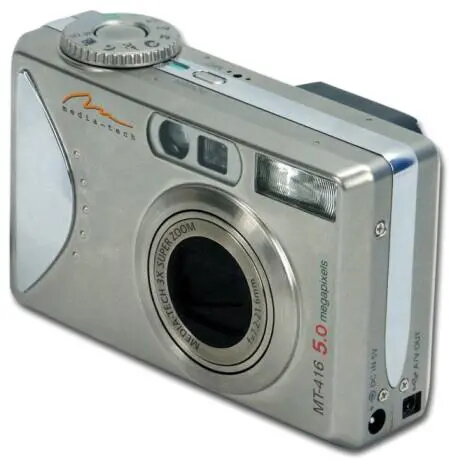
-
Internal memory:
The amount of memory, usually measured in bytes (e.g. MB, GB), which is installed in the system's hardware.
-
512 MB
-
Megapixel (approx.):
The number (in millions) of light-sensitive picture elements known as pixels actually used by the camera's image sensor (CCD) to record light, and which are reflected to the final number of recorded pixels stored on the memory card.
-
5.25 MP
-
Display:
The description of display that can includes display type, resolution, size etc.
-
TFT
-
Light exposure correction:
-
± 2EV (1/2EV step)
-
White balance:
Technique in photography and image processing, which involves a global adjustment of the intensities of the colors (typically red, green, and blue primary colors). An important goal of this adjustment is to render specific colors – particularly neutral colors including white – correctly.
-
Fluorescent L, Auto, Cloudy, Daylight
-
Light exposure control:
-
Program AE
-
Self-timer delay:
Duration of self-timer, that's a camera device that gives a delay between pressing the shutter release and the shutter's firing. It is most commonly used to let photographers to take a photo of themselves (often with the family), hence the name.
-
2, 10, 12
-
Display diagonal:
Size of the display for this product, measured diagonally, usually in inches.
-
1.5 "
-
Viewfinder type:
A viewfinder is the window in the camera through which a photographer views the picture. Used for choosing, composing, and often focusing the image. There are two types: optical and digital. In an optical viewfinder, the photographer looks through a transparent window to frame and focus the image. The photographer is seeing the real image, through the window of the viewfinder. With a digital viewfinde, there is an LCD display built into a camera that gives a digital view of where the camera is pointing. It's used to compose and focus the image.
-
Optical
-
Focal length range:
Measure of how strongly the system converges or diverges light. For an optical system in air, it is the distance over which initially collimated rays are brought to a focus. A system with a shorter focal length has greater optical power than one with a long focal length; that is, it bends the rays more strongly, bringing them to a focus in a shorter distance.For an optical system in air, the effective focal length (f and f′) gives the distance from the front and rear principal planes (H and H′) to the corresponding focal points (F and F′).
-
7.2 - 21.6
-
Analog signal format system:
The supported protocols for exchanging analog signals.
-
NTSC, PAL
-
Shooting modes:
-
Movie, Scene
-
Still image resolution(s):
List of image resolutions that supported by device.
-
640 x 480,1280 x 960,2048 x 1536,2560 x 1920
-
ISO sensitivity:
A measure of a photographic film's sensitivity to light.
-
100, 200, 400
-
Image formats supported:
The type of image files that the device can use/display e.g. gif, JPEG (jpg).
-
EXIF
-
Flash range (wide):
-
0.5 - 3
-
Normal focusing range:
-
0.8 - ∞
-
Super Macro focusing range:
-
0.09 - ∞
-
Minimum aperture number:
The minimum size of the hole through which light enters a camera.
-
2.8
-
Maximum aperture number:
-
4.7
-
Light exposure modes:
The different lengths of time for the exposure for a camera e.g. longer exposure for low light.
-
Shutter priority AE
-
Video formats supported:
The type of video formats that can be used by this device.
-
AVI
-
Scene modes:
Scenery mode', 'Portrait mode' and other modes which are manually/automatically activated on a camera and change the settings (e.g. exposure time) accordingly.
-
Night, Portrait, Sports
-
Flash modes:
Different modes for a camera flash which are manually/automatically activated e.g. auto-flash mode, flash on with red eye reduction.
-
Flash on, Red-eye reduction, Flash off
-
Maximum video resolution:
This is the maximum resolution of video images. Resolution is a measure of the degree of detail visible.
-
320 x 240
-
Maximum image resolution:
Resolution is the amount of detail held by an image. The higher the resolution, the better (sharper) the image. The maximum image resolution produces the best image.
-
2560 x 1920
-
Power source type:
What the power source is.
-
Battery
-
Camera type:
There are a number of common types of digital cameras: compact cameras, bridge cameras, mirrorless interchangeable-lens cameras (MILC) and single lens reflex (SLR) cameras. Bridge cameras 'bridge the gap' between the low-end compact and high-end professional (SLR) cameras. Also MILCs populate this mid-segment by combining the larger sensors and interchangeable lenses of DSLRs with the live-preview viewing system of compact cameras.
-
Compact camera
-
Camera file system:
-
DCF, DPOF 1.1, Exif 2.1
-
USB version:
Universal Serial Bus (USB) is an industry standard developed in the mid-1990s that defines the interface used for connection, communication and power supply between computers and electronic devices. Every new version - for example 1.1, 2.0, 3.0 - is much faster than the previous one.
-
2.0
-
Video recording:
Recording moving visual images.
-
Yes
-
Fastest camera shutter speed:
The minimum time which the camera shutter is open when taking a photo.
-
1/1500
-
HD type:
Type of supported High Definition (e.g. Full HD, 4K Ultra HD).
-
Not supported
-
Image sensor size:
The total dimensions of the sensor within the camera, given in inches ('').
-
1/1.8