-
Certification:
-
Class B, ROHS, WEEE
-
Number of processors installed:
Number of processors in the product.
-
1
-
Form factor:
The shape or design of the product.
-
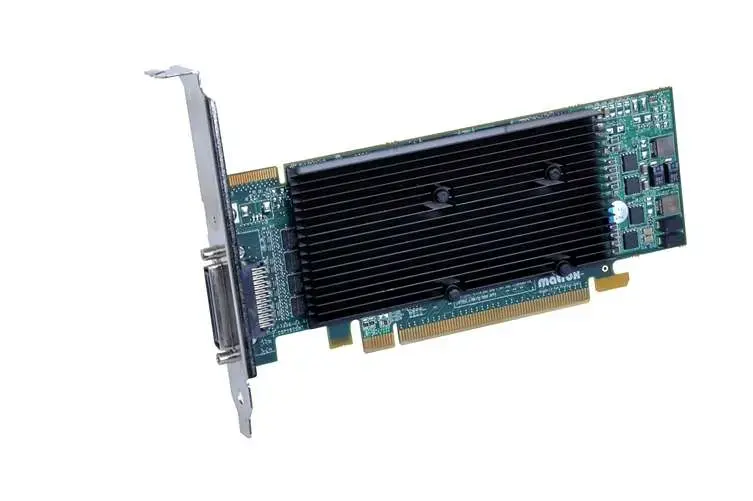
Half-Height/Half-Length (HH/HL)
-
Mac compatibility:
Product can be used with Apple Mac software and/or hardware.
-
No
-
Graphics card memory type:
The type of memory used by the video card. Often a combination of dedicated memory (Video RAM or VRAM) and dynamic system memory is used. UMA stands for Unified Memory Architecture, and is a computer memory architecture that allows the graphics processing unit to share system memory. Other abreviations: RAM = Random Access Memory, SDRAM = synchronous dynamic RAM, DDR = double-data-rate.
-
GDDR2
-
Interface type:
-
PCI Express x16
-
Cable length:
How long the cable is.
-
0.3 m
-
Height:
The measurement of the product from head to foot or from base to top.
-
69 mm
-
Depth:
The distance from the front to the back of something.
-
19 mm
-
Graphics processor:
Also known as a graphics processing unit (GPU), this is a specialized electronic circuit designed to rapidly manipulate and alter memory to accelerate the creation of images in a frame buffer intended for output to a display. GPUs are used in embedded systems, mobile phones, personal computers, workstations, and game consoles. Modern GPUs are very efficient at manipulating computer graphics.
-
M9140
-
Maximum resolution:
The maximum number of pixels that can be displayed in the image. It is usually quoted as width × height,: for example, "1024 × 768" means the width is 1024 pixels and the height is 768 pixels.
-
1920 x 1200
-
TV tuner integrated:
Device has an in-built TV tuner.
-
No
-
VGA (D-Sub) ports quantity:
Number of VGA (D-Sub) ports (connecting interfaces) in the device. The VGA (D-Sub) connector is a 15 pin connector between a computer and a monitor. It was first introduced in 1987 by IBM.
-
4
-
Length:
The measurement or extent of something from end to end.
-
168 mm
-
Dual VGA:
-
Yes
-
Parallel processing technology support:
Parallel processing technology is the simultaneous use of more than one CPU or processor core to execute a program or multiple computational threads. Ideally, parallel processing makes programs run faster because there are more engines (CPUs or Cores) running it. In practice, it is often difficult to divide a program in such a way that separate CPUs or cores can execute different portions without interfering with each other. Most computers have just one CPU, but some models have several, and multi-core processor chips are becoming the norm. There are even computers with thousands of CPUs.
-
Not supported
-
OpenGL version:
OpenGL (Open Graphics Library) is a specification defining a cross-language cross-platform API for writing applications that produce 3D computer graphics (and 2D computer graphics as well). The interface consists of over 250 different function calls which can be used to draw complex three-dimensional scenes from simple primitives.
-
2.0
-
DVI-I ports quantity:
This is the amount of DVI-I interfaces. Digital Visual Interface (DVI) is a video display interface developed by the Digital Display Working Group (DDWG). The digital interface is used to connect a video source to a display device, such as a computer monitor. DVI-I is DVI integrated, which means it can support digital and analog.
-
0
-
DVI-D ports quantity:
This is the amount of DVI-I interfaces. Digital Visual Interface (DVI) is a video display interface developed by the Digital Display Working Group (DDWG). The digital interface is used to connect a video source to a display device, such as a computer monitor. DVI-D means DVI digital, which means it can only support digital, but not analog.
-
0
-
Dual Link DVI:
A dual-link DVI interface sends data over both of the DVI links to the monitor, and this is how higher resolutions are achieved. With dual-link DVI, a resolution of 2048 x 1536 is possible.
-
No
-
TV-out:
-
No
-
HDMI ports quantity:
The number of sockets (ports) for HDMI connections. HDMI (High-Definition Multimedia Interface) is a compact audio/video interface for transferring uncompressed video data and compressed/uncompressed digital audio data from a HDMI-compliant device ("the source device") to a compatible computer monitor, video projector, digital television, or digital audio device. HDMI is a digital replacement for existing analog video standards.
-
0
-
HDMI:
HDMI (High-Definition Multimedia Interface) is a compact audio/video interface for transferring uncompressed video data and compressed/uncompressed digital audio data from a HDMI-compliant device ("the source device") to a compatible computer monitor, video projector, digital television, or digital audio device. HDMI is a digital replacement for existing analog video standards.
-
No
-
HDCP:
High-bandwidth Digital Content Protection (HDCP) is a form of digital copy protection to prevent copying of digital audio and video content as it travels across connections.
-
No
-
Cooling type:
The method used to cool the device or to cool the air around the device.
-
Passive
-
Maximum displays per videocard:
-
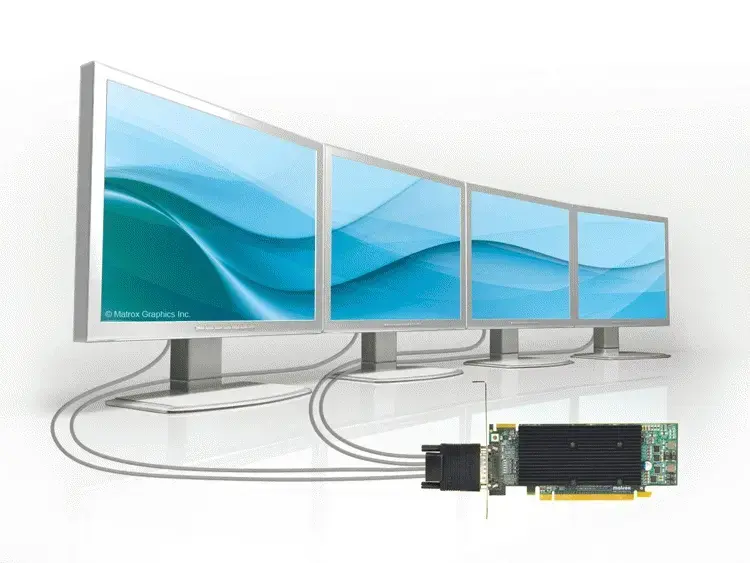
4
-
PhysX:
PPU (microprocessor) expansion card designed by Ageia to accelerate PhysX-enabled video games.
-
No
-
CUDA:
CUDA (aka Compute Unified Device Architecture) is a parallel computing platform and programming model created by NVIDIA and implemented by the graphics processing units (GPUs) that they produce. CUDA gives program developers direct access to the virtual instruction set and memory of the parallel computational elements in CUDA GPUs.
-
No
-
DisplayPorts quantity:
Number of DisplayPorts. A DisplayPort is a digital display interface developed by the Video Electronics Standards Association (VESA). The interface is primarily used to connect a video source to a display device such as a computer monitor, though it can also be used to carry audio, USB, and other forms of data.
-
0
-
Windows operating systems supported:
Windows vesions wich can be used with the device.
-
Windows Vista Ultimate, Windows 7 Home Premium x64, Windows 7 Professional, Windows 7 Professional x64, Windows 7 Starter, Windows 7 Starter x64, Windows 7 Ultimate, Windows 7 Ultimate x64, Windows Vista Business, Windows Vista Business x64, Windows Vista Home Basic, Windows Vista Home Basic x64, Windows Vista Home Premium, Windows Vista Home Premium x64, Windows 7 Home Premium, Windows Vista Ultimate x64, Windows XP Home, Windows XP Home x64, Windows XP Professional, Windows XP Professional x64
-
Mac operating systems supported:
Mac operating systems e.g. OS X can be used with the device.
-
No
-
Linux operating systems supported:
8 RT. Linux (9.4, 9.5), Red Hat Enterprise Linux 5.0 (supported with a pre-built package); SUSE Linux (10.3, 11.0, 11, 11.1, 11.2), Fedora (9, 9.0, 10, 10.0, 11.0, 11, 12, 12.0), Ubuntu (8.04, 8.04.1, 8.04.2, 8.10, 9.04, 9.10, 10.04), Debian (5.0, 5.0.1, 5.0.2, 5.0.3)
-
Yes
-
Graphics processor family:
The category to which the graphics processor (GPU) belongs e.g. Southern Islands family of Radeon processors (made by AMD), GeForce 600 (made by NVIDIA).
-
Matrox
-
FireStream:
A stream processor produced by Advanced Micro Devices (AMD) to use the stream processing/GPGPU (General Purpose Graphics Processing Units) concept for heavy floating-point computations to target various industries, such as the High Performance Computing (HPC), scientific, and financial sectors. Originally developed by ATI Technologies until the company was acquired by AMD in 2006, the product line was previously branded as both ATI FireStream and AMD Stream Processor.
-
No
-
Discrete graphics card memory:
-
0.5 GB
-
Harmonized System (HS) code:
-
84733020