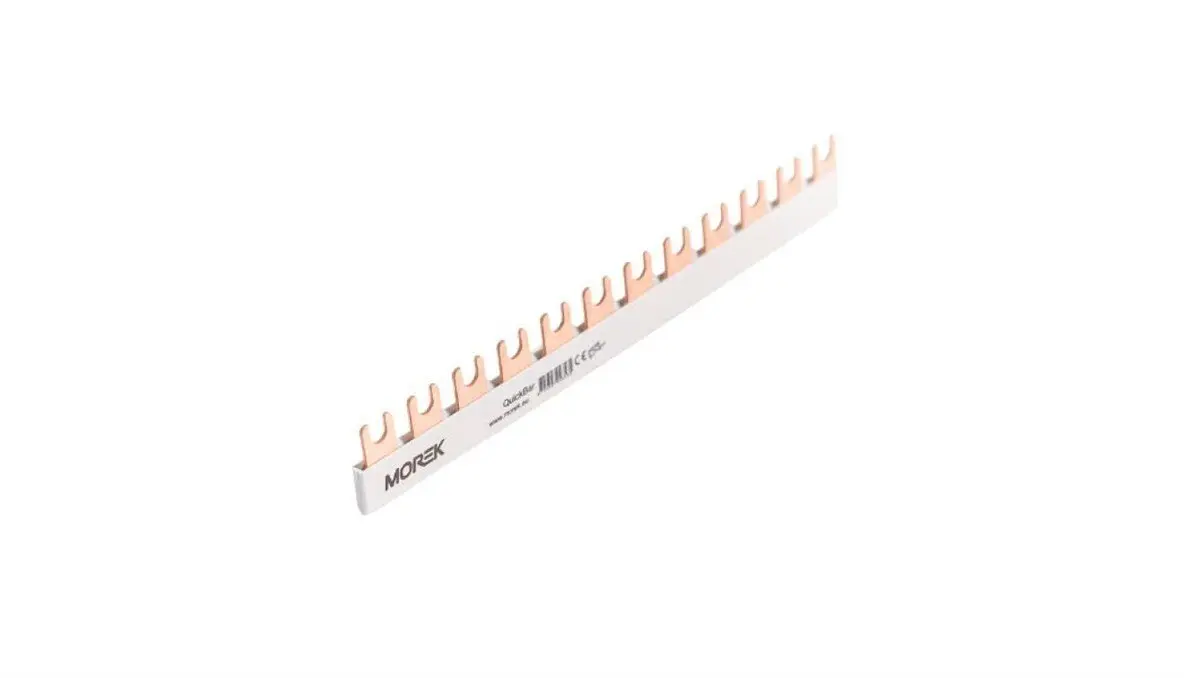
The electrical accessory MOREK QuickBar 1-pole fork busbar 16mm² cross-section type E 15 modules MEF11516A00 is compared with similar distribution busbars from MOREK, including MOREK QuickBar Fork Busbar, 1-pole, 10mm² cross-section, type E, 18 modules length, MOREK QuickBar Pin Busbar, 1-pole, 16mm² cross-section, type E, 9 modules length, MOREK QuickBar Fork Busbar, 4-Pole, 16mm² Cross-Section, Type E, 12 Modules, MOREK Fork Busbar MCB, 1-pole, 16 mm² cross-section, type L, length 57 modules MEF15716A00, and MOREK QuickBar Fork Busbar 4-Pole 16mm² Type E 16 Modules MEF41616N01. All compared products belong to the category of distribution board wiring accessories, but differ in pole count, contact type (fork or pin), conductor cross-section, module length, and terminal configuration.
⚙️ Below is a comparison of basic product characteristics, including busbar type, pole count, conductor cross-section, module length, and connection configuration, which determines compatibility with specific modular devices and board layout.
| Parameter | MOREK 15 modules 16mm² (main) | MOREK 18 modules 10mm² | MOREK 9 modules pin type | MOREK 4-pole 12 modules | MOREK 1-pole 57 modules | MOREK 4-pole 16 modules | Practical significance of differences |
|---|
| Type and Brand | MOREK QuickBar, fork type | MOREK QuickBar, fork type | MOREK QuickBar, pin type | MOREK QuickBar, fork type | MOREK Fork Busbar MCB, fork type | MOREK QuickBar, fork type | All items are manufactured by MOREK and designed for professional electrical panel installation. |
| Pole Count | 1-pole | 1-pole | 1-pole | 4-pole | 1-pole | 4-pole | Single-pole busbars are used for phase lines, while multi-pole options are for three-phase equipment. |
| Conductor Cross-Section | 16 mm² | 10 mm² | 16 mm² | 16 mm² | 16 mm² | 16 mm² | A 16 mm² cross-section supports higher current loads compared to the 10 mm² variant. |
| Module Length | 15 modules | 18 modules | 9 modules | 12 modules | 57 modules | 16 modules | Length determines the number of connectable modular devices and overall enclosure dimensions. |
| Configuration | Type E | Type E | Type E | Type E | Type L | Type E | Configuration affects installation specifics and terminal compatibility with specific circuit breakers. |
◎ The table below evaluates usage scenarios and buyer needs to help select the most suitable distribution busbar for specific electrical installation tasks.
| Use Case | Recommended Product | Why This Choice Is Optimal |
|---|
| Standard single-phase wiring of medium length | MOREK 15 modules 16mm² (main) | Provides an optimal 16 mm² cross-section for higher currents and a 15-module length for compact groups. |
| Wiring with lower current requirements and greater length | MOREK 18 modules 10mm² | Suitable for circuits with lower current demands while offering a longer 18-module span. |
| Connecting devices with pin-type terminals | MOREK 9 modules pin type | Uses a pin-type construction for compatibility with corresponding protection device terminals. |
| Three-phase power distribution in compact enclosures | MOREK 4-pole 12 modules | Allows four-pole circuit bridging within a compact 12-module length. |
| Large-scale distribution boards with long module rows | MOREK 1-pole 57 modules | Provides a maximum length of 57 modules for large commercial or residential electrical installations. |
| Three-phase boards with an increased module count | MOREK 4-pole 16 modules | Provides a four-pole connection across a 16-module length for larger three-phase groups. |
The main product MOREK QuickBar 1-pole fork busbar 16mm² cross-section type E 15 modules MEF11516A00 differs from alternatives through its balanced combination of single-pole execution, fork-type E contact, 16 mm² cross-section, and a moderate length of 15 modules. This model is best suited for medium-capacity professional electrical panels where reliable power distribution without excessive length is required. Choosing the main product is recommended if the enclosure dimensions match 15 modules and the current load demands a 16 mm² conductor, whereas alternatives are preferable when pin connection, a different length, more poles, or another cross-section is required.