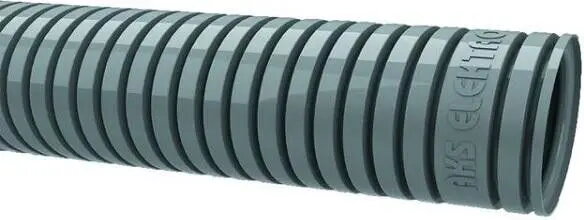
Corrugated PVC conduit RKGL-25 FI25/18.3 on a 50 m roll provides flexible mechanical protection for electrical cables and wiring. Made from PVC with a corrugated profile, this conduit combines bending flexibility with resistance to compression and mechanical stress, specified at 320 N crush resistance. It is intended for indoor and sheltered outdoor installations where routing around obstacles and through confined spaces is required. The conduit is supplied in a continuous 50 m length to support longer runs and reduce the need for joints.
Advantages
The corrugated construction allows tight bending radii while maintaining support and protection for cables. PVC material offers resistance to moisture and many common chemicals encountered in building environments, and the 320 N crush resistance gives measurable mechanical protection against incidental loads. Supplied on a 50 m roll, the conduit minimizes interruptions in continuous runs and simplifies installation planning in residential, commercial, and light industrial projects.
Suitable for
- Routing and protecting electrical power and communication cables in walls, ceilings, and floor voids
- Indoor installations and sheltered outdoor locations such as covered utility ducts
- Applications requiring frequent bends or routing around structural obstacles
- Projects where longer continuous runs reduce the number of joints and fittings
When it may not be suitable
This corrugated PVC conduit is not intended for direct burial in open ground or for continuous exposure to harsh outdoor weather without additional protective measures. It is also not designed for use where very high crush loads or heavy mechanical impact are expected; consult specifications and choose a more robust conduit or metallic protection in such cases.
Key specifications
- Material: PVC (corrugated)
- Nominal inner/outer dimensions: FI25/18.3 profile
- Length per roll: 50 m
- Crush resistance: 320 N
- Flexible corrugated profile for reduced bending radius
- Suitable for indoor and sheltered outdoor use
How to use
Measure the required run length and cut the conduit from the 50 m roll using a suitable PVC cutter or fine-toothed saw, ensuring a clean, square cut. Route the conduit along the planned path, using appropriate fixings and clamps to secure it to walls, ceilings, or support structures at recommended intervals. Where joints or transitions are needed, use compatible couplers, reducers, or gland fittings designed for corrugated PVC conduit, and ensure cable entry points are sealed or protected with grommets to prevent abrasion. Pull cables through the conduit using a draw rope or fish tape, avoiding excessive tensile loads on the cable and keeping bends within the recommended radius for the conduit and cable type.
What to consider before purchase
- Confirm the conduit internal diameter and profile FI25/18.3 are compatible with the cable diameter and number of cores to be routed
- Assess whether 320 N crush resistance meets expected mechanical loads and select a stronger option if necessary
- Decide if indoor/sheltered outdoor rating is suitable or if UV-stabilized or burial-rated alternatives are required
- Plan for fittings, couplers, and sealing accessories needed for installation
Usage recommendations
For reliable installations, maintain recommended fixing spacing and avoid sharp bends that compress the corrugations. When routing multiple cables, allow sufficient fill factor to prevent overheating and facilitate future cable replacement. If the installation may be exposed to direct sunlight or outdoor weather for extended periods, consider additional UV protection or a conduit specified for external use.