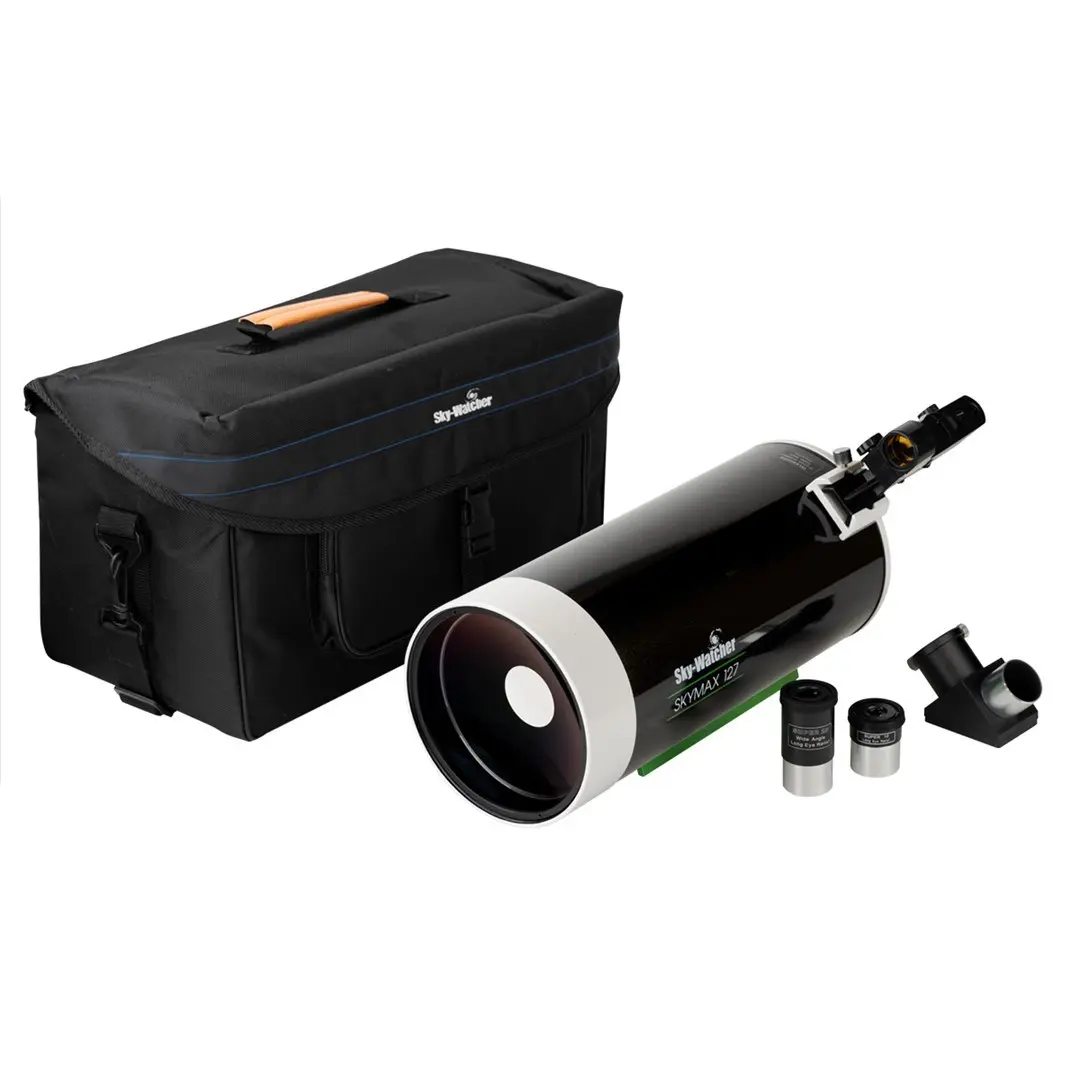
In this comparison, the Sky-Watcher BKMAK 127 SP OTA Telescope is evaluated against alternative optical tube assemblies (OTAs) from Sky-Watcher, ranging from 90 mm and 102 mm to 180 mm Maksutov-Cassegrains, as well as a 150/750 mm Newtonian reflector. All compared products are optical tubes without mounts or tripods, designed for astronomy enthusiasts engaged in visual observing and astrophotography. The primary differences lie in their optical design, aperture diameter, and focal length, which dictate physical dimensions, light-gathering power, and image detail when observing planets, the Moon, and deep-sky objects.
⚙️ The specifications comparison covers optical design, aperture diameter, focal length, product form factor, and practical application to help assess the real-world capabilities of each model.
| Feature | Sky-Watcher BKMAK 127 SP OTA Telescope | Telescope Sky-Watcher BKMAK 127 OTAW 127 mm aperture | Refractor/Reflector telescope Skywatcher BKMAK 90 SP OTA | Telescope Skywatcher BKMAK 180 OTA Maksutov-Cassegrain | Telescope Skywatcher BKMAK 102 OTA optical tube assembly | Optical tube Sky-Watcher BKP 150/750 OTAW | Practical conclusion |
|---|
| Optical design | Maksutov-Cassegrain | Maksutov-Cassegrain | Maksutov-Cassegrain | Maksutov-Cassegrain | Maksutov-Cassegrain | Newtonian reflector | Maksutov designs excel in high-contrast planetary views, whereas Newtonian reflectors offer higher light speed for deep-sky objects. |
| Aperture | 127 mm | 127 mm | 90 mm | 180 mm | 102 mm | 150 mm | A 127 mm aperture (found on both the parent model and BKMAK 127 OTAW) provides an optimal balance between portability and resolution. |
| Focal length | Not specified (standard for 127 mm) | Long focal length in a compact body | 1250 mm | Not specified (extended) | Not specified (compact) | 750 mm | Long focal lengths in Maksutov models suit planets, while the 750 mm focal length in the Newtonian provides wider field views. |
| OTA format | Optical tube assembly (OTA) | Optical tube assembly (OTA) | Optical tube assembly (OTA) | Optical tube assembly (OTA) | Optical tube assembly (OTA) | Optical tube assembly (OTA) | All options require a compatible mount, tripod, and accessories to be purchased separately for field use. |
◎ The suitability and use case comparison evaluates user needs and observing scenarios to help determine which model fits specific requirements.
| Use case | Recommended product | Why |
|---|
| Entry-level planetary viewing with high portability | Refractor/Reflector telescope Skywatcher BKMAK 90 SP OTA | A smaller 90 mm aperture and compact tube make this model exceptionally lightweight and easy to transport for field trips. |
| Versatile and sharp Moon and planetary observation | Sky-Watcher BKMAK 127 SP OTA Telescope | A 127 mm aperture offers a great sweet spot for light gathering and high-contrast views without excessive physical bulk. |
| Advanced observation and detailed astrophotography | Telescope Skywatcher BKMAK 180 OTA Maksutov-Cassegrain | A large 180 mm aperture gathers more light and resolves finer details on demanding planetary and deep-sky targets. |
| Wide-field deep-sky observation | Optical tube Sky-Watcher BKP 150/750 OTAW | A Newtonian design with a 150 mm aperture and 750 mm focal length is better suited for nebulae, galaxies, and star clusters. |
The comparison shows that the Sky-Watcher BKMAK 127 SP OTA Telescope is a well-balanced choice within the Maksutov-Cassegrain lineup, offering a 127 mm aperture for detailed lunar and planetary observation without requiring heavy-duty mounting hardware. Compared to the 90 mm and 102 mm alternatives, it provides significantly brighter and more detailed views, while remaining much more portable and manageable than the 180 mm model. For observers seeking a capable and versatile optical tube for regular stargazing sessions, this model represents an ideal middle ground.