
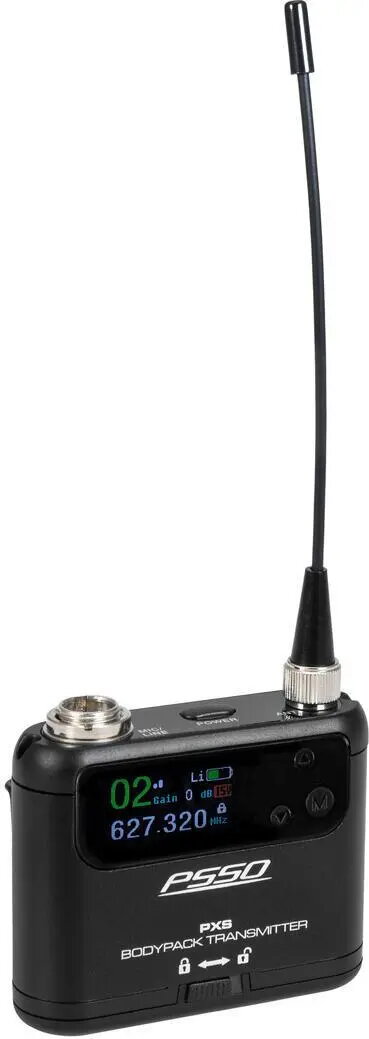
The PSSO PXS Mini Pocket Transmitter 640-690 MHz is compared against other PSSO PXS wireless audio system components and modifications, including receivers, handheld microphones, and similar transmitters operating in alternative frequency bands. All these devices are designed for reliable wireless audio transmission within the PSSO ecosystem, yet they serve different functional roles in the audio chain (transmitters, receivers, microphones) and operate across distinct radio frequency bands, which dictates their compatibility and practical use cases.
⚙️ The table below compares the core characteristics of the devices, such as their equipment type, form factor, and operating frequency band, helping to understand their practical differences and technical integration.
| Parameter | PSSO PXS Mini Pocket Transmitter 640-690 MHz | PSSO PXS TWO 2-Channel True Diversity Receiver 640-690 MHz | PSSO PXS Dynamic Wireless Microphone 640-690 MHz | PSSO PXS Mini Pocket Transmitter 470–510 MHz | PSSO PXS TWO 2-Channel True Diversity Receiver 470–510 MHz | PSSO PXS Dynamic Wireless Microphone 470–510 MHz | Practical Conclusion |
|---|
| Device Type | Pocket transmitter | 2-channel True Diversity receiver | Dynamic wireless microphone | Pocket transmitter | 2-channel True Diversity receiver | Dynamic wireless microphone | The devices perform complementary roles in a wireless audio setup. Transmitters require a matching compatible receiver to function. |
| Frequency Band | 640-690 MHz | 640-690 MHz | 640-690 MHz | 470-510 MHz | 470-510 MHz | 470-510 MHz | Transmitters and receivers must operate on the exact same frequency band to achieve successful pairing and stable wireless transmission. |
| Form Factor and Purpose | Compact pocket transmitter for lavalier or headset microphones | Stationary dual-channel receiver for professional sound reinforcement | Handheld wireless microphone for vocals and speech | Compact pocket transmitter for mobile audio setups | Stationary dual-channel receiver | Handheld wireless microphone | Form factor selection depends entirely on whether the sound source is handheld, body-worn, or processed at the mixing desk end. |
◎ The table below evaluates how well each product suits different user needs, usage scenarios, and roles in professional sound reinforcement and stage setups.
| Use Case | Recommended Product | Why |
|---|
| Wireless transmission from a headset or lavalier microphone | PSSO PXS Mini Pocket Transmitter 640-690 MHz | Best suited for presenters and performers who require a discreet bodypack transmitter paired with a 640-690 MHz receiver. |
| Signal reception for dual wireless audio channels | PSSO PXS TWO 2-Channel True Diversity Receiver 640-690 MHz | Ensures dropout-free signal reception for transmitters and microphones operating within the 640-690 MHz frequency range. |
| Vocal performances and public speaking with mobility | PSSO PXS Dynamic Wireless Microphone 640-690 MHz | An integrated handheld wireless microphone that delivers clear voice reproduction for live events without external body cables. |
| Operation in an alternative radio frequency spectrum | PSSO PXS Mini Pocket Transmitter 470–510 MHz | Suitable when the 640-690 MHz band is congested and the wireless system needs to be deployed in the 470-510 MHz range instead. |
PSSO PXS Mini Pocket Transmitter 640-690 MHz is a specialized pocket transmitter that differs from receivers and handheld microphones by requiring an external microphone and a matching receiver to operate. This product is optimal for users setting up or expanding a mobile wireless audio rig within the 640-690 MHz frequency band. Choose it when you specifically need a discreet bodypack transmitter rather than an all-in-one handheld microphone or a stationary receiver.