
A curated selection of maximum value offers!
In cart {{totalProductsCount}} item(s)
Your cart is empty
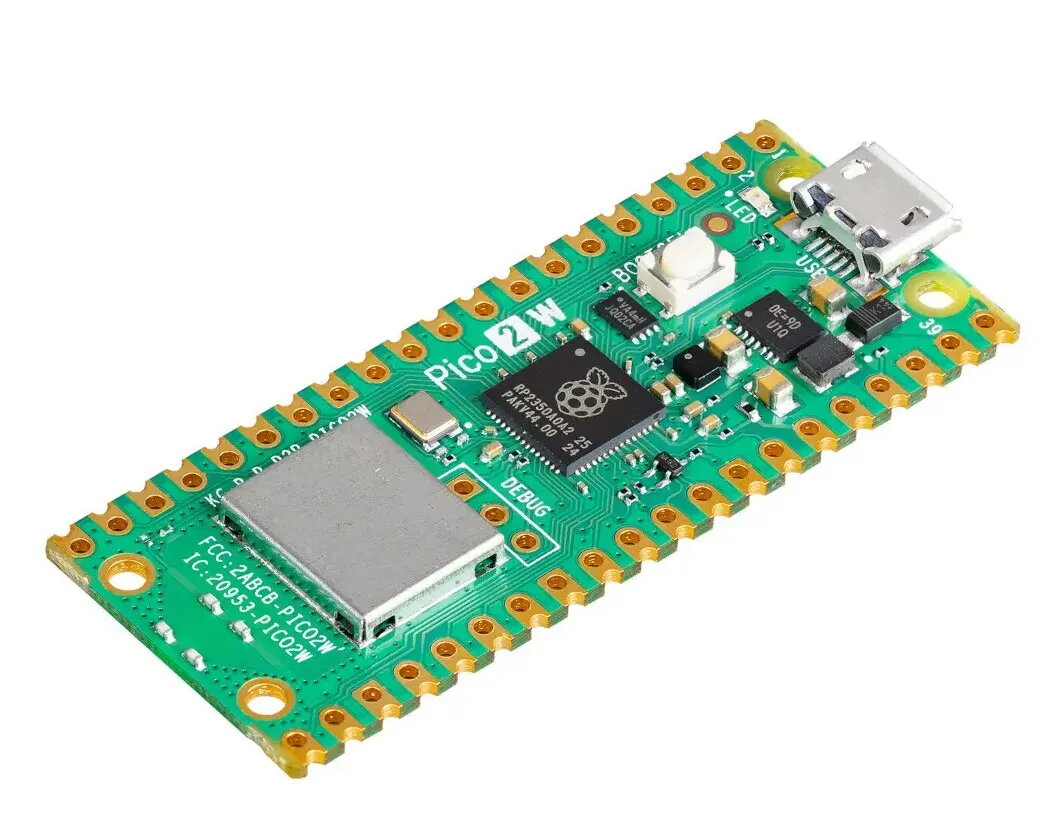
Development board Raspberry Pi Pico 2 W RP2350 with ARM Cortex-M33, Wi‑Fi and Bluetooth
The Raspberry Pi Pico 2 W is a development board based on the RP2350 microcontroller that adds onboard 2.4 GHz Wi‑Fi and Bluetooth 5.2 using an integrated antenna. It retains compatibility with the original Pico while offering higher core clock speeds, larger memory and more powerful Arm cores for improved performance in embedded, prototyping and IoT applications. The board supports secure boot, hardware TRNG and other security features, and is programmable in C/C++ and Python with comprehensive documentation for both hobbyists and professional developers.
The Pico 2 W delivers a significant performance boost over the first-generation Pico through faster cores and doubled on‑chip memory, while keeping hardware and software compatibility. It provides ready-to-use 2.4 GHz Wi‑Fi and Bluetooth 5.2 connectivity with modular compliance certification and an onboard antenna. The castellated module form factor allows direct soldering to carrier boards and the device includes optional boot signing, protected OTP storage, hardware SHA‑256 acceleration and mitigations against fault injection for improved device security.
Connect the Pico 2 W to a host computer via USB or solder it to a carrier board depending on your project. Program the board using the Raspberry Pi SDK or tools for C/C++ and MicroPython; follow the official documentation for toolchain setup, flashing firmware and configuring Wi‑Fi/Bluetooth. Use available GPIO, SPI, I2C and UART interfaces to connect sensors and actuators. Observe the input voltage range (1.8–5.5 V) and recommended operating temperature when designing your circuit.
For reliable wireless operation, ensure adequate antenna clearance on your carrier board and follow modular compliance guidance. Use enforced boot signing and protected OTP storage for applications that require higher security. Test power supply stability and thermal conditions within the -20 °C to +85 °C range during development and deployment.
{{highlightedFeature.featureTitle}}:
{{getProductFeatureValueById(product, highlightedFeature.featureId)}}
{{ productComparisonGenerationError }}