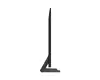
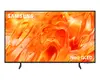
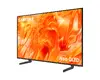
-
Wi-Fi standards:
The type of wireless local area network (LAN). It can be ad-hoc, where units in a network communicate peer-to-peer, or Infrastructure, where units communicate with each other via an access point A LAN interconnects computers in a small area e.g. home, school or office.
-
Wi-Fi 5 (802.11ac)
-
Power consumption (typical):
Amount of power consumed by this model, often expressed in watts (W). Typical values that manufacturers give are power consumption when off, standby/suspended mode, typical use, maximum usage.
-
45 W
-
Package weight:
Weight of the packaged product.
-
10900 g
-
Display diagonal:
Size of the display for this product, measured diagonally, usually in inches.
-
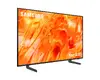
43 "
-
Bluetooth version:
The type of bluetooth technology in the product e.g. Bluetooth Smart (v4.0).
-
5.3
-
Ethernet LAN:
An Ethernet LAN (Local Area Network) interface is present, for a wired conection via a cable.
-
Yes
-
Display resolution:
The number of distinct pixels in each dimension that can be displayed. It is usually quoted as width × height, with the units in pixels: for example, "1024 × 768" means the width is 1024 pixels and the height is 768 pixels. The higher the number of pixels, the sharper the image.
-
3840 x 2160
-
Product colour:
The colour e.g. red, blue, green, black, white.
-
Black
-
Cables included:
-
AC
-
RMS rated power:
RMS (Root mean square) is a measure of the continuous power required by a device, in particular audio amplifiers and loudspeakers.
-
20 W
-
Power consumption (standby):
The amount of electricity that is consumed when the product is on standby.
-
0.5 W
-
Bluetooth:
Bluetooth is a low-power radio technology developed to replace the cables and wires currently used to link or connect electronic devices such as personal computers, printers, and a wide variety of handheld devices including mobile phones. Because it uses radio-wave connectivity, a Bluetooth-enabled device has a constant, established connection to whatever browser it uses. This saves the user the trouble of logging on to check for emails or news updates, for example.
-
Yes
-
Audio output channels:
An audio output channel is an electric circuit which acts as a path for a signal produced by a device. A device may have several audio output channels.
-
2.0
-
USB 2.0 ports quantity:
Number of USB 2.0 ports (connecting interfaces) in the device. USB 2.0 was released in April 2000 (now called "Hi-Speed"), adding higher maximum signaling rate of 480 Mbit/s (effective throughput up to 35 MB/s or 280 Mbit/s), USB 2.0 ports are usually black.
-
2
-
Tuner type:
The type of radio tuner e.g. analog, digital.
-
Analog & Digital
-
Noise reduction:
-
Yes
-
Digital audio optical out:
The socket in the device for the digital audio output. The signal is carried via an optical cable with an TOSLINK connector.
-
1
-
Operating system installed:
Type of operating system on a device e.g. IOS on Apple devices, Android for mobile devices.
-
Tizen
-
Wi-Fi:
Popular technology that allows an electronic device to exchange data or connect to the internet wirelessly using radio waves.
-
Yes
-
Game mode:
-
Yes
-
Electronic Programme Guide (EPG):
An Electronic Programme Guide (EPG) allows device users to navigate scheduling information menus interactively, selecting and discovering programming by time, title, station, or genre using an input device such as a keypad, computer keyboard, or TV remote control. Its interactive menus are generated entirely within local receiving or display equipment using raw scheduling data sent by individual broadcast stations or centralized scheduling information providers. A typical IPG provides information covering the next 7 or 14 days.
-
Yes
-
HDMI ports quantity:
The number of sockets (ports) for HDMI connections. HDMI (High-Definition Multimedia Interface) is a compact audio/video interface for transferring uncompressed video data and compressed/uncompressed digital audio data from a HDMI-compliant device ("the source device") to a compatible computer monitor, video projector, digital television, or digital audio device. HDMI is a digital replacement for existing analog video standards.
-
3
-
Package depth:
The distance from the front to the back of the packaging.
-
119 mm
-
Package height:
The distance from the top to the bottom of the packaging.
-
647 mm
-
Package width:
The distance from one side of the packaging to the other.
-
1085 mm
-
Panel mounting interface:
The product can be used wih VESA mounting interfaces.
-
200 x 200
-
Width (with stand):
-
956.5 mm
-
Display diagonal (metric):
This is the size of the display screen, measured diagonally.
-
108 cm
-
Height (with stand):
-
614.7 mm
-
Depth (with stand):
-
198.4 mm
-
Number of OSD languages:
-
28
-
Common interface Plus (CI+):
In Digital Video Broadcasting, the Common Interface (CI) is a technology which allows separation of conditional access functionality from a digital TV receiver-decoder (Host) into a removable conditional access module (CAM). CI+ or Common Interface Plus implements a form of copy protection between a Conditional Access Module (CAM) and the television receiver (Host). CI+ is backward compatible with CIv1. Old television receivers, which have CIv1 CI-slot, can be used with CI+ CAM and vice versa, but for viewing only those of TV programs which are not marked as CI+ protected.
-
Yes
-
Digital signal format system:
The protocols supported for exchange of digital signal.
-
DVB-C, DVB-S2, DVB-T2
-
AC input frequency:
-
50/60
-
AC input voltage:
The voltage of the AC electricity that is inputted into the product.
-
220 - 240
-
Internet TV:
Digital distribution of television content via the Internet. Internet television is a general term that covers the delivery of television shows and other video content over the Internet by video streaming technology, typically by major traditional television broadcasters.
-
Yes
-
Power consumption (max):
The maximum amount of power used by the device.
-
140 W
-
Motion interpolation technology:
Describes which motion interpolation technology device uses e.g. BLS (Back Light Scanning), PPR (Picture Perfection Rate), PMR (Perfect Motion Rate), TruMotion.
-
Motion Xcelerator
-
Display technology:
The technology used in the display e.g. plasma, LED.
-
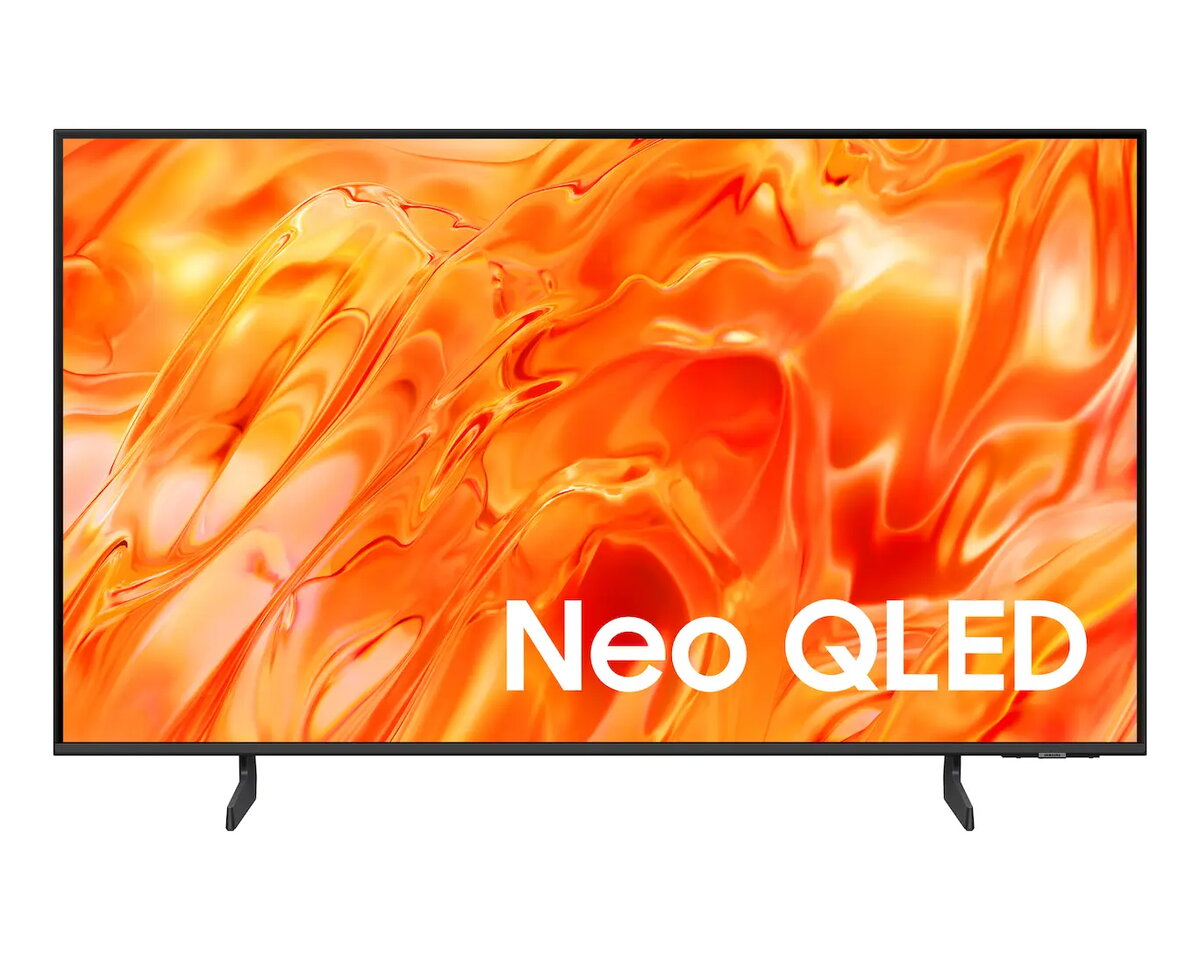
Neo QLED
-
Smart TV:
Smart TV features access to a large number of channels that offer TV programs, movies, and music without the need to connect a TV antenna or subscribe to a cable/satellite service. Some smart TVs provide web browsing, gaming, and access to compatible media content stored on computers.
-
Yes
-
HD type:
Type of supported High Definition (e.g. Full HD, 4K Ultra HD).
-
4K Ultra HD
-
Weight (without stand):
-
8100 g
-
Height (without stand):
-
559.4 mm
-
Width (without stand):
-
965.5 mm
-
Depth (without stand):
-
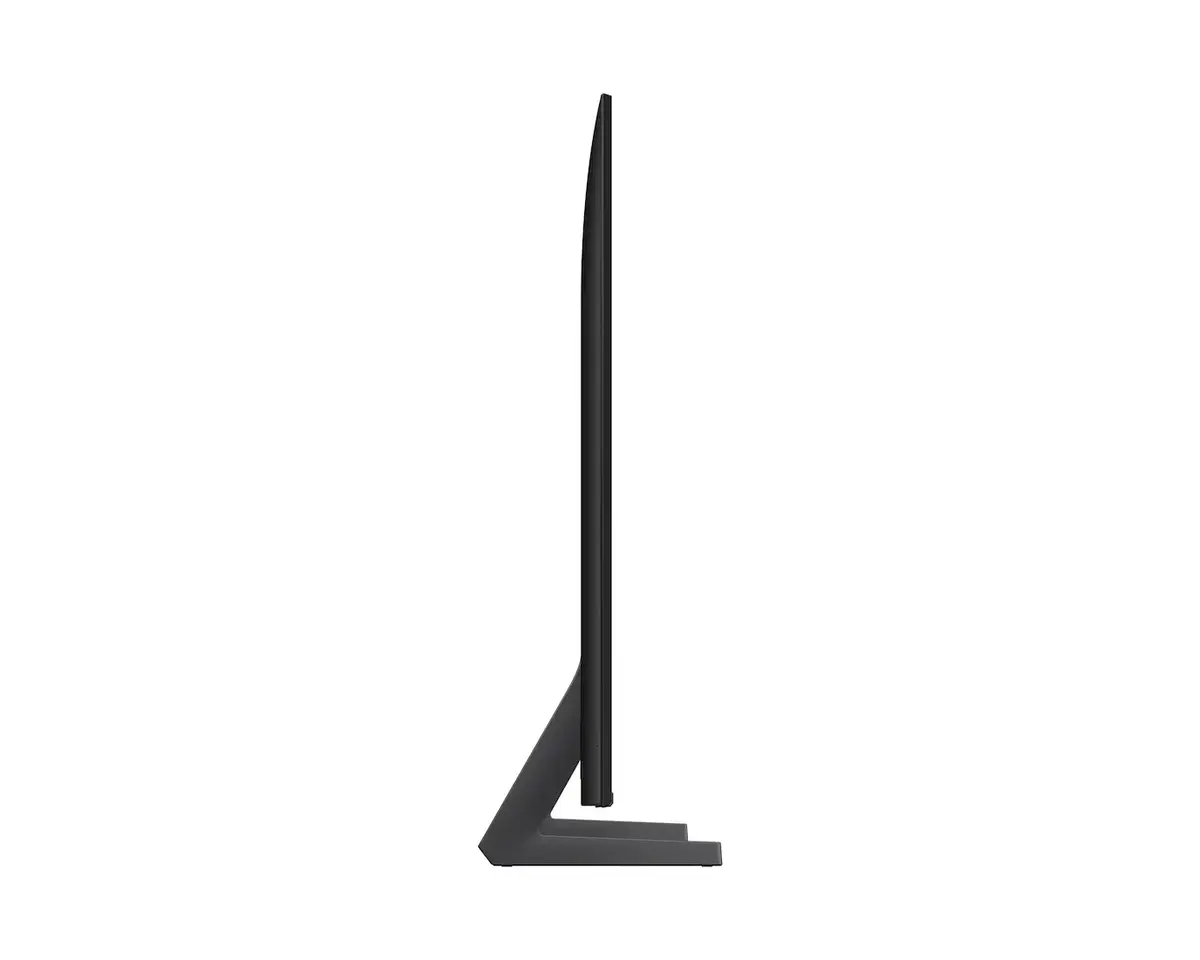
25.7 mm
-
Sound modes:
-
AI Sound
-
4K Ultra HD upscaling:
-
Yes
-
VESA mounting:
-
Yes
-
Screen shape:
-
Flat
-
Weight (with stand):
-
8400 g
-
Common interface Plus (CI+) version:
-
1.4
-
Web browser:
-
Yes
-
Works with Amazon Alexa:
-
Yes
-
Native refresh rate:
-
50 Hz
-
High Dynamic Range (HDR) supported:
-
Yes
-
Works with Samsung Bixby:
-
Yes
-
High Dynamic Range (HDR) technology:
-
High Dynamic Range 10+ (HDR10 Plus), Neo Quantum HDR
-
TV key support:
-
Yes
-
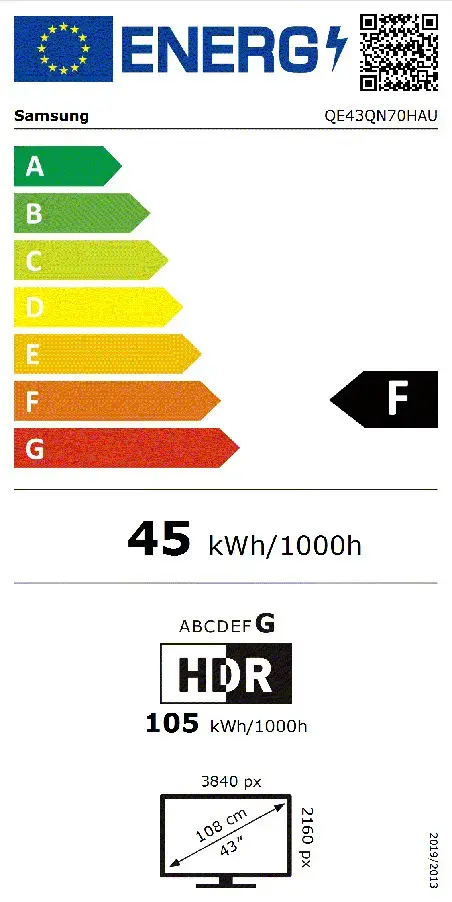
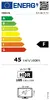
Energy efficiency class (SDR):
Energy efficiency class is a standard classification that is used all over Europe and which is understandable at first sight. Products can be efficiently compared according to classes, starting from A (the most energy efficient class), and ending with G (the most energy-intensive class). The classification of energy efficiency is based on annual energy consumption which is being calculated on the basis of several different parameters.
-
F
-
Energy efficiency class (HDR):
Energy efficiency class is a standard classification that is used all over Europe and which is understandable at first sight. Products can be efficiently compared according to classes, starting from A (the most energy efficient class), and ending with G (the most energy-intensive class). The classification of energy efficiency is based on annual energy consumption which is being calculated on the basis of several different parameters.
-
G
-
Energy consumption (SDR) per 1000 hours:
Power consumption in switched-on state expressed in W.
-
45 kWh
-
Energy consumption (HDR) per 1000 hours:
Power consumption in switched-on state expressed in W.
-
105 kWh
-
Active voice amplifier (AVA):
-
Yes
-
Universal guide:
-
Yes
-
Remote access:
-
Yes
-
Adaptive sound+:
-
Yes
-
Picture processor:
-
NQ4 AI Gen2