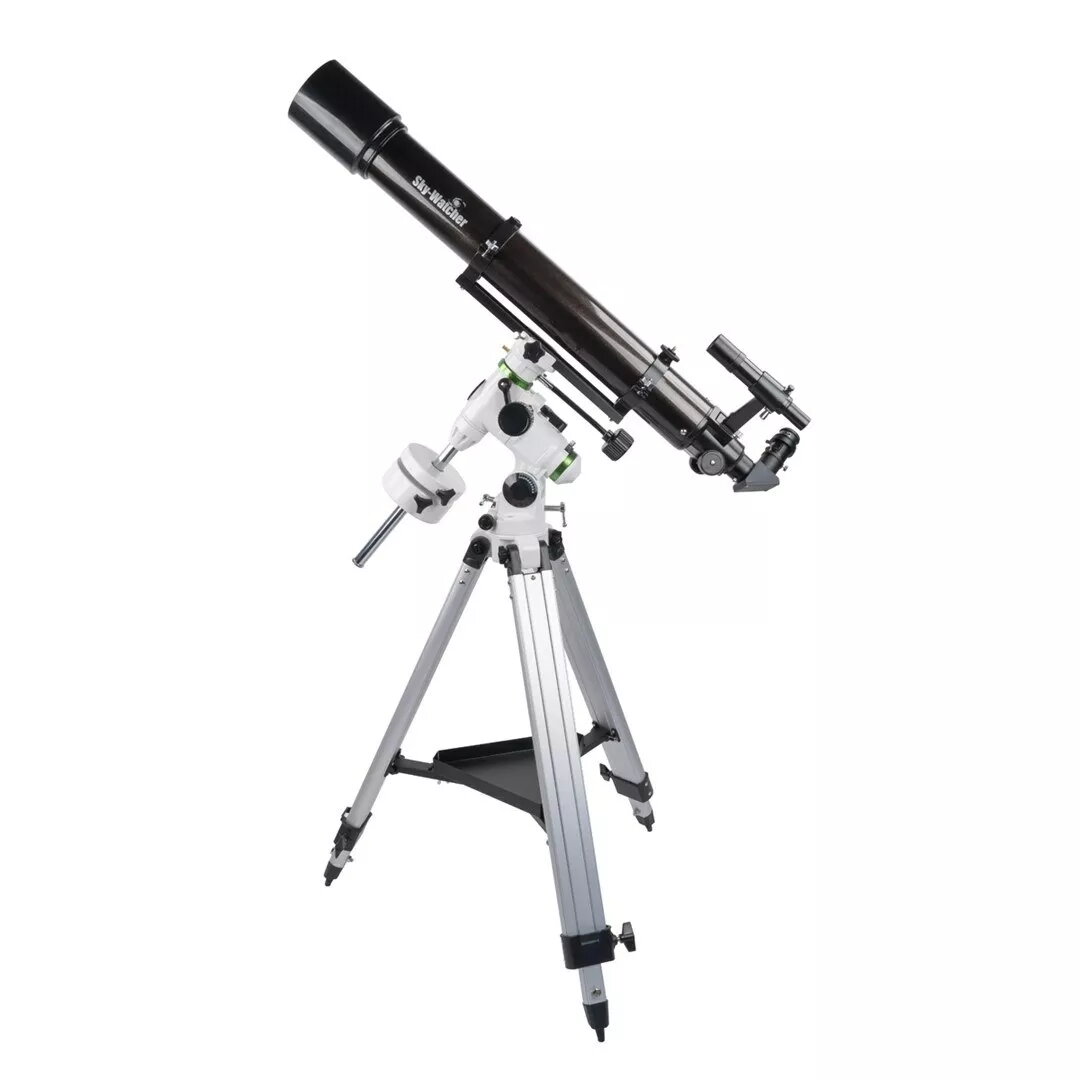
The Skywatcher BK 909 EQ3-2 refractor telescope features a 90 mm aperture and a 900 mm focal length in a compact optical tube mounted on an EQ3-2 equatorial mount. It is designed for visual observation of the Moon, planets and brighter deep-sky objects, and comes as a portable kit that balances optical performance with straightforward setup. The instrument includes basic accessories for immediate use and provides stable tracking for manual or motor-assisted guiding.
Advantages
The 90 mm objective delivers clear, high-contrast views of lunar and planetary detail while the 900 mm focal length provides moderate magnification suitable for a range of targets. The refractor design requires minimal collimation and maintenance compared with reflector systems, and the compact tube makes the instrument easier to transport and store. The EQ3-2 equatorial mount enables polar alignment and controlled tracking, which is helpful for longer observing sessions and entry-level astrophotography.
Suitable for
- Visual observation of the Moon and planets
- Viewing star clusters and brighter deep-sky objects
- Beginner to intermediate amateur astronomers
- Portable observing sessions and casual field use
- Basic astrophotography with careful setup and guiding
When it may not be suitable
This telescope is not optimized for faint, very deep-sky objects that require larger apertures to resolve low-surface-brightness detail. Users seeking high-resolution planetary imaging or advanced deep-sky astrophotography may find the aperture and mount limitations restrictive compared with larger aperture instruments and more robust mounts. Long-exposure astrophotography will require precise polar alignment and possibly motorization or autoguiding accessories to reduce tracking error.
Key specifications
- Optical type: Refractor
- Aperture: 90 mm
- Focal length: 900 mm
- Focal ratio: f/10
- Mount type: Equatorial (EQ3-2)
- Suitable for visual observing and entry-level astrophotography
- Portable optical tube design
How to use
Set the tripod on a stable, level surface and attach the EQ3-2 equatorial mount, then mount the optical tube and secure all clamps. Perform a rough polar alignment using a visible pole star or the mount's polar scope if available, then balance the tube on both axes before locking the clutches. Begin with a low-power eyepiece to locate targets, then increase magnification as seeing allows. For basic astrophotography, attach a camera using the provided adapters, ensure accurate balance and polar alignment, and use short exposures or a motor drive to limit field rotation and tracking error.
What to consider before purchase
- Intended use: mainly lunar, planetary and brighter deep-sky observing
- Portability: compact tube suits car transport and field trips
- Mount capability: EQ3-2 supports entry-level tracking but has load limits
- Accessories needed for astrophotography: camera adapters, possible autoguider
- Storage and setup space for the tripod and mount
Usage recommendations
Use low- to medium-power eyepieces for initial target acquisition and switch to higher magnification for planetary detail when atmospheric seeing is stable. For long sessions, polar-align the mount carefully and balance the optical tube to minimise strain on the mount bearings. When imaging, start with short exposures or video capture for planetary work; add a motor drive or autoguider for longer deep-sky exposures.