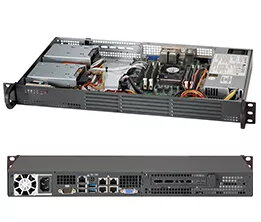
-
BIOS memory size:
-
128 Mbit
-
Ethernet LAN:
An Ethernet LAN (Local Area Network) interface is present, for a wired conection via a cable.
-
Yes
-
RAID levels:
RAID is a storage technology that combines multiple disk drive components into a logical unit for the purposes of data redundancy and performance improvement. Data is distributed across the drives in one of several ways, referred to as RAID levels, depending on the specific level of redundancy and performance required.
-
1, 5, 10
-
ECC:
ECC means Error Correction Code, and it is memory that is able to detect and correct some memory errors without user intervention.
-
Yes
-
BIOS type:
The BIOS (Basic Input/Output System) initializes and tests system hardware components, and loads a bootloader or an operating system from a mass memory device. The BIOS additionally provides abstraction layer for the hardware, i.e. a consistent way for application programs and operating systems to interact with the keyboard, display, and other input/output devices. There are several types of BIOS, including the motherboard ROM BIOS, video BIOS, drive controller BIOS, network adapter BIOS, and SCSI adapter BIOS.
-
AMI
-
Ethernet LAN (RJ-45) ports:
Number of Ethernet LAN (RJ-45) ports (connecting interfaces) in the device. Ethernet LAN (RJ-45) ports allow a computer to connect to the ethernet.
-
4
-
VGA (D-Sub) ports quantity:
Number of VGA (D-Sub) ports (connecting interfaces) in the device. The VGA (D-Sub) connector is a 15 pin connector between a computer and a monitor. It was first introduced in 1987 by IBM.
-
1
-
Number of DIMM slots:
The number of places where DIMMs can be connected. A DIMM or dual in-line memory module comprises a series of dynamic random-access memory integrated circuits. These modules are mounted on a printed circuit board and designed for use in personal computers, workstations and servers. DIMMs began to replace SIMMs (single in-line memory modules) as the predominant type of memory module as Intel P5-based Pentium processors began to gain market share.
-
2
-
Memory voltage:
The voltage (V) of the memory in the device.
-
1.35, 1.5
-
Supported DIMM module capacities:
-
8GB, 4GB, 2GB, 1GB
-
Supported memory types:
Types of memory which can be used with the product.
-
DDR3-SDRAM
-
Built-in processor:
Whether or not a processor is built into the device.
-
No
-
Number of SATA III connectors:
Serial ATA (Advanced Technology Attachment) (SATA) is a computer bus interface that connects host bus adapters to mass storage devices such as hard disk drives and optical drives. SATA III (revision 3.x) interface, formally known as SATA 6Gb/s, is a third generation SATA interface running at 6.0Gb/s. The bandwidth throughput, which is supported by the interface, is up to 600MB/s. This interface is backwards compatible with SATA 3 Gb/s interface.
-
2
-
Number of SATA II connectors:
Serial ATA (Advanced Technology Attachment) (SATA) is a computer bus interface that connects host bus adapters to mass storage devices such as hard disk drives and optical drives. SATA II (revision 2.x) interface, formally known as SATA 3Gb/s, is a second generation SATA interface running at 3.0 Gb/s. The bandwidth throughput, which is supported by the interface, is up to 300MB/s.
-
2