{{ totalProductsCount }}

In cart {{totalProductsCount}} item(s)

Total:
{{sum | formatAmount}}

Your cart is empty

header-product Motherboard Supermicro MBD-X11SDV-8C-TP8F-B Flex-ATX, Intel D-2146NT SoC, DDR4 up to 512GB, SATA III, RAID 0/1/5/10, Aspeed AST2500, Gigabit Ethernet

Motherboard Supermicro MBD-X11SDV-8C-TP8F-B Flex-ATX, Intel D-2146NT SoC, DDR4 up to 512GB, SATA III, RAID 0/1/5/10, Aspeed AST2500, Gigabit Ethernet

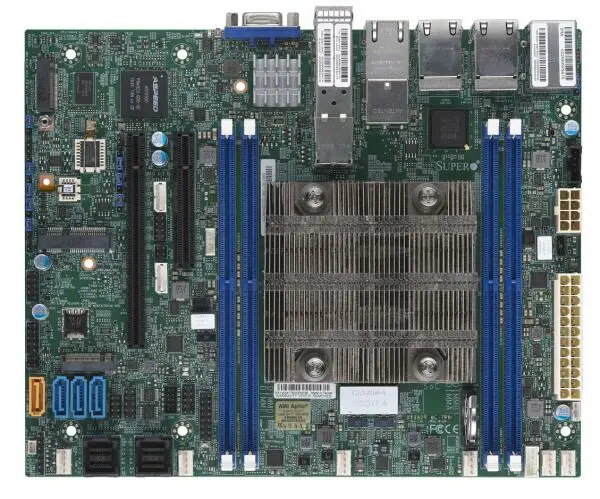
Motherboard Supermicro MBD-X11SDV-8C-TP8F-B Photo 1
Out of stock.
View similar!

Short description

Flex-ATX server motherboard Supermicro MBD-X11SDV-8C-TP8F-B with integrated Intel SoC using the Intel® Xeon® D-2146NT processor. Supports DDR4 DIMMs up to 512 GB total memory and SATA III storage with RAID 0/1/5/10. Features onboard Aspeed AST2500 graphics and Gigabit Ethernet connectivity, suitable for compact servers, storage nodes and network appliances.
Warranty: 2 Years
SKU: 12059989
delivery
Information regarding the items availability for purchase will be posted on this site
price
Item cost information will be published on this site
Together cheaper
{{product.price | formatAmount}}
{{product.title}}
{{productBundle.reference.specialPrice | formatAmount}}
{{productBundle.title}}
{{productBundlePreviousPrice | formatAmount}}
{{productBundleSpecialPrice | formatAmount}}

You saving {{productBundleYouSave | formatAmount}}

Product information

Description

Supermicro MBD-X11SDV-8C-TP8F-B is a Flex-ATX server motherboard built around an integrated Intel SoC featuring the Intel® Xeon® D-2146NT processor. The board supports up to 512 GB of DDR4 memory across four DIMM slots, provides SATA III storage with hardware RAID levels 0, 1, 5 and 10, and includes onboard Aspeed AST2500 out-of-band graphics for remote management. Dual Gigabit Ethernet interfaces and a compact Flex-ATX form factor make this motherboard suitable for space-constrained server installations, storage nodes and network appliances that require server-grade CPU performance and high memory capacity.

Advantages

This Supermicro motherboard integrates a Xeon D SoC to deliver multi-core server performance with lower power consumption compared with separate CPU and chipset solutions. The support for up to 512 GB of DDR4 RAM across four DIMM slots enables large memory footprints for virtualization or in-memory databases. Built-in SATA III ports with RAID 0/1/5/10 simplify local storage configurations, while the Aspeed AST2500 controller offers remote management and basic video output without an additional GPU. The Flex-ATX form factor allows installation in compact chassis where a full-size server board would not fit.

Suitable for

  • Compact rack or tower servers for small data centers
  • Storage nodes and RAID-capable NAS appliances
  • Virtualization hosts and hyperconverged nodes with high memory needs
  • Network appliances and edge servers requiring integrated management

Key specifications

  • Processor: integrated Intel® Xeon® D-2146NT SoC with multiple cores
  • Form factor: Flex-ATX suitable for compact server chassis
  • Memory: 4 x DDR4 DIMM slots, maximum supported memory up to 512 GB
  • Storage interfaces: multiple SATA III ports with RAID 0/1/5/10 support
  • Graphics and management: Aspeed AST2500 BMC with remote management and video output
  • Networking: Gigabit Ethernet connectivity for network and management traffic
  • BIOS: UEFI firmware

How to use

Install the motherboard into a compatible Flex-ATX or larger chassis and connect the required power supply following the chassis and Supermicro installation guides. Populate DDR4 DIMMs in matched pairs or according to the memory population rules in the motherboard manual to achieve the desired capacity and optimal performance. Attach SATA III drives and configure RAID arrays through the on-board RAID controller or UEFI setup utility. Connect network cables to the Gigabit Ethernet ports and configure IP addresses and management access as required. Use the Aspeed AST2500 BMC for out-of-band management, remote console access and firmware updates.

Usage recommendations

For stable operation and longevity, use ECC DDR4 DIMMs if system memory error correction is required, follow the motherboard memory population guidelines to balance channels, and ensure adequate airflow in the chassis to cool the SoC and VRM components under sustained load.

Specifications

BIOS type: The BIOS (Basic Input/Output System) initializes and tests system hardware components, and loads a bootloader or an operating system from a mass memory device. The BIOS additionally provides abstraction layer for the hardware, i.e. a consistent way for application programs and operating systems to interact with the keyboard, display, and other input/output devices. There are several types of BIOS, including the motherboard ROM BIOS, video BIOS, drive controller BIOS, network adapter BIOS, and SCSI adapter BIOS.
UEFI
Motherboard chipset: The chipset connects the microprocessor to the rest of the motherboard.
Intel SoC
Motherboard form factor: Design of the motherboard (ATX, BTX etc).
Flex-ATX
Component for: What this product is used as a part of (component for).
Server
Wi-Fi: Popular technology that allows an electronic device to exchange data or connect to the internet wirelessly using radio waves.
No
DVI-D ports quantity: This is the amount of DVI-I interfaces. Digital Visual Interface (DVI) is a video display interface developed by the Digital Display Working Group (DDWG). The digital interface is used to connect a video source to a display device, such as a computer monitor. DVI-D means DVI digital, which means it can only support digital, but not analog.
0
HDMI ports quantity: The number of sockets (ports) for HDMI connections. HDMI (High-Definition Multimedia Interface) is a compact audio/video interface for transferring uncompressed video data and compressed/uncompressed digital audio data from a HDMI-compliant device ("the source device") to a compatible computer monitor, video projector, digital television, or digital audio device. HDMI is a digital replacement for existing analog video standards.
0
VGA (D-Sub) ports quantity: Number of VGA (D-Sub) ports (connecting interfaces) in the device. The VGA (D-Sub) connector is a 15 pin connector between a computer and a monitor. It was first introduced in 1987 by IBM.
1
Ethernet LAN (RJ-45) ports: Number of Ethernet LAN (RJ-45) ports (connecting interfaces) in the device. Ethernet LAN (RJ-45) ports allow a computer to connect to the ethernet.
6
USB 3.2 Gen 2 (3.1 Gen 2) Type-C ports quantity: Number of USB 3.1 (3.1 Gen 2) ports with Type-C connector. USB 3.1 (3.1 Gen 2) is USB interface version which supports transfer rate up to 10 Gbit/s (SuperSpeed+). USB Type-C connector has symmetrical design architecture and compatible with Thunderbolt 3 interface.
0
USB 3.2 Gen 2 (3.1 Gen 2) Type-A ports quantity:
0
USB 3.2 Gen 1 (3.1 Gen 1) Type-C ports quantity: Number of USB 3.0 (3.1 Gen 1) ports with Type-C connector. USB 3.0 (3.1 Gen 1) is USB interface version which supports transfer rate up to 5 Gbit/s (SuperSpeed). USB Type-C connector has symmetrical design architecture and compatible with Thunderbolt 3 interface.
0
USB 3.2 Gen 1 (3.1 Gen 1) Type-A ports quantity:
2
USB 2.0 ports quantity: Number of USB 2.0 ports (connecting interfaces) in the device. USB 2.0 was released in April 2000 (now called "Hi-Speed"), adding higher maximum signaling rate of 480 Mbit/s (effective throughput up to 35 MB/s or 280 Mbit/s), USB 2.0 ports are usually black.
0
Number of SATA III connectors: Serial ATA (Advanced Technology Attachment) (SATA) is a computer bus interface that connects host bus adapters to mass storage devices such as hard disk drives and optical drives. SATA III (revision 3.x) interface, formally known as SATA 6Gb/s, is a third generation SATA interface running at 6.0Gb/s. The bandwidth throughput, which is supported by the interface, is up to 600MB/s. This interface is backwards compatible with SATA 3 Gb/s interface.
4
USB 3.2 Gen 2 (3.1 Gen 2) connectors:
0
USB 3.2 Gen 1 (3.1 Gen 1) connectors: This is a connector (normally attached to a cable) for USB 3.0. USB 3.0 is the second major revision of the Universal Serial Bus (USB) standard for computer connectivity. First introduced in 2008, USB 3.0 adds a new transfer mode called "SuperSpeed," (distinguishable from USB 2.0 by either the blue colour of the port or the initials SS) capable of transferring data at up to 5Gbit/s—more than ten times as fast as the 480 Mbit/s top speed of USB 2.0.
0
USB 2.0 connectors: The end of a cable with a USB 2.0 connector. USB 2.0 was released in April 2000 (now called "Hi-Speed"), adding higher maximum signaling rate of 480 Mbit/s (effective throughput up to 35 MB/s or 280 Mbit/s), in addition to the "USB 1.x Full Speed" signaling rate of 12 Mbit/s. USB 2.0 connectors are usually colored black.
2
Maximum internal memory: The maximum internal memory which is available in the product.
512 GB
Number of memory slots:
4
Processor manufacturer: The manufacturer that produced the processor.
Intel
Supported storage drive interfaces:
SATA III
Supported memory types: Types of memory which can be used with the product.
DDR4-SDRAM
Compatible processor series: A processor which is compatible with this device, belongs to a 'series' which is part of 'family' e.g Celeron D, Celeron G, Celeron M, or, in some cases, is the same as 'family'.
Intel® Xeon®
All features

Other features

Thermal Design Power (TDP):
80 W
Number of DIMM slots: The number of places where DIMMs can be connected. A DIMM or dual in-line memory module comprises a series of dynamic random-access memory integrated circuits. These modules are mounted on a printed circuit board and designed for use in personal computers, workstations and servers. DIMMs began to replace SIMMs (single in-line memory modules) as the predominant type of memory module as Intel P5-based Pentium processors began to gain market share.
4
Number of processors supported: The quantity of processors which can be used by the product.
1
Supported RDIMM module capacity:
32GB, 16GB, 64GB
Supported RDIMM clock speeds:
2666, 2400, 2133
Maximum LRDIMM memory:
512 GB
Supported LRDIMM clock speeds:
2133, 2400
Supported LRDIMM module capacity:
16GB, 32GB, 64GB
Supported DIMM module capacities:
16GB, 32GB, 64GB, 128MB

Technical details

Form factor: The shape or design of the product.
Flex ATX
Compliance certificates: Indicates which regulatory, safety, and environmental standards the product complies with, as verified by recognized authorities or certification bodies.
RoHS

Packaging content

Bundled software: Software distributed with another product such as a piece of computer hardware or other electronic device, or a group of software packages which are sold together. A software suite is an example of bundled software, as is software which is pre-installed on a new computer.
IPMI2.0, KVM with dedicated LAN, Watchdog

Weight & dimensions

Depth: The distance from the front to the back of something.
184.2 mm
Width: The measurement or extent of something from side to side.
228.6 mm

Logistics data

Harmonized System (HS) code:
84733020

Operational conditions

Operating relative humidity (H-H):
8 - 90
Storage relative humidity (H-H):
5 - 95
Operating temperature (T-T): The minimum and maximum temperatures at which the product can be safely operated.
0 - 60
Storage temperature (T-T): The minimum and maximum temperatures at which the product can be safely stored.
-40 - 70

Processor special features

Trusted Platform Module (TPM):
Yes

BIOS

Plug and Play: Indicates whether this product supports is "plug and play". Plug and play is hardware or software that, after being installed ("plugged in"), can immediately be used ("played with"), as opposed to hardware or software which requires configuration.
Yes
System Management BIOS (SMBIOS) version:
3.1
BIOS memory size:
128 Mbit
BIOS type: The BIOS (Basic Input/Output System) initializes and tests system hardware components, and loads a bootloader or an operating system from a mass memory device. The BIOS additionally provides abstraction layer for the hardware, i.e. a consistent way for application programs and operating systems to interact with the keyboard, display, and other input/output devices. There are several types of BIOS, including the motherboard ROM BIOS, video BIOS, drive controller BIOS, network adapter BIOS, and SCSI adapter BIOS.
UEFI

Expansion slots

PCI Express x16 (Gen 3.x) slots: Places where PCI Express x16 (Gen 3.x) are placed inside and connected to the computer motherboard.
1
PCI Express x8 (Gen 3.x) slots: Slots in the computer for PCI Express x8 (Gen 3.x), which is a high-speed serial computer expansion bus standard with 8 pins.
1

Features

PC health monitoring:
Temperature, LED, FAN, Voltage
Motherboard chipset: The chipset connects the microprocessor to the rest of the motherboard.
Intel SoC
Motherboard form factor: Design of the motherboard (ATX, BTX etc).
Flex-ATX
Component for: What this product is used as a part of (component for).
Server

Network

Wi-Fi: Popular technology that allows an electronic device to exchange data or connect to the internet wirelessly using radio waves.
No
Ethernet interface type:
Gigabit Ethernet
Ethernet LAN: An Ethernet LAN (Local Area Network) interface is present, for a wired conection via a cable.
Yes

Rear panel I/O ports

COM ports quantity:
1
DVI-D ports quantity: This is the amount of DVI-I interfaces. Digital Visual Interface (DVI) is a video display interface developed by the Digital Display Working Group (DDWG). The digital interface is used to connect a video source to a display device, such as a computer monitor. DVI-D means DVI digital, which means it can only support digital, but not analog.
0
HDMI ports quantity: The number of sockets (ports) for HDMI connections. HDMI (High-Definition Multimedia Interface) is a compact audio/video interface for transferring uncompressed video data and compressed/uncompressed digital audio data from a HDMI-compliant device ("the source device") to a compatible computer monitor, video projector, digital television, or digital audio device. HDMI is a digital replacement for existing analog video standards.
0
VGA (D-Sub) ports quantity: Number of VGA (D-Sub) ports (connecting interfaces) in the device. The VGA (D-Sub) connector is a 15 pin connector between a computer and a monitor. It was first introduced in 1987 by IBM.
1
Ethernet LAN (RJ-45) ports: Number of Ethernet LAN (RJ-45) ports (connecting interfaces) in the device. Ethernet LAN (RJ-45) ports allow a computer to connect to the ethernet.
6
USB 3.2 Gen 2 (3.1 Gen 2) Type-C ports quantity: Number of USB 3.1 (3.1 Gen 2) ports with Type-C connector. USB 3.1 (3.1 Gen 2) is USB interface version which supports transfer rate up to 10 Gbit/s (SuperSpeed+). USB Type-C connector has symmetrical design architecture and compatible with Thunderbolt 3 interface.
0
USB 3.2 Gen 2 (3.1 Gen 2) Type-A ports quantity:
0
USB 3.2 Gen 1 (3.1 Gen 1) Type-C ports quantity: Number of USB 3.0 (3.1 Gen 1) ports with Type-C connector. USB 3.0 (3.1 Gen 1) is USB interface version which supports transfer rate up to 5 Gbit/s (SuperSpeed). USB Type-C connector has symmetrical design architecture and compatible with Thunderbolt 3 interface.
0
USB 3.2 Gen 1 (3.1 Gen 1) Type-A ports quantity:
2
USB 2.0 ports quantity: Number of USB 2.0 ports (connecting interfaces) in the device. USB 2.0 was released in April 2000 (now called "Hi-Speed"), adding higher maximum signaling rate of 480 Mbit/s (effective throughput up to 35 MB/s or 280 Mbit/s), USB 2.0 ports are usually black.
0

Internal I/O

Number of COM connectors:
1
TPM connector:
Yes
Number of chassis fan connectors:
6
Number of SATA III connectors: Serial ATA (Advanced Technology Attachment) (SATA) is a computer bus interface that connects host bus adapters to mass storage devices such as hard disk drives and optical drives. SATA III (revision 3.x) interface, formally known as SATA 6Gb/s, is a third generation SATA interface running at 6.0Gb/s. The bandwidth throughput, which is supported by the interface, is up to 600MB/s. This interface is backwards compatible with SATA 3 Gb/s interface.
4
USB 3.2 Gen 2 (3.1 Gen 2) connectors:
0
USB 3.2 Gen 1 (3.1 Gen 1) connectors: This is a connector (normally attached to a cable) for USB 3.0. USB 3.0 is the second major revision of the Universal Serial Bus (USB) standard for computer connectivity. First introduced in 2008, USB 3.0 adds a new transfer mode called "SuperSpeed," (distinguishable from USB 2.0 by either the blue colour of the port or the initials SS) capable of transferring data at up to 5Gbit/s—more than ten times as fast as the 480 Mbit/s top speed of USB 2.0.
0
USB 2.0 connectors: The end of a cable with a USB 2.0 connector. USB 2.0 was released in April 2000 (now called "Hi-Speed"), adding higher maximum signaling rate of 480 Mbit/s (effective throughput up to 35 MB/s or 280 Mbit/s), in addition to the "USB 1.x Full Speed" signaling rate of 12 Mbit/s. USB 2.0 connectors are usually colored black.
2

Graphics

On-board graphics card model: "Graphic adapter" is the hardware that produces images on a display. "On-board" means that the graphics adapter is intergrated inside the motherboard.
Aspeed AST2500

Storage controllers

RAID levels: RAID is a storage technology that combines multiple disk drive components into a logical unit for the purposes of data redundancy and performance improvement. Data is distributed across the drives in one of several ways, referred to as RAID levels, depending on the specific level of redundancy and performance required.
10, 5, 1
RAID support: The device uses RAID, which is a storage technology that combines multiple disk drive components into a logical unit for the purposes of data redundancy and performance improvement. Data is distributed across the drives in one of several ways, referred to as RAID levels, depending on the specific level of redundancy and performance required.
Yes
Supported storage drive interfaces:
SATA III

Memory

Maximum RDIMM memory:
256 GB
Maximum internal memory: The maximum internal memory which is available in the product.
512 GB
Supported memory clock speed (max):
2666 MHz
Supported memory clock speeds: Memory clock speed is the time it takes for a computer to complete basic operations. It refers to the computer's processing speed and is measured in hertz. It is however not such a reliable measure of a computer's speed as it doesn't take into account other factors like RAM and cache size.
2400, 2666, 2133
ECC сompatibility:
ECC
Memory voltage: The voltage (V) of the memory in the device.
1.2
Memory slots type: A memory slot, also known as a memory socket or RAM slot, is what allows computer memory (RAM) to be inserted into the computer. Depending on the motherboard, there will usually be 2 to 4 memory slots (sometimes more on high-end motherboards). The most common types of RAM are SDRAM and DDR for desktop computers and SODIMM for laptop computers, each having various types and speeds.
DIMM
Number of memory slots:
4
Supported memory types: Types of memory which can be used with the product.
DDR4-SDRAM

Processor

Processor cores: The number of central processing units ('cores') in a processor. Some processors have 1 core, others have 2 (e.g. Intel Core Duo) or more (e.g. the Intel Xeon E7-2850 has 10 cores).
8
Processor model: The model number for the processor in a computer.
D-2146NT
Processor number of cores supported: The quantity of processor cores which can be used in the device.
8
Compatible processor series: A processor which is compatible with this device, belongs to a 'series' which is part of 'family' e.g Celeron D, Celeron G, Celeron M, or, in some cases, is the same as 'family'.
Intel® Xeon®
Processor manufacturer: The manufacturer that produced the processor.
Intel

Description

Machine translation. Load original

Similar products

{{product.title}} Show details Hide details

{{highlightedFeature.featureTitle}}:

{{getProductFeatureValueById(product, highlightedFeature.featureId)}}

{{product.price | formatAmount}}
Might be useful
{{product.manufacturerName}}
{{product.categoryName}}
{{product.title}}
{{product.specialPrice}}
{{product.price}}

Customer reviews

Customer questions

FAQ

What payment options are available?

AiO.lv offers several payment methods: Bank transfer, Leasing for legal entities. All transactions are 100% secure and encrypted.

Can this product be purchased for a company (with VAT)?

Yes. AiO.lv works with legal entities in Latvia and across Europe. The product price already includes VAT. For certain product categories, as well as for companies from other EU countries with a valid VAT number, a 0% VAT rate may apply. We issue the invoice immediately after the order is placed, support electronic BIS invoices, and automatically generate all necessary accounting documents. You can complete the purchase for a company online — simply select the company profile and choose bank transfer as the payment method during checkout.

What is the warranty period?

All Supermicro products come with an official 2 Years warranty. It covers all manufacturing defects and malfunctions that may occur during use. The warranty is valid at all authorized Supermicro service centers and through AiO.lv

Can the product be returned after purchase?

Yes, you can return the product within 14 days of purchase if you bought it as a consumer (not a legal entity). Returns are possible without giving any reason — the main condition is that the product retains its original appearance and full set of accessories. We will make the process as simple and convenient as possible: just contact our customer support team, and we will help you arrange the return.

Where should I contact for warranty service?

For warranty-related questions you can contact the AiO.lv (SIA VSPRO) customer support team. We will assist with consultation, warranty claim processing, and coordination with certified service centers.

How can I tell if this product suits my needs?

When making a choice, we recommend paying attention to the key features: bios type, motherboard chipset, motherboard form factor, component for, wi-fi, dvi-d ports quantity, hdmi ports quantity, vga (d-sub) ports quantity, ethernet lan (rj-45) ports, usb 3.2 gen 2 (3.1 gen 2) type-c ports quantity, usb 3.2 gen 2 (3.1 gen 2) type-a ports quantity, usb 3.2 gen 1 (3.1 gen 1) type-c ports quantity, usb 3.2 gen 1 (3.1 gen 1) type-a ports quantity, usb 2.0 ports quantity, number of sata iii connectors, usb 3.2 gen 2 (3.1 gen 2) connectors, usb 3.2 gen 1 (3.1 gen 1) connectors, usb 2.0 connectors, maximum internal memory, number of memory slots, processor manufacturer, supported storage drive interfaces, supported memory types, compatible processor series, compatibility with your devices or usage conditions, material quality, functionality, and warranty terms. These characteristics will help you determine how well the model meets your needs.
warranty
14-Day Return Policy We are confident in our quality, but if the purchase doesn’t fit — you have 14 days to return the product with peace of mind.
shipping
Fast Delivery Get your orders as quickly as possible — right to your door, parcel lockers, or pickup points across Latvia and the EU.
payment
Secure Payment Pay the way you prefer: cash, VISA, MasterCard, Apple Pay, Google Pay, bank transfer, or 0% installment plan.
warranty
Quality Since 2008 AiO.lv has been on the market for over 18 years and has earned trust — with more than 6000 genuine positive reviews on Google.