

-
Headphone outputs:
Number of sockets /ports where headphones are connected.
-
0
-
Component video (YPbPr/YCbCr) out:
The number of sockets (ports) for RF (radio frequency) connections out of the product.
-
0
-
AC (power) in:
-
Yes
-
RF ports quantity:
The number of sockets (ports) for RF (radio frequency) connections.
-
1
-
HDMI version:
-
2.1
-
Consumer Electronics Control (CEC):
-
T-link
-
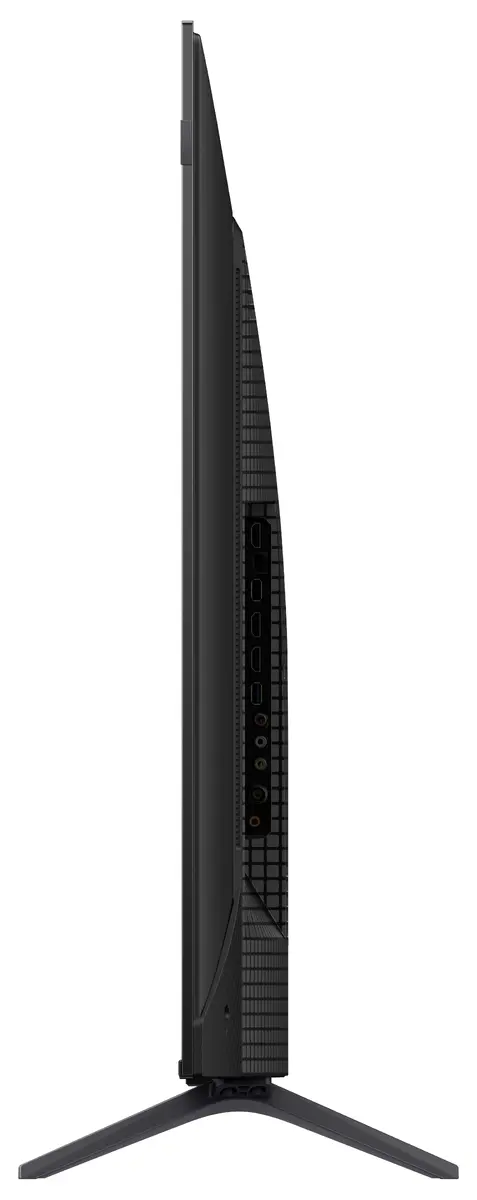
HDMI ports quantity:
The number of sockets (ports) for HDMI connections. HDMI (High-Definition Multimedia Interface) is a compact audio/video interface for transferring uncompressed video data and compressed/uncompressed digital audio data from a HDMI-compliant device ("the source device") to a compatible computer monitor, video projector, digital television, or digital audio device. HDMI is a digital replacement for existing analog video standards.
-
4
-
USB 2.0 ports quantity:
Number of USB 2.0 ports (connecting interfaces) in the device. USB 2.0 was released in April 2000 (now called "Hi-Speed"), adding higher maximum signaling rate of 480 Mbit/s (effective throughput up to 35 MB/s or 280 Mbit/s), USB 2.0 ports are usually black.
-
0
-
Common interface Plus (CI+) version:
-
1.4
-
Common interface Plus (CI+):
In Digital Video Broadcasting, the Common Interface (CI) is a technology which allows separation of conditional access functionality from a digital TV receiver-decoder (Host) into a removable conditional access module (CAM). CI+ or Common Interface Plus implements a form of copy protection between a Conditional Access Module (CAM) and the television receiver (Host). CI+ is backward compatible with CIv1. Old television receivers, which have CIv1 CI-slot, can be used with CI+ CAM and vice versa, but for viewing only those of TV programs which are not marked as CI+ protected.
-
Yes
-
Common interface (CI):
Technology which allows separation of conditional access functionality from a digital TV receiver-decoder (Host) into a removable conditional access module (CAM). It is also referenced as DVB-CI for Digital Video Broadcast - Common Interface. The host is responsible for tuning to pay TV channels and demodulation of the RF signal, while CAM is responsible for CA descrambling. The Common Interface allows them to communicate with each other.
-
Yes
-
RF connector type:
-
F, IEC
-
Digital audio coaxial out:
The socket in the device for the digital audio output. The signal is carried via a coaxial cable with an RCA connector.
-
0
-
Digital audio coaxial in:
The socket in the device for the digital audio input. The signal is broight into the device via a coaxial cable with an RCA connector.
-
0
-
Digital audio optical out:
The socket in the device for the digital audio output. The signal is carried via an optical cable with an TOSLINK connector.
-
1
-
PC Audio in:
The socket (port) for the PC audio input.
-
No
-
Audio (L/R) out:
The two sockets (ports) for transmitting left audio signal (white cable) and right audio signal (red cable).
-
0
-
USB 3.2 Gen 2 (3.1 Gen 2) Type-C ports quantity:
Number of USB 3.1 (3.1 Gen 2) ports with Type-C connector. USB 3.1 (3.1 Gen 2) is USB interface version which supports transfer rate up to 10 Gbit/s (SuperSpeed+). USB Type-C connector has symmetrical design architecture and compatible with Thunderbolt 3 interface.
-
0
-
USB 3.2 Gen 1 (3.1 Gen 1) Type-C ports quantity:
Number of USB 3.0 (3.1 Gen 1) ports with Type-C connector. USB 3.0 (3.1 Gen 1) is USB interface version which supports transfer rate up to 5 Gbit/s (SuperSpeed). USB Type-C connector has symmetrical design architecture and compatible with Thunderbolt 3 interface.
-
0
-
USB 3.2 Gen 1 (3.1 Gen 1) Type-A ports quantity:
-
1
-
Ethernet LAN (RJ-45) ports:
Number of Ethernet LAN (RJ-45) ports (connecting interfaces) in the device. Ethernet LAN (RJ-45) ports allow a computer to connect to the ethernet.
-
1
-
DVI-D ports quantity:
This is the amount of DVI-I interfaces. Digital Visual Interface (DVI) is a video display interface developed by the Digital Display Working Group (DDWG). The digital interface is used to connect a video source to a display device, such as a computer monitor. DVI-D means DVI digital, which means it can only support digital, but not analog.
-
0
-
DVI port:
Digital Visual Interface (DVI) is a video display interface to connect a video source to a display device, such as a computer monitor.
-
No
-
VGA (D-Sub) ports quantity:
Number of VGA (D-Sub) ports (connecting interfaces) in the device. The VGA (D-Sub) connector is a 15 pin connector between a computer and a monitor. It was first introduced in 1987 by IBM.
-
0
-
PC in (D-Sub):
The socket (port) to receive input from a PC via a D-sub, which is a connector with a characteristic D-shaped metal shield.
-
No
-
HDCP:
High-bandwidth Digital Content Protection (HDCP) is a form of digital copy protection to prevent copying of digital audio and video content as it travels across connections.
-
Yes
-
Mobile High-Definition Link (MHL):
-
Yes
-
Audio Return Channel (ARC):
-
Yes