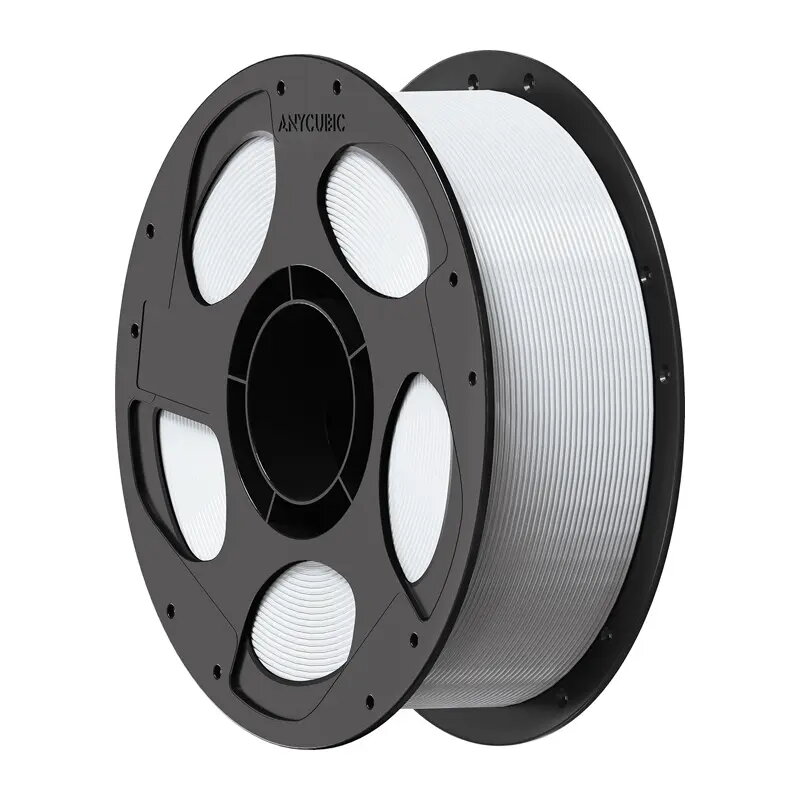
This product page focuses on the PC Filament AnyCubic IPHPCWH-101 (Polycarbonate) White 1 kg, which is compared with alternative 1 kg spool materials from AnyCubic, including different colors of polycarbonate as well as PLA and TPU filaments. All compared options are designed for FDM/FFF 3D printers but differ significantly in chemical composition, mechanical behavior, and practical use cases. Their primary similarities are the brand and spool weight, while key differences lie in rigidity, thermal performance, flexibility, and printing requirements.
⚙️ The technical specification comparison in the table below covers material type, color, flexibility level, heat resistance, and printing environment requirements.
| Comparison parameter | AnyCubic PC White | AnyCubic PC Black | AnyCubic PC Transparent White | AnyCubic PLA White | AnyCubic TPU Transparent | AnyCubic TPU Black | Practical conclusion |
|---|
| Material type | Polycarbonate (PC) | Polycarbonate (PC) | Polycarbonate (PC) | Bioplastic (PLA) | Thermoplastic polyurethane (TPU) | Thermoplastic polyurethane (TPU) | Materials range from engineering-grade rigid plastics (PC) and easy general-purpose plastics (PLA) to flexible elastomers (TPU). |
| Color | White | Black | Transparent White | White | Transparent | Black | Color determines the visual appearance of the final print without changing core material properties. |
| Spool weight | 1 kg | 1 kg | 1 kg | 1 kg | 1 kg | 1 kg | All variants are supplied on standard 1 kg spools, ensuring compatibility with common printer holders. |
| Purpose and properties | High strength, heat resistance, rigidity | High strength, heat resistance, rigidity | High strength, heat resistance, rigidity | Easy printing, smooth finish, low warping | Flexibility, elasticity, shock absorption | Flexibility, elasticity, shock absorption | Polycarbonate suits load-bearing parts, PLA fits general models and hobbies, and TPU serves flexible components. |
| Printing requirements | Requires enclosure and PC settings | Requires enclosure and bed adhesion | Requires enclosure and PC settings | Easy extrusion, minimal warping | Requires flexible filament settings | Requires flexible filament settings | Polycarbonate demands strict printer settings and enclosures, whereas PLA prints easily and TPU requires careful feeding setup. |
◎ The evaluation of use cases and suitable scenarios for each product is provided in the suitability table below.
| Use case | Recommended product | Why |
|---|
| Load-bearing and mechanical components | AnyCubic PC White | White polycarbonate delivers maximum strength, rigidity, and thermal resistance for demanding end-use parts. |
| Durable black structural elements | AnyCubic PC Black | Black polycarbonate works best for concealed or dark mechanical parts requiring high structural integrity. |
| Durable parts requiring light diffusion | AnyCubic PC Transparent White | Transparent white polycarbonate is suitable for functional enclosures and semi-translucent mechanical items. |
| General models, hobbies, and education | AnyCubic PLA White | PLA prints easily without a closed enclosure, offering a smooth finish and low risk of warping. |
| Flexible gaskets and dampers | AnyCubic TPU Transparent | Transparent TPU provides stretch, resilience, and abrasion resistance for elastic components. |
| Black bumpers, seals, and straps | AnyCubic TPU Black | Black polyurethane is well-suited for rubber-like functional items, protective bumpers, and flexible prototypes. |
The choice between these filaments depends on your application: PC Filament AnyCubic IPHPCWH-101 (Polycarbonate) White 1 kg is recommended when you need strong, rigid, and heat-resistant white parts that soft PLA or flexible TPU cannot support, though it requires appropriate printer enclosures and thermal settings.