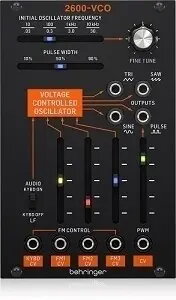
The Behringer 2600-VCO is a high-quality voltage controlled oscillator module designed for Eurorack modular synthesizer systems. As a faithful recreation of a classic analog circuit, this module serves as a foundational sound source, offering precise pitch tracking and a wide range of sonic possibilities for sound designers and musicians alike. It integrates seamlessly into any patchable rig, providing the essential building blocks for complex synthesis.
Advantages
This module excels by offering exceptional stability and a rich, authentic analog character that is highly sought after in modern synthesis. Its intuitive layout allows for rapid sound shaping, while the high-quality components ensure reliable performance during both studio sessions and live performances. The inclusion of multiple waveform outputs and dedicated control inputs makes it a versatile tool for creating everything from deep, resonant basses to soaring, expressive leads.
Suitable for
- Modular synthesizer sound design
- Creating basslines and lead melodies
- Live electronic music performance
- Experimental sound synthesis
This module may not be suitable for users who require digital precision or built-in effects processing, as it is a purely analog sound source. It also requires a compatible Eurorack modular case and power supply to function, making it less ideal for beginners who do not already own a modular system.
Key specifications
- Analog voltage controlled oscillator
- Multiple waveform outputs including sawtooth, pulse, and triangle
- CV inputs for pitch and pulse width modulation
- Eurorack compatible format
- Manual frequency and fine-tune controls
To use the Behringer 2600-VCO, mount the module into your powered Eurorack case and connect the power ribbon cable correctly. Patch your control voltage source into the pitch CV input to control the frequency, and route the desired waveform output to your filter or mixer. Use the manual frequency knobs to adjust the base pitch and fine-tune the oscillator to your preferred tuning.
What to consider before purchase
- Requires a Eurorack-compatible power supply and case
- Requires patch cables for signal routing
- Analog circuitry may require warm-up time for optimal tuning stability
For the best results, allow the module to warm up for several minutes after powering on to ensure stable pitch tracking. Experiment with modulating the pulse width using an external LFO to achieve complex, evolving textures.