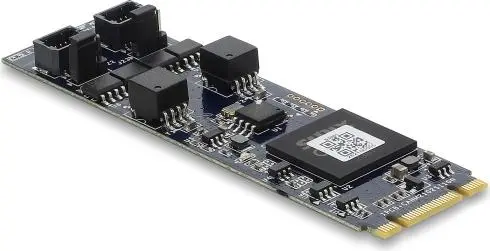
The DELOCK 63001 interface card is compared with two alternative models from the same brand: Delock 63002 and Delock 63007. All three devices are designed to support CAN 2.0 and CAN FD networks in industrial automation, automotive diagnostics, and embedded systems, sharing the same data transfer rate up to 8 Mbps, two D-Sub 9-pin ports, and built-in protection against overvoltage. The primary difference between the models is the host system interface used to connect to the motherboard.
⚙️ Comparison of technical specifications and design features.
| Parameter | DELOCK 63001 | Delock 63002 | Delock 63007 | Practical conclusion |
|---|
| Host interface | PCIe M.2 Key B+M | Mini PCIe | PCI Express | The choice depends entirely on the available expansion slots on your motherboard or embedded computer. |
| Supported CAN standards | CAN 2.0 and CAN FD | CAN 2.0 and CAN FD | CAN 2.0 and CAN FD | All three models offer identical core communication capabilities and support speeds up to 8 Mbps. |
| Port count | 2 x D-Sub 9 Pin | 2 x D-Sub 9 Pin | 2 x D-Sub 9 Pin | Each card provides two independent ports for connecting dual communication lines. |
| Protection features | Isolation and overvoltage protection | Electrical isolation and overvoltage protection | Electrical isolation and surge protection | All devices include robust protection mechanisms for reliable operation in demanding environments. |
◎ Evaluation of use cases and suitable scenarios for different buyers.
| Use case | Recommended product | Why |
|---|
| Installation in compact embedded systems with M.2 support | DELOCK 63001 | Best suited for modern space-constrained devices featuring an M.2 Key B+M slot. |
| Integration into industrial PCs utilizing Mini PCIe slots | Delock 63002 | The optimal choice for hardware relying on the Mini PCIe expansion form factor. |
| Mounting in standard desktop PCs or servers with PCIe slots | Delock 63007 | Designed for standard motherboards equipped with conventional PCI Express slots. |
DELOCK 63001 differs from the alternatives by utilizing a PCIe M.2 Key B+M connection, making it the preferred choice for modern space-saving embedded hardware. It is most suitable for engineers working with compact M.2-based systems, while the alternative models should be chosen strictly based on whether your equipment requires a Mini PCIe or standard PCI Express interface.