
Save time and money with our discounts!
In cart {{totalProductsCount}} item(s)
Your cart is empty
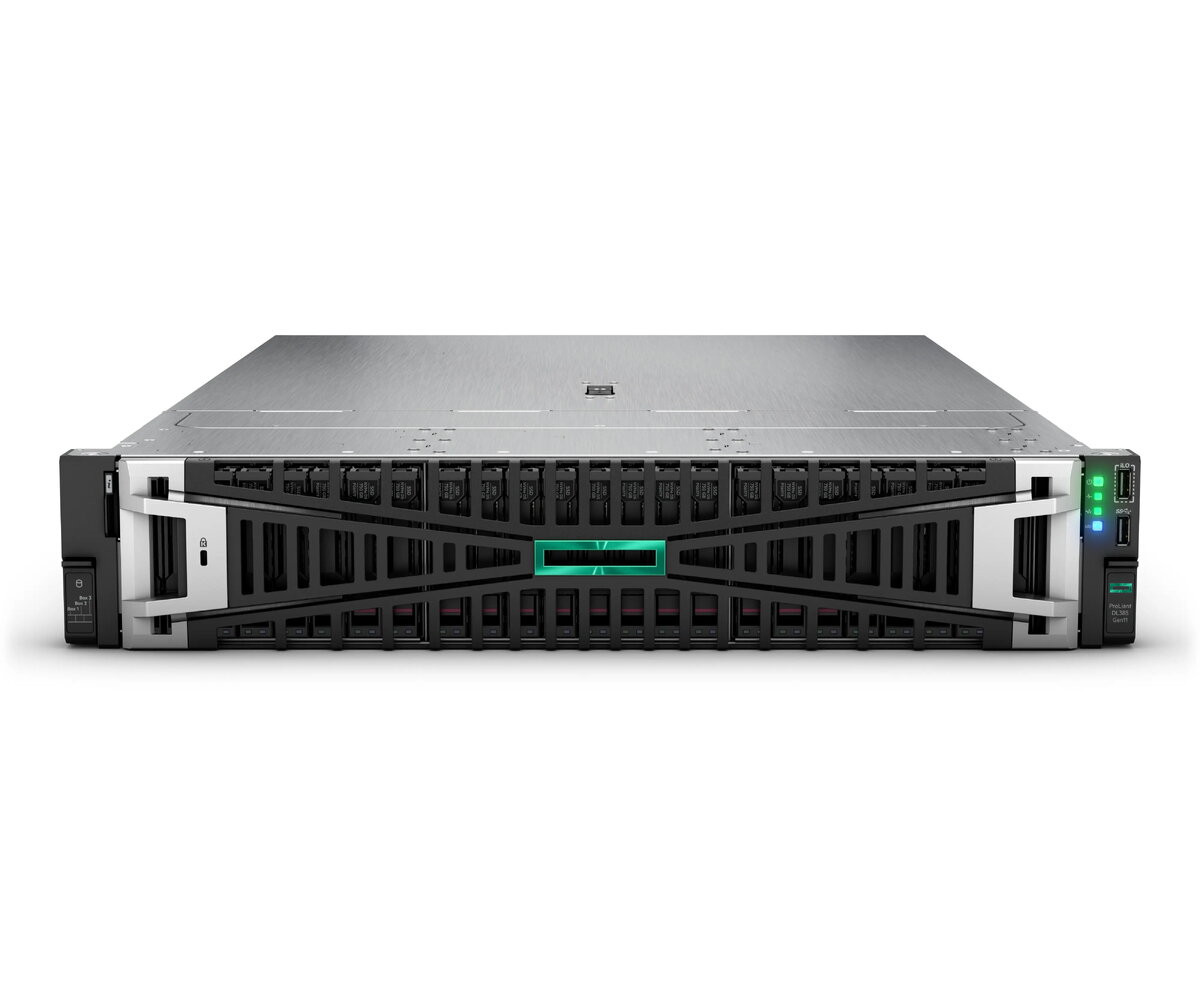
Rack server HP ProLiant DL385 Gen11 with AMD EPYC 9124 3.0GHz 16-core, 64GB DDR5 (2x32GB), 8x SFF bays, MR408i-o, 2×480GB SATA SSD, 2×1000W PS
HP ProLiant DL385 Gen11 rack server with an AMD EPYC 9124 3.0 GHz 16-core processor, 64 GB DDR5 memory (2×32 GB), integrated MR408i‑o storage controller and eight SFF drive bays populated with two 480 GB SATA SSDs (960 GB total). The system comes in a 2U chassis with redundant dual 1000 W power supplies and integrated Ethernet connectivity. Designed for data center deployments, this configuration offers balanced compute, memory and storage for virtualization, database and general-purpose workloads.
The server combines a recent-generation AMD EPYC CPU with DDR5 memory to deliver improved memory bandwidth and processing density compared with prior generations. A hardware RAID controller (MR408i‑o) provides onboard storage management and supports the installed SATA SSDs for reliable local storage. Dual 1000 W redundant power supplies increase availability in rack environments, while the 2U form factor enables higher density in server racks. Integrated management and standard Ethernet interfaces simplify deployment and remote administration.
Install the server into a standard 19-inch rack occupying 2U of space, connect redundant AC inputs to separate power sources where available, and attach network cabling to the integrated Ethernet ports. Use the server management interface to configure firmware and provisioning settings, initialize and configure RAID volumes with the MR408i‑o controller, and install the chosen operating system or hypervisor on the SATA SSDs or on alternate boot media. Follow vendor guidance for BIOS/firmware updates and driver installation to ensure full compatibility with DDR5 memory and the EPYC processor.
For best performance in virtualization and database scenarios, populate additional memory and consider using enterprise-grade NVMe or EDSFF drives for higher I/O workloads; ensure redundant network paths and separate power feeds to maximize availability.
HPE ProLiant DL385 Gen11 delivers an intuitive cloud operating experience that centralizes management across edge, core and cloud. Whether deployed as a physical rack server or consumed as-a-service with HPE GreenLake, it lets IT teams move from reactive firefighting to proactive operations via a self-service console with global visibility. Built-in automation accelerates deployment, scales compute instantly and reduces routine tasks—shortening maintenance windows and simplifying lifecycle management.
HPE Compute Ops Management is included to provide an as-a-service compute management layer that increases agility and speed across your entire infrastructure. It streamlines provisioning, monitoring and support so your team can focus on strategic workloads—ideal for virtualization, databases and general-purpose compute in data centers.
The DL385 Gen11 is engineered with a silicon root of trust and the AMD Secure Processor (part of the AMD EPYC SoC) to enforce secure boot, memory encryption and protected virtualization. Firmware and platform integrity are verified at boot by an immutable fingerprint anchored in HPE ASICs, helping contain malicious code and keep healthy servers protected.
These servers continuously detect and contain security-compromised systems—preventing boot where required—and ship with IDevID certificates installed by default. Automated recovery workflows restore validated firmware and help rapidly bring the OS, applications and data connections back online, reducing downtime after security events.
Designed for modern data centers, this 2U HP ProLiant DL385 Gen11 configuration combines an AMD EPYC 9124 3.0 GHz 16-core processor, 64 GB DDR5 (2×32 GB), integrated MR408i-o controller, eight SFF bays populated with 2×480 GB SATA SSDs (960 GB total) and redundant 2×1000 W power supplies—providing a balanced platform for virtualization, databases and general-purpose compute workloads.

{{highlightedFeature.featureTitle}}:
{{getProductFeatureValueById(product, highlightedFeature.featureId)}}
{{ productComparisonGenerationError }}