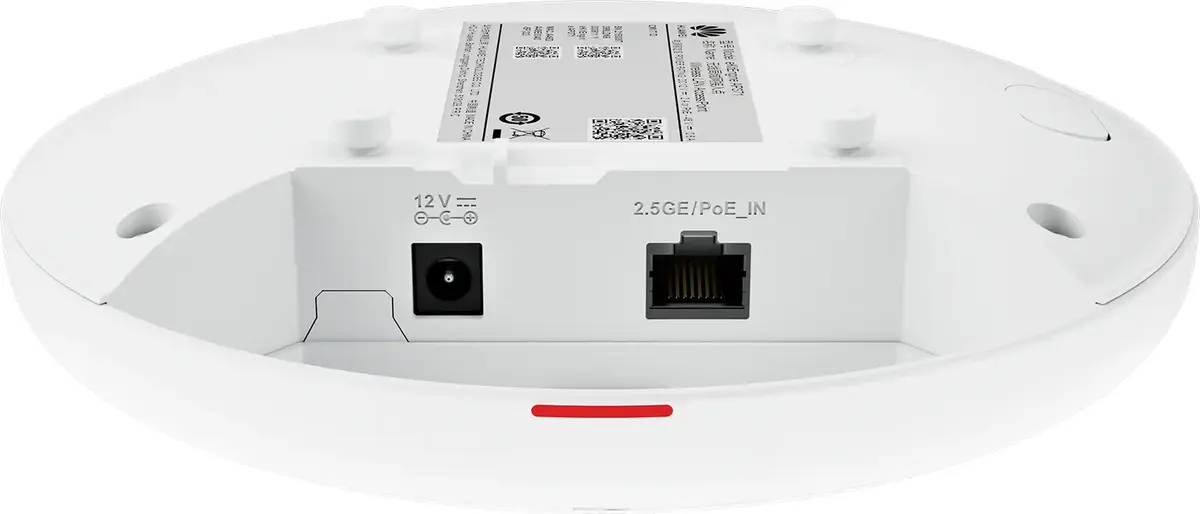
-
BeamForming:
-
Yes
-
Quality of Service (QoS) support:
-
Yes
-
Cyclic Delay Diversity (CDD):
-
Yes
-
Cyclic Shift Diversity (CSD):
-
Yes
-
Dynamic Frequency Selection (DFS):
-
Yes
-
Maximal-Ratio Combining (MRC):
-
Yes
-
Adaptive bandwidth management:
-
Yes
-
Virtual LAN features:
-
SSID-based VLAN assignment
-
VLAN support:
A Virtual Local Area Network (VLAN) consists of a group of computers and switches that can be physically distributed over different networks and buildings, but form one LAN on a logical level.
-
Yes
-
Fast roaming:
-
Yes
-
WLAN channel features:
-
WLAN channel rate adjustment, WLAN channel management
-
Wi-Fi Multimedia (WMM)/(WME):
-
Yes
-
Spread spectrum method:
-
OFDMA
-
MIMO type:
-
Multi User MIMO
-
MIMO:
-
Yes
-
Auto MDI/MDI-X:
A Medium Dependent Interface (MDI) describes the interface (both physical and electrical) in a computer network from a physical layer implementation to the physical medium used to carry the transmission. Ethernet over twisted pair also defines a medium dependent interface crossover (MDIX) interface. Auto-MDIX ports on newer network interfaces detect if the connection would require a crossover, and automatically chooses the MDI or MDIX configuration to properly match the other end of the link.
-
Yes
-
Tunnel forwarding:
-
Yes
-
Automatic channel scanning:
-
Yes
-
Bluetooth version:
The type of bluetooth technology in the product e.g. Bluetooth Smart (v4.0).
-
5.4
-
Bluetooth Low Energy (BLE):
-
Yes
-
Bluetooth:
Bluetooth is a low-power radio technology developed to replace the cables and wires currently used to link or connect electronic devices such as personal computers, printers, and a wide variety of handheld devices including mobile phones. Because it uses radio-wave connectivity, a Bluetooth-enabled device has a constant, established connection to whatever browser it uses. This saves the user the trouble of logging on to check for emails or news updates, for example.
-
Yes
-
Networking standards:
The way in which the network is working, e.g. IEEE 802.11a, IEEE 802.11b, IEEE 802.11g.
-
IEEE 802.11ac, IEEE 802.11a, IEEE 802.3at, IEEE 802.3af, IEEE 802.11n, IEEE 802.11be, IEEE 802.11ax
-
Ethernet LAN data rates:
The different speed levels of the Ethernet LAN connection.
-
2500, 1000, 100
-
Maximum data transfer rate:
The maximum speed with which data can be transmitted from one device to another.
-
2500 Mbit/s
-
5 GHz:
-
Yes
-
6 GHz:
-
No
-
2.4 GHz:
-
Yes