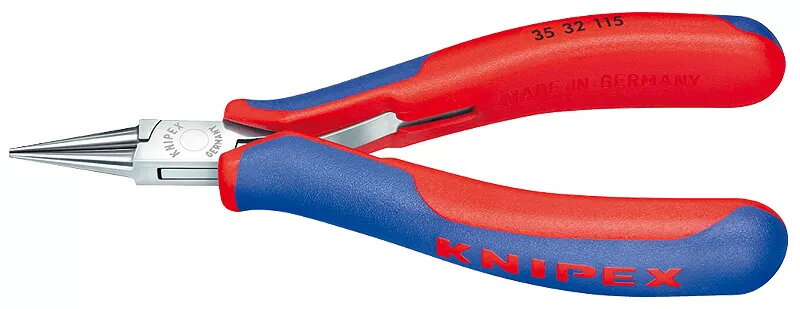
The main product Needle-nose pliers Knipex 35 32 115 is compared with alternatives Needle-nose pliers Knipex 35 12 115, Needle-nose pliers Knipex 35 22 115, Needle-nose pliers Knipex 35 11 115, and Needle-nose pliers Knipex 35 42 115. All these tools share a total length of 115 mm and a jaw length of 2.25 cm, but vary in jaw width and weight, influencing their suitability for precise tasks in tight spaces.
⚙️ The specifications comparison focuses on shared physical dimensions as well as key differences in jaw width and weight, which determine how each model handles intricate tasks in electronics, assembly, and tight spaces.
| Parameter | Knipex 35 32 115 | Knipex 35 12 115 | Knipex 35 22 115 | Knipex 35 11 115 | Knipex 35 42 115 | Practical significance |
|---|
| Total length | 115 mm | 115 mm | 115 mm | 115 mm | 115 mm | Identical compact size for easy handling and maneuverability. |
| Jaw length | 2.25 cm | 2.25 cm | 2.25 cm | 2.25 cm | 2.25 cm | Same working reach for accessing confined areas. |
| Jaw width | 1 mm | 4 mm | 1.5 mm | 4 mm | 1.5 mm | 1 mm width offers maximum precision for micro-tasks, while 4 mm provides a stronger grip. |
| Weight | 72 g | 72 g | 73 g | 61 g | 74 g | Lightweight design across all versions prevents hand fatigue during extended use. |
◎ Suitability and use cases are evaluated to help match the right tool variant to specific user needs, from micro-electronics to general hobby work.
| Use case | Recommended product | Why |
|---|
| Micro-electronics and tightest spaces | Needle-nose pliers Knipex 35 32 115 | The 1 mm jaw width provides the highest level of precision for gripping tiny components. |
| General electrical and mechanical tasks | Needle-nose pliers Knipex 35 12 115 | The wider 4 mm jaws offer robust grip and durability for standard handling. |
| Jewelry making and detailed crafting | Needle-nose pliers Knipex 35 42 115 | The 1.5 mm jaw width balances delicate access with reliable control. |
The Needle-nose pliers Knipex 35 32 115 differs from the alternatives by featuring the narrowest jaw width of just 1 mm, making it the superior choice for ultra-precise micro-tasks, whereas models with wider jaws are more suitable for general applications requiring a sturdier grip.