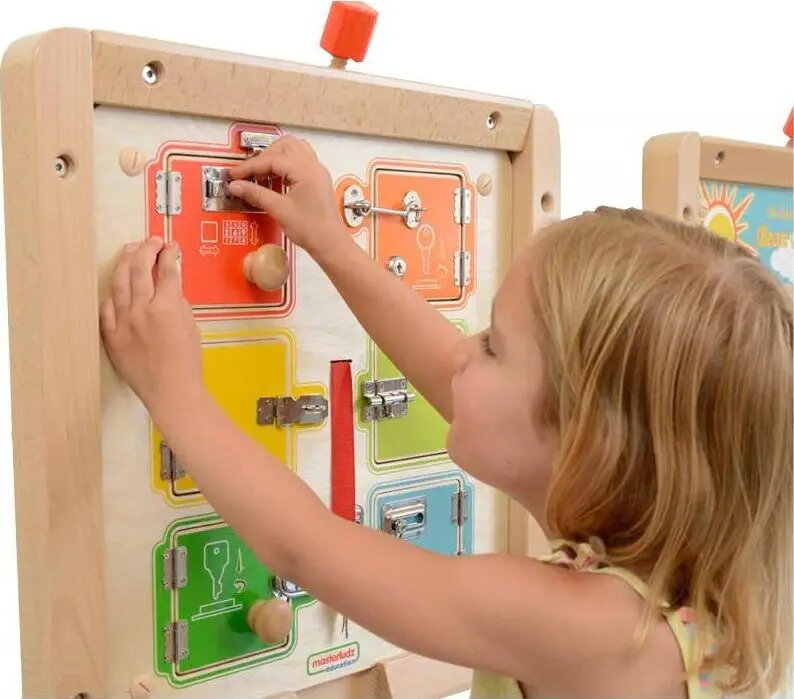
Masterkidz ME12531 is a wall-mounted wooden learning board that features six distinct lock boxes arranged on a single panel. Each box contains a different mechanism—latches, a key lock, a combination-style fastener and simple sliding or turning locks—designed to give children hands-on experience with opening and closing devices while practising finger dexterity and hand-eye coordination. The wooden panel is intended for mounting on a wall in a classroom, playroom or learning corner to provide repeated, safe practice of practical life skills and basic problem-solving.
Advantages
The set offers six varied lock types in one compact, wall-mounted format that saves floor space and keeps activities visible and accessible. Solid wood construction and simple mechanical components provide robust, tactile feedback appropriate for preschool and early-school-age children. By combining multiple mechanisms on a single board, the product supports progressive skill development and sustained engagement during supervised play or guided learning sessions.
Suitable for
- Preschool and kindergarten classrooms for group or individual fine motor practice
- Occupational therapy settings focusing on hand strength and coordination
- Home learning areas or playrooms to develop practical life skills and problem-solving
- Early childhood programs that include sensory and manipulative activities
When it may not be suitable
This product is designed for children and relies on adult supervision; it is not suitable for unsupervised infants or toddlers who may put small parts in their mouths. The lock mechanisms are simple and intended for introductory skill development, so older children seeking advanced mechanical challenges may find the activities limited.
Key specifications
- Material: predominantly solid wood panel with metal and plastic lock components
- Configuration: six individual lock boxes mounted on one wall panel
- Mounting: wall-mounted installation for fixed, visible use
- Intended age: preschool and early school years (adult supervision recommended)
- Use: indoor educational and therapeutic settings
How to use
Install the wooden board securely to a wall at a height appropriate for the child or group using it, following any included mounting instructions and using suitable fixings for your wall type. Demonstrate each mechanism to the child before allowing independent use, showing how to unlatch, turn, slide or use a key or combination movement safely. Encourage repeated trials to build confidence and dexterity, and rotate guided tasks to focus on different aspects such as pincer grip, bilateral coordination and sequential problem solving.
What to consider before purchase
- Check mounting requirements and wall compatibility to ensure secure installation
- Confirm the recommended age range and the need for adult supervision
- Consider the learning objectives—basic fine motor practice and introductory lock mechanisms rather than advanced mechanical training
- Assess available space and visibility, since the item is wall-mounted and intended for routine use
Usage recommendations
Use the board as part of short, supervised practice sessions that focus on one mechanism at a time. Pair the activity with verbal prompts or simple picture cards to support step-by-step learning. Regular, brief practice is more effective than long, unsupervised play for developing fine motor skills and practical problem-solving.