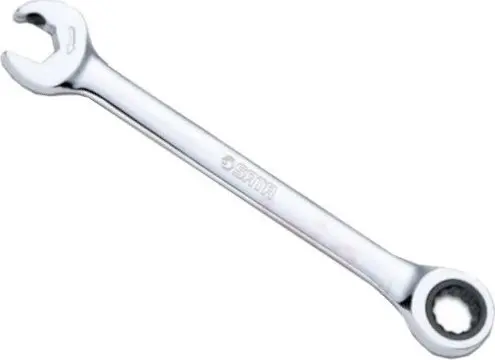
The Sata Combination Ratchet Wrench 24 mm with Double Ratchet Mechanism is compared against several alternative models from key manufacturers for automotive and mechanical applications. All reviewed tools are designed for fastener handling, but they differ in ratchet mechanism design and head type, which directly impacts ease of use in confined spaces.
⚙️ The following table compares key characteristics including tool type, size, ratchet construction features, and the practical significance of these differences for real-world use.
| Parameter | Sata Combination Ratchet Wrench 24 mm with Double Ratchet Mechanism | Combined Ratchet Wrench Proxxon 24 mm model 23273 | Sata combination wrench with ratchet 24 mm, model GL43215 | Wrench 24 mm Proxxon MicroSpeeder PR23061 with universal joint | Combination ratchet wrench 21 mm Sata S43213, 21mm ratcheting box-end and open-end | Combination Ratcheting Wrench 7 mm Sata S43603 with Double Ratchet | Practical significance |
|---|
| Tool type and size | Combination ratchet wrench, 24 mm | Combined ratchet wrench, 24 mm | Combination wrench with ratchet, 24 mm | Flat/box combination wrench with universal joint, 24 mm | Combination ratchet wrench, 21 mm | Combination wrench with double ratchet, 7 mm | Most models are tailored for standard 24 mm fasteners, while alternatives offer different sizes or specialized pivoting joints. |
| Mechanism features | Double ratchet mechanism | Standard box-end ratchet mechanism | Integrated ratchet mechanism | Built-in universal joint (pivoting) | Box-end ratchet mechanism | Double ratchet mechanism | Double ratchets and pivoting joints improve efficiency and reach in hard-to-reach areas compared to standard designs. |
| Application purpose | Automotive and mechanical tasks | Automotive, mechanical, and maintenance tasks | Mechanic, maintenance, and assembly tasks | Precision mechanical work and repairs at an angle | Mechanical and maintenance work | Automotive, workshop, and assembly tasks | All tools target professional workshop and automotive use, but are adapted to different clearance requirements. |
◎ The following table evaluates how well each product fits different use cases, access constraints, and user needs.
| Use case | Recommended product | Why |
|---|
| Fastening 24 mm hardware in tight spaces with high efficiency | Sata Combination Ratchet Wrench 24 mm with Double Ratchet Mechanism | The double ratchet mechanism provides maximum speed and efficiency when tightening and loosening in confined areas. |
| Standard maintenance of large assemblies and machinery | Combined Ratchet Wrench Proxxon 24 mm model 23273 | Combines an open jaw and a classic ratchet for quick repositioning on 24 mm fasteners. |
| Working at an angle in restricted spaces | Wrench 24 mm Proxxon MicroSpeeder PR23061 with universal joint | The pivoting universal joint reaches fasteners that are difficult to access with straight wrenches. |
| Servicing smaller fasteners (7 mm or 21 mm) | Combination ratchet wrench 21 mm Sata S43213 or Combination Ratcheting Wrench 7 mm Sata S43603 | Suited for specialized small or non-standard connections where a 24 mm wrench is too large. |
The primary advantage of the Sata Combination Ratchet Wrench 24 mm with Double Ratchet Mechanism is its double ratchet mechanism combined with a standard 24 mm size. This model is ideal for professional mechanics and technicians needing enhanced productivity in tight spaces. If angling capability or a different fastener size is required, alternative Sata or Proxxon models may be more suitable.