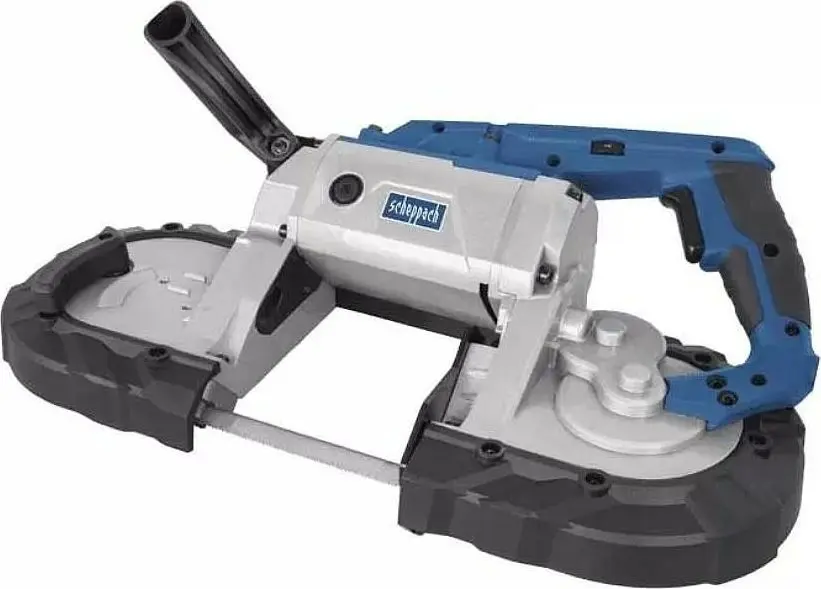
The Scheppach MBS1100 Metal Cutting Band Saw is compared with several alternative cutting tools: the Makita cordless metal cut-off saw Makita Cordless Metal Cut-Off Saw 355 mm 2x18V, the Scheppach wood tape cutting machine Tape cutting machine Scheppach HBS261, the Makita cordless metal cutting saw Metal Cutting Cordless Saw Makita M DCS553Z 18V Li‑ion, 150 mm Blade, the stationary electric metal cutting saw Electric Metal Cutting Saw GEKO G81026, 400V, 2.2 kW, and the Scheppach wood band saw Band Saw Scheppach HBS30X 350 W 80 mm for Wood. All these tools serve workshops and construction sites, but they differ in power source (corded versus cordless), intended material (metal versus wood), and form factor.
⚙️ Below is a comparison of technical characteristics and practical differences, covering material suitability, design type, and power source.
| Parameter | Scheppach MBS1100 Metal Cutting Band Saw | Makita Cordless Metal Cut-Off Saw 355 mm 2x18V | Tape cutting machine Scheppach HBS261 | Metal Cutting Cordless Saw Makita M DCS553Z 18V Li‑ion, 150 mm Blade | Electric Metal Cutting Saw GEKO G81026, 400V, 2.2 kW | Band Saw Scheppach HBS30X 350 W 80 mm for Wood | Practical significance |
|---|
| Application and material | Metal cutting (profiles, tubes, rods) | Metal cutting (profiles, pipes, rods) | Precision cutting of wood and other materials | Metal cutting (profiles, pipes, sheet) | Stationary cutting of metal and steel profiles | Wood cutting, straight and curved cuts | The core difference lies in the material focus: most tools handle metal, while two Scheppach models are dedicated to woodworking. |
| Tool type | Metal cutting band saw | Cordless cut-off circular saw | Tape cutting machine | Cordless metal cutting circular saw | Stationary electric saw (400V) | Wood band saw | The form factor dictates mobility and cut character: band saws handle contours well, while circular saws excel at quick straight cuts. |
| Power source | Electric mains | Cordless (2x18V batteries) | Electric mains | Cordless (18V Li‑ion battery) | Electric mains (400V) | Electric mains | Makita models offer jobsite mobility without cords, whereas mains-powered tools are built for continuous workshop operation. |
◎ The following table evaluates how well each product fits different user needs and usage scenarios.
| Use case | Recommended product | Why |
|---|
| Precise cutting of metal pipes and profiles in a workshop or plugged-in site | Scheppach MBS1100 Metal Cutting Band Saw | Delivers clean and accurate metal cuts through stable operation and an ergonomic handle design. |
| Mobile metal construction work without access to mains power | Makita Cordless Metal Cut-Off Saw 355 mm 2x18V | Battery-powered operation enables remote jobsite work with large stock thanks to its 355 mm blade. |
| Woodworking and timber cutting tasks in a workshop | Tape cutting machine Scheppach HBS261 or Band Saw Scheppach HBS30X 350 W 80 mm for Wood | These models are engineered specifically for timber, featuring speed adjustments and suitable cutting capacities. |
| Onsite repairs and quick sheet metal or pipe trimming | Metal Cutting Cordless Saw Makita M DCS553Z 18V Li‑ion, 150 mm Blade | Compact cordless design makes it convenient for quick maintenance tasks and sheet metal cutting. |
| Heavy-duty stationary steel cutting in fabrication settings | Electric Metal Cutting Saw GEKO G81026, 400V, 2.2 kW | A powerful three-phase motor supports stable, repetitive metal cutting for small-scale production. |
The Scheppach MBS1100 Metal Cutting Band Saw is best suited for users who need a reliable corded tool for accurate and stable cutting of metal profiles and tubes. Unlike the cordless Makita alternatives, it does not rely on battery charge, and compared to the heavy GEKO model, it provides a much more manageable and portable format. It is the preferred choice if you work primarily with metal inside an equipped workshop or a fixed jobsite location.