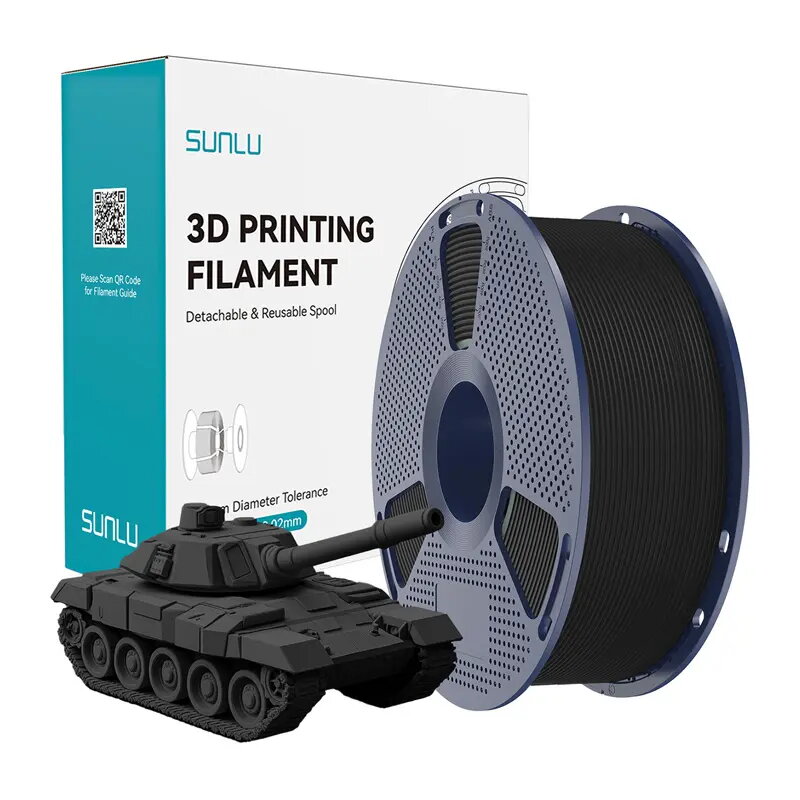
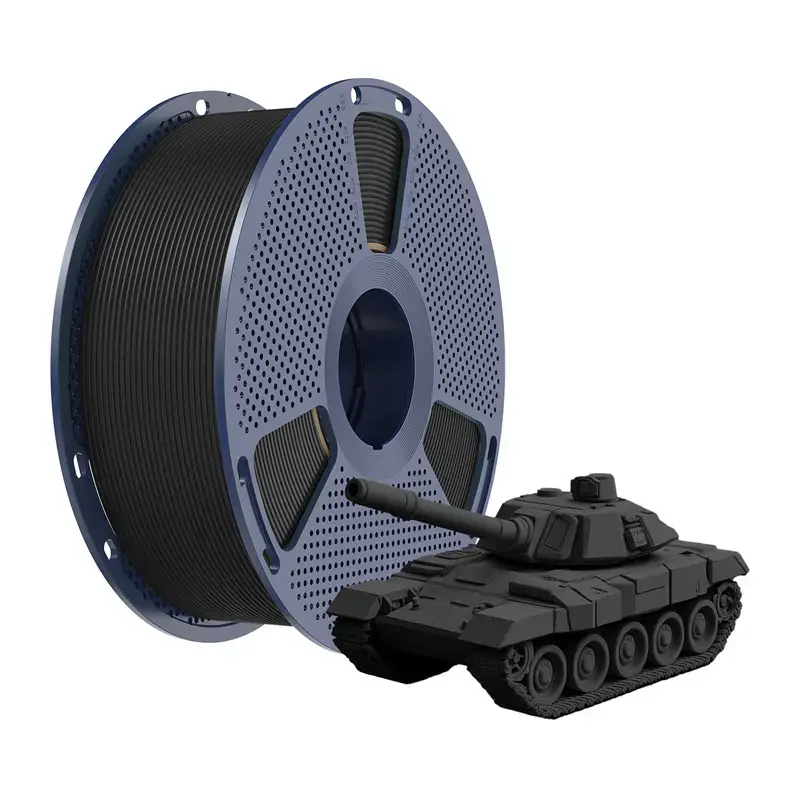
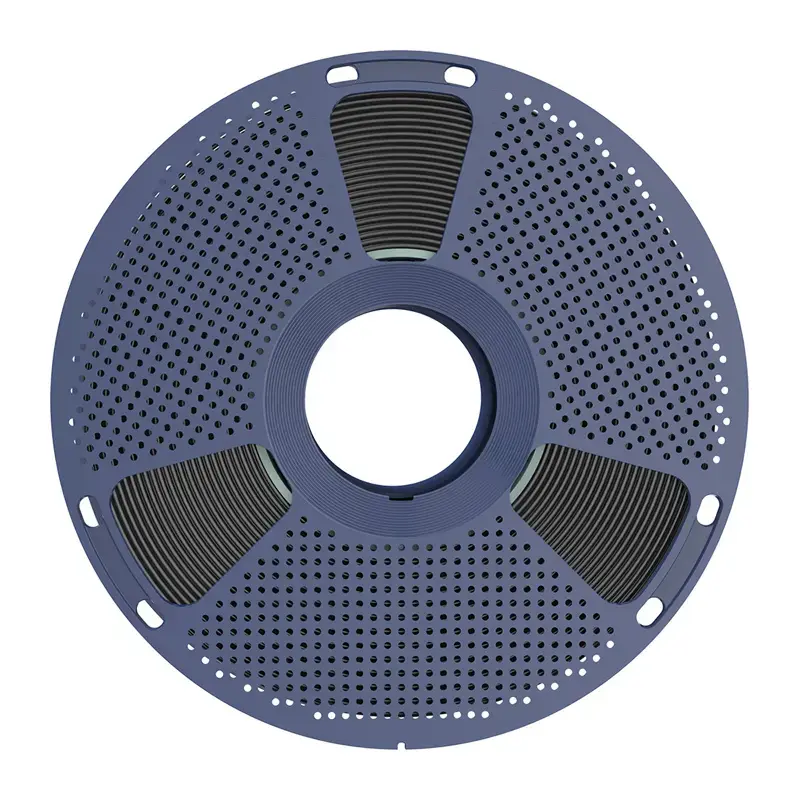
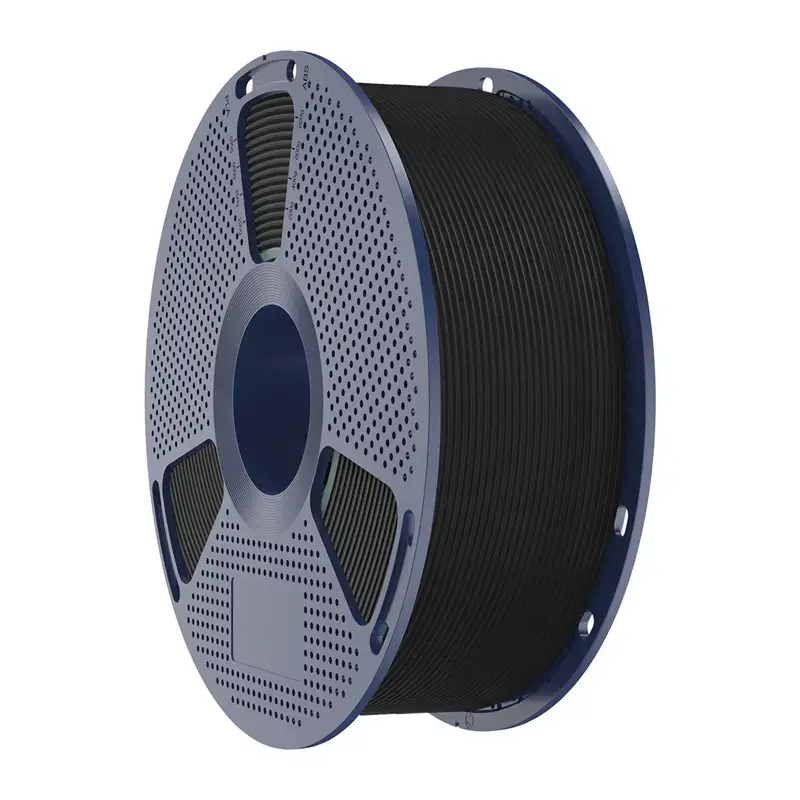
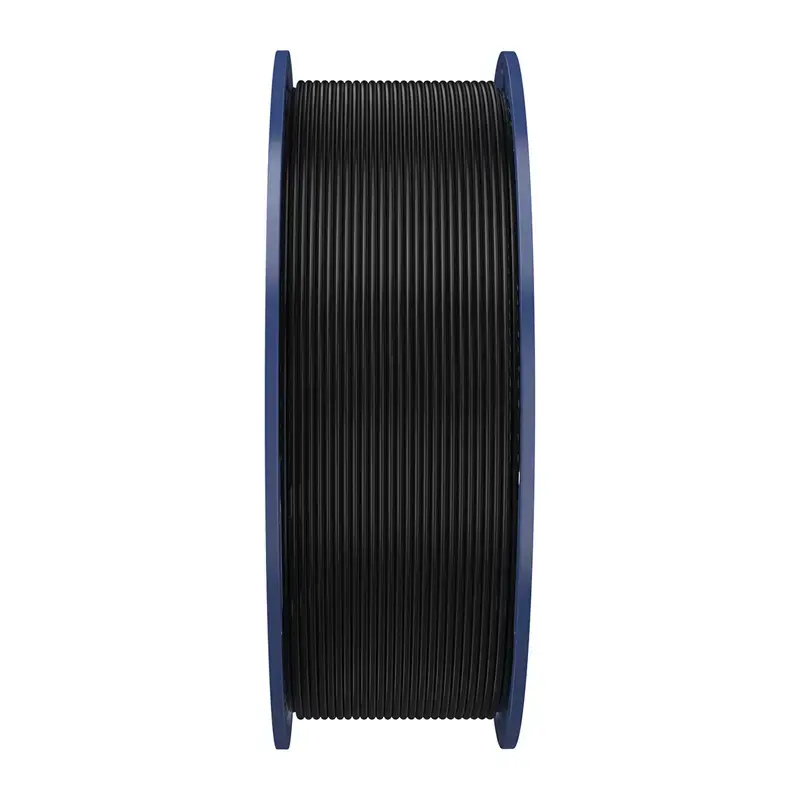
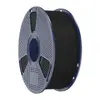
Sunlu PLA+ High-Speed Black Filament is a black PLA+ material formulated for faster FDM/FFF 3D printing while preserving reliable layer bonding and good surface finish. It aims to combine improved toughness and impact resistance with smooth feeding and dimensional stability, making it suitable for everyday prints and more demanding functional models.
Advantages
The filament is manufactured with precise winding to ensure consistent feeding and reduce the risk of tangles or interruptions during printing. It demonstrates low shrinkage, excellent interlayer adhesion and resistance to common printing issues such as nozzle clogging, stringing and warping. Mechanical properties such as increased impact strength and tensile performance provide greater durability compared to many standard PLA variants.
Suitable for
- Rapid prototyping where shorter print times are important
- Functional parts requiring improved toughness and impact resistance
- Visual models and consumer prints that need a clean black finish
- FDM/FFF printers using 1.75 mm filament (e.g., Bambu Lab, Creality, Prusa, Anycubic)
When it may not be suitable
This PLA+ has moderate heat resistance (Vicat ~54°C, HDT ~53°C), so it may not be appropriate for parts exposed to high continuous temperatures or outdoor use where prolonged UV and heat exposure are expected. For applications that require high temperature performance or specific chemical resistance, alternative engineering materials should be considered.
Key specifications
- Filament diameter: 1.75 mm with dimensional tolerance ±0.02 mm
- Color: Black
- Density: 1.23 g/cm³
- Vicat softening temperature: 54 °C
- Heat deflection temperature (HDT): 53 °C
- Melting temperature: 164 °C
- Melt Flow Rate: 6.3 g/10 min
- Tensile strength: 64 MPa
- Elongation at break: 17%
- Flexural strength: 86 MPa
- Flexural modulus: 2907 MPa
- Notched impact strength (X–Y): 3.5 kJ/m²; reported overall impact resistance up to ~8 kJ/m² in optimized conditions
How to use
Load the 1.75 mm Sunlu PLA+ High-Speed filament into any compatible FDM/FFF printer and set printing temperatures according to your printer and nozzle; a melting temperature is around 164 °C but typical print temps for PLA+ are often higher—consult printer guidance and perform test prints. Use a well-leveled bed and appropriate adhesion method (glue, tape, or heated bed) to reduce warping. Because the filament is designed for high-speed printing, tune movement speeds and retraction settings to balance surface quality and print time.
What to consider before purchase
- Ensure your printer supports 1.75 mm filament and can achieve appropriate extrusion temperatures
- Consider the filament's moderate heat resistance if parts will face elevated temperatures or prolonged sunlight
- Verify required spool weight and storage conditions to avoid moisture absorption (store dry)
- Check compatibility with your slicer settings for high-speed print profiles
Usage recommendations
For best results when using Sunlu PLA+ High-Speed Black Filament, pre-dry the filament if stored in humid environments, start with conservative speed and temperature settings and gradually increase print speed while monitoring layer adhesion and surface quality. Use cooling and optimized retraction to minimize stringing at higher speeds.