
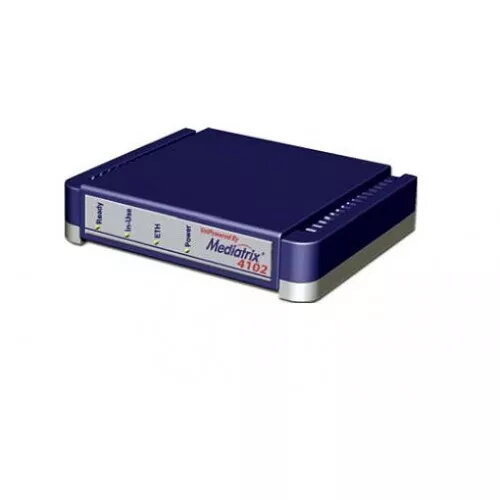
VoIP Gateway Unify Mediatrix 4102
215.99 €
{{selectedOffer && selectedOffer.price | formatAmount}}
Offer for legal entity, cashless payment.
Why is an item available only for a legal entity?
This is due to long delivery times and limited product warranties.
This is due to long delivery times and limited product warranties.
Short description
The Unify Mediatrix 4102 VoIP Gateway supports multiple voice codecs including G.729A, G.729B, and G.711, ensuring high-quality voice transmission. It is compatible with various VoIP protocols such as SIP and MGCP, providing flexibility in deployment. With robust management protocols like SNMP and TR-069, it offers easy configuration and monitoring. Security features include AES encryption and HTTPS support, ensuring secure communications. Compact and lightweight, it is ideal for various networking environments.
Cheapest delivery:
Unisend LV
Pick-up points
Unisend LV
Cost
1.79 €
Deliver
{{selectedOffer.parcelStationDeliveryString}}
Customer service center
2b. Kengaraga str., Riga, Latvia, LV-1063
26.08.2026
{{selectedOffer.officeDeliveryString}}
free
Courier Delivery
Please note that in case of a large parcel additional delivery costs may apply!
From 4.99 € (Weight: 0.71 kg)
Parcel couriers
Unisend LV / Venipak Pickup LV / Venipak Locker LV / Latvijas Pasts pakomāts / DPD Paku skapis / Omniva LV / Latvijas Pasts nodaļa
31.08.2026
{{selectedOffer.parcelStationDeliveryString}}
From 1.79 €

Payment Methods:
Cash payment, Bank transfer, Bank cards on-line, Apple Pay, Google Pay
Available for private customers at price 226.99 €:
10 pcs.


