Dreame vacuums for fast and efficient cleaning!

{{ totalProductsCount }}
In cart {{totalProductsCount}} item(s)
In cart {{totalProductsCount}} item(s)
Total:
{{sum | formatAmount}}
Your cart is empty
Markdown Firewalls
Renew

Renew
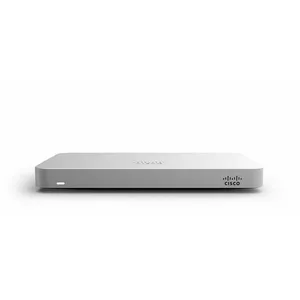
Cisco
Firewall router Cisco Meraki MX64 Cloud Managed — compact security appliance, cloud-managed MX64-HW-RFB
Delivery: 04.11.2026
34.49 €
Demo
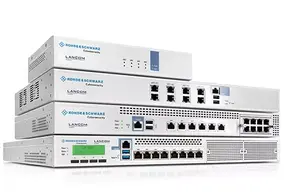
Demo
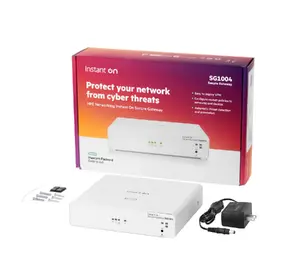
HP Enterprise
HPE Networking Instant On Secure SG1004 Gateway with 4-Port Gigabit Ethernet
Delivery: 26.11.2026
127.49 €
Firewalls are network security devices or software that monitor and control incoming and outgoing network traffic based on predefined security rules. They are used to protect networks, servers, and individual devices from unauthorized access, malware, and other network threats by enforcing policies at different points in the network. Organizations and individuals choose firewalls to segment networks, restrict access to sensitive resources, and log or block suspicious activity. Firewalls are applied in scenarios such as office networks, data centers, cloud environments, and home networks where traffic filtering, policy enforcement, and basic intrusion prevention are required. Selection depends on performance needs, supported protocols, management features, and integration with existing security infrastructure. Proper configuration and maintenance are necessary to ensure a firewall continues to provide intended protection and minimal performance impact.
Types of Firewalls
Common firewall types differ by deployment and function:
- Packet-filtering firewalls — evaluate packet headers and allow or deny traffic based on IP addresses, ports, and protocols.
- Stateful inspection firewalls — track active connections and apply rules based on connection state and context.
- Application-layer (proxy) firewalls — inspect and filter traffic at the application layer, understanding protocols such as HTTP, FTP, or SMTP.
- Next-Generation Firewalls (NGFW) — combine traditional filtering with deeper inspection, application awareness, and integration with threat intelligence.
- Cloud and virtual firewalls — software-based firewalls designed for cloud instances and virtualized environments.
- Hardware (appliance) firewalls — dedicated physical devices deployed at network edges or between network segments.
What are Firewalls used for?
Firewalls serve multiple practical purposes in network security and administration:
- Access control — permit or block traffic to specific hosts, services, or networks according to policy.
- Network segmentation — separate networks or departments to limit lateral movement of threats.
- Threat prevention — block known malicious traffic patterns, exploit attempts, and certain types of malware communication.
- Traffic monitoring and logging — record connection attempts and traffic flows for auditing and incident investigation.
- Performance management — shape or prioritize traffic to ensure critical services receive required bandwidth.
Key Differences between Firewalls
Differences among firewall products are based on several measurable and functional factors:
- Inspection depth — from basic packet filtering to full application-layer analysis and content inspection.
- Performance and throughput — measured in Mbps/Gbps and concurrent sessions supported, relevant to network size and load.
- Feature set — VPN support, intrusion prevention, SSL/TLS inspection, identity-based policies, logging, and reporting capabilities.
- Deployment model — physical appliance, virtual instance, or cloud-native service affects scalability and management.
- Management interface — local web GUI, command-line interface, centralized management platforms, or API-driven automation.
- Integration — compatibility with SIEM, endpoint protection, directory services, and threat intelligence feeds.
How to Choose Firewalls?
Selecting a firewall involves assessing technical requirements and operational constraints:
- Define security objectives — identify which assets need protection and what threats are most relevant.
- Estimate capacity needs — calculate required throughput, peak concurrent connections, and expected growth.
- Evaluate required features — determine if you need application awareness, VPN, SSL inspection, or advanced threat prevention.
- Consider deployment environment — choose between hardware, virtual, or cloud-native solutions based on infrastructure.
- Assess management and maintenance — check logging, reporting, update processes, and central management options.
- Plan for integration and compliance — ensure the firewall works with existing tools and meets regulatory requirements.
Why is it worth buying markdown firewalls at AiO.lv?
At the AiO.lv online store, you can place an order at a great price with delivery across Latvia — to Riga, Daugavpils, Liepaja, Jurmala, Ventspils, and other cities, as well as throughout Europe. We offer products from leading manufacturers: Cisco, D-Link, Dell, HP, Zyxel, TP-LINK, MikroTik, WatchGuard, Terra, Triton, HP Enterprise, Fortinet, SonicWall, Sophos, Lancom, rohde & schwarz, Intra2net, SecurePoint, Wortmann AG, Milesight. When you shop with us, you get:
- official warranty and guaranteed quality;
- convenient payment options (including installment and credit);
- fast and reliable delivery across Latvia and to any EU country.
FAQ
Where can you find a markdown firewalls with cheap prices?
You can buy cheaper at the AiO.lv online store. We offer competitive prices and regular discounts, so you always have the chance to find a great deal.
What is the delivery time for markdown firewalls?
If you place your order today, delivery will take between 1 and 5 business days depending on the chosen method.
How long is the warranty period for markdown firewalls?
Our store provides an official manufacturer’s warranty ranging from 12 to 36 months, depending on the model and brand. If needed, you can always contact our customer service department or the manufacturer’s authorized service center for support.
Are markdown firewalls purchasable with leasing?
Yes, if the selected product costs more than €50. You can learn more about installment purchase options and the terms of application on the Payment page.
Can markdown firewalls be purchased for a company (with VAT)?
Yes. AiO.lv works with legal entities in Latvia and throughout Europe. All product prices are shown with VAT included. In certain cases, a 0% VAT rate may apply — for example, when purchasing from other EU countries with a valid VAT number. We issue an invoice immediately after the order is placed, support BIS electronic invoices, and automatically generate all required accounting documents. To complete a purchase for a company, simply select the company profile during checkout.

14-Day Return Policy
We are confident in our quality, but if the purchase doesn’t fit — you have 14 days to return the product with peace of mind.

Fast Delivery
Get your orders as quickly as possible — right to your door, parcel lockers, or pickup points across Latvia and the EU.

Secure Payment
Pay the way you prefer: cash, VISA, MasterCard, Apple Pay, Google Pay, bank transfer, or 0% installment plan.

Quality Since 2008
AiO.lv has been on the market for over 18 years and has earned trust — with more than 6000 genuine positive reviews on Google.