
Dreame vacuums for fast and efficient cleaning!
In cart {{totalProductsCount}} item(s)
Your cart is empty
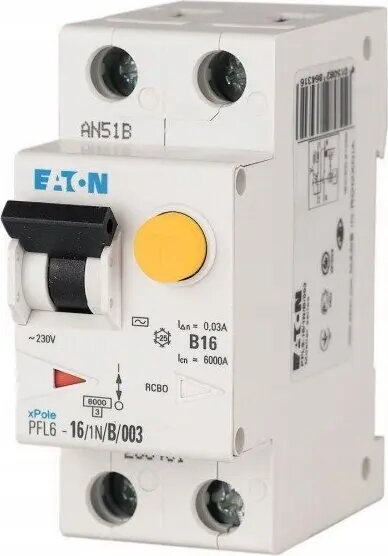
Eaton PFL6-20/1N/B/03-A Residual Current Circuit Breaker with Overcurrent Protection 1P+N 20A 300mA Type A
The Eaton PFL6-20/1N/B/03-A is a high-quality residual current circuit breaker with overcurrent protection (RCBO), designed to provide comprehensive electrical safety in both residential and commercial environments. This 1P+N device combines the functions of a miniature circuit breaker and a residual current device into a single compact unit, ensuring efficient protection against short circuits, overloads, and dangerous earth leakage currents.
This RCBO offers superior reliability by integrating two critical safety functions into one space-saving module. The Type A classification ensures that the device is sensitive not only to standard AC residual currents but also to pulsating DC residual currents, which are increasingly common in modern electronic equipment. Its robust construction and precise engineering provide long-term operational stability, helping to prevent electrical fires and protect users from accidental contact with live parts.
This device is not intended for use in industrial environments with extremely high surge currents or specialized heavy machinery that requires different tripping characteristics. It is also not suitable for DC-only electrical systems or circuits where the leakage current threshold needs to be significantly lower than 300mA for specialized safety requirements.
The Eaton RCBO should be installed by a qualified electrician in a standard DIN-rail distribution board. The device is mounted by snapping it onto the rail and connecting the phase and neutral conductors to the designated terminals. Ensure that the supply voltage matches the device specifications and that all connections are tightened to the manufacturer's torque requirements to prevent overheating.
Regularly test the device using the integrated test button to ensure the mechanical tripping mechanism remains functional. It is recommended to perform this check at least every six months to maintain optimal safety levels.
{{highlightedFeature.featureTitle}}:
{{getProductFeatureValueById(product, highlightedFeature.featureId)}}