
JBL speakers and headphones for pure and deep sound!
In cart {{totalProductsCount}} item(s)
Your cart is empty
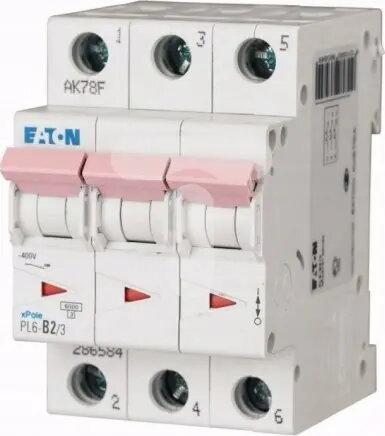
Eaton PL6-D2/3 Miniature Circuit Breaker, 3-Pole, D-Curve, 2A, 6kA
The Eaton PL6-D2/3 is a professional-grade 3-pole miniature circuit breaker engineered to provide robust protection for electrical distribution systems. This device is specifically designed to safeguard circuits against overloads and short circuits, ensuring operational safety in demanding environments. With its D-type tripping characteristic, it is particularly effective at managing high inrush currents often associated with inductive loads, making it a reliable component for industrial and commercial electrical installations.
This circuit breaker offers exceptional reliability through its high-quality construction and precise tripping mechanism. The D-curve characteristic allows for a higher tolerance of temporary current spikes, preventing nuisance tripping during the startup of motors, transformers, or other inductive equipment. Its 3-pole configuration provides comprehensive protection for three-phase systems, while the 6kA breaking capacity ensures that the device can safely interrupt fault currents, thereby protecting downstream equipment and wiring from damage.
This device is not intended for residential applications where standard B or C curve breakers are typically required for general-purpose lighting and socket circuits. Using a D-curve breaker in circuits without significant inrush current may result in delayed protection during a fault condition.
The Eaton PL6-D2/3 should be installed by a qualified electrician into a standard DIN rail distribution board. Ensure that the supply voltage and load requirements are compatible with the device ratings before installation. The wires should be securely fastened to the terminals according to the specified torque settings to prevent overheating. Once installed, the toggle switch can be used to manually disconnect or reconnect the circuit as needed.
Regularly inspect the circuit breaker for signs of thermal damage or loose connections. It is recommended to perform periodic testing of the tripping mechanism to ensure continued operational integrity within your electrical system.
{{highlightedFeature.featureTitle}}:
{{getProductFeatureValueById(product, highlightedFeature.featureId)}}
{{ productComparisonGenerationError }}