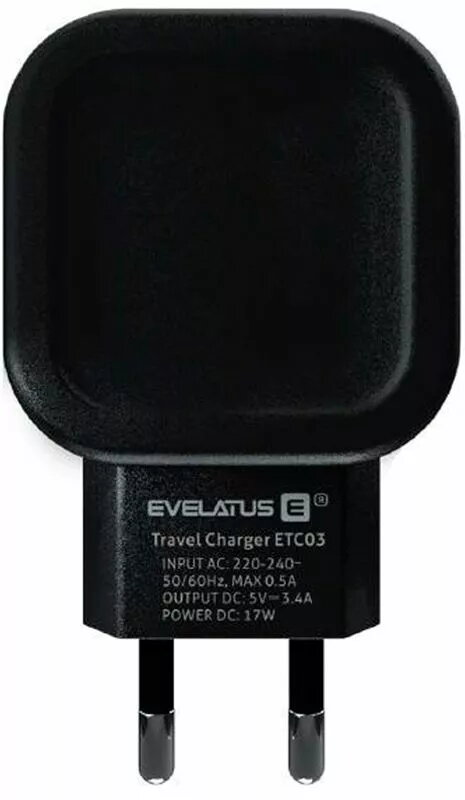
In this overview, the travel charger Travel charger Evelatus ETC03 Black is compared with several alternative charging options, including wireless pads Wireless Charger Evelatus EWC02 Black, Wireless charger Evelatus EWC01, and Wireless Desk Charger Evelatus EWD01, as well as wired wall adapters USB charger PLATINET 43723 and Power charger SWISSTEN Travel Charger SW-21A105W-BK. All these products are designed to replenish power for mobile electronics, but they differ fundamentally in their connection method: some use traditional cables and USB ports for simultaneous multi-device charging, while others offer wireless Qi technology for a cable-free experience on a desk or bedside table.
⚙️ The table below compares the key characteristics of the devices: device type, number of USB ports or presence of wireless technology, output power, and design features to help clarify the practical differences between wired and wireless solutions.
| Comparison parameter | Travel charger Evelatus ETC03 Black | Wireless Charger Evelatus EWC02 Black | Wireless charger Evelatus EWC01 | USB charger PLATINET 43723 | Wireless Desk Charger Evelatus EWD01 | Power charger SWISSTEN Travel Charger SW-21A105W-BK | Practical significance of differences |
|---|
| Device type | Wired wall charger | Wireless induction charger | Wireless induction charger | Wired wall charger | Wireless desktop charger | Wired wall charger | Wired models require a cable but often allow charging multiple devices at once, whereas wireless units provide the convenience of placing the phone on a pad without plugging in a connector. |
| Interfaces and ports | Two USB ports | Wireless pad (Qi) | Wireless pad (Qi) | Two USB ports | Wireless pad (Qi) | Two USB ports | Having two USB ports makes it possible to power a pair of devices simultaneously from a single outlet, while wireless stations focus on a single gadget at a time. |
| Output specifications | Combined current 3.4A | Supports fast wireless charging | Supports fast wireless charging | Combined current 3.4A (two ports) | Fast wireless charging | Up to 2.1A per port (10.5W total) | The Evelatus ETC03 and the PLATINET alternative offer fixed power across two ports, whereas wireless versions rely on the Qi standard for compatible smartphones. |
◎ The table below evaluates usage scenarios and buyer needs to determine which product is best suited for specific home, office, or travel environments.
| Usage scenario | Recommended product | Why this choice is optimal |
|---|
| Travel and trips with multiple gadgets | Travel charger Evelatus ETC03 Black | The compact housing and two USB ports with a combined 3.4A output are great for charging a smartphone and tablet simultaneously on the go. |
| Organizing a desktop without cable clutter | Wireless Desk Charger Evelatus EWD01 | The desktop wireless design allows placing the smartphone conveniently on the surface while reducing visual clutter from wires. |
| Stationary charging at home or office focusing on wireless format | Wireless Charger Evelatus EWC02 Black or Wireless charger Evelatus EWC01 | Induction pads simplify the daily routine of replenishing energy for compatible devices by simply placing them on the surface. |
| Everyday wired use with alternative housing design | USB charger PLATINET 43723 or Power charger SWISSTEN Travel Charger SW-21A105W-BK | Alternative wall adapters with two USB ports provide familiar wired power for everyday tasks during business trips and at home. |
Travel charger Evelatus ETC03 Black differs favorably from wireless alternatives by offering simultaneous wired connection for two devices via classic USB ports and a balanced 3.4A current, and from other wired alternatives through its specific brand design. This model is best suited for users who value mobility, travel, and reliable wired power for multiple gadgets from a single wall outlet. A buyer would prefer it over wireless models if their device lacks Qi support or if charging two units at the same time is required.