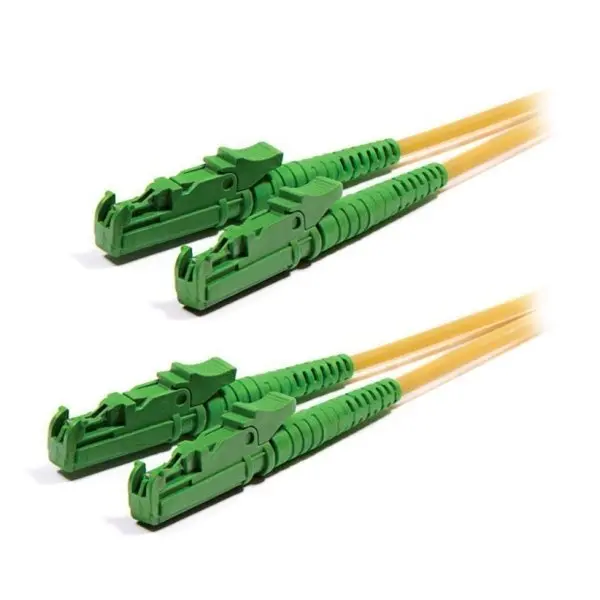
The fiber optic patchcord Fiber Optic Patchcord Duplex E2000/APC-E2000/APC 9/125 1m OS2 is compared with several alternative cables from OEM and ACT brands, varying in length, connector types, and structural design. All compared products use the single-mode 9/125 OS2 fiber standard designed for high-speed data transmission, but they differ in cable length, connector configurations (E2000/APC, LC, and SC), and specialized protective features such as LSZH jackets or short boots.
⚙️ The specifications comparison table below contrasts the fiber type, cable length, connector types, and structural features of each product to highlight their technical differences and practical applications.
| Specification | Fiber Optic Patchcord Duplex E2000/APC-E2000/APC 9/125 1m OS2 | Fiber optic patchcord duplex E2000/APC-E2000/APC 9/125 2m OS2 | Fiber optic patchcord E2000/APC 3 m, singlemode 9/125 µm OS2 | ACT 20 meter LSZH Singlemode 9/125 OS2 fiber patch cable duplex with LC and SC connectors | ACT 3 meter LSZH Singlemode 9/125 OS2 Short Boot Fiber Patch Cable Duplex with LC Connectors RL1703 | ACT RL5401 10-Meter Singlemode 9/125 OS2 Duplex Ruggedized Fiber Cable with LC Connectors | Practical significance |
|---|
| Fiber type | Single-mode 9/125 OS2 | Single-mode 9/125 OS2 | Single-mode 9/125 OS2 | Single-mode 9/125 OS2 | Single-mode 9/125 OS2 | Single-mode 9/125 OS2 | Delivers identical high data transmission speeds and minimal signal loss across all evaluated options. |
| Cable length | 1 meter | 2 meters | 3 meters | 20 meters | 3 meters | 10 meters | Length determines the maximum distance between connected equipment: shorter lengths suit patch panels within a rack, while longer ones support remote connections. |
| Connector types | E2000/APC on both ends | E2000/APC on both ends | E2000/APC on both ends | LC and SC | LC | LC | E2000/APC connectors provide high precision and low return loss, whereas LC and SC are widely used in standard network hardware. |
| Construction and materials | Duplex | Duplex | Not specified | Duplex, LSZH | Duplex, LSZH, short boot | Duplex, ruggedized design | LSZH materials improve fire safety, while ruggedized versions suit demanding physical environments. |
◎ The suitability table below evaluates different use cases and network environments to help determine which product best fits specific operational needs.
| Use case | Recommended product | Why |
|---|
| Short connections in telecom racks with precise E2000/APC connectors | Fiber Optic Patchcord Duplex E2000/APC-E2000/APC 9/125 1m OS2 | Best suited for minimal distances between adjacent equipment where precision connectors and no excess cable slack are required. |
| Interconnecting equipment up to two meters apart with E2000/APC | Fiber optic patchcord duplex E2000/APC-E2000/APC 9/125 2m OS2 | Offers the same E2000/APC technology with additional length slack for easier cable management. |
| Laboratory testing and high-precision networks with E2000/APC | Fiber optic patchcord E2000/APC 3 m, singlemode 9/125 µm OS2 | The three-meter length and precision terminations are optimized for test benches and patch panel interconnects. |
| Running long cable paths in data centers | ACT 20 meter LSZH Singlemode 9/125 OS2 fiber patch cable duplex with LC and SC connectors | The 20-meter length and safe LSZH jacket make it ideal for linking distant nodes with LC and SC interfaces. |
| Installation in tight spaces with LC connectors | ACT 3 meter LSZH Singlemode 9/125 OS2 Short Boot Fiber Patch Cable Duplex with LC Connectors RL1703 | Short boots and LSZH material facilitate high-density cabling in server cabinets. |
| Deployment in demanding or rugged environments | ACT RL5401 10-Meter Singlemode 9/125 OS2 Duplex Ruggedized Fiber Cable with LC Connectors | The robust construction and 10-meter length ensure reliability under heavier physical demands. |
The Fiber Optic Patchcord Duplex E2000/APC-E2000/APC 9/125 1m OS2 stands out from the alternatives with its compact 1-meter length and high-precision E2000/APC connectors on both ends. It is best suited for short, precision interconnects between adjacent devices in telecom racks, whereas alternative products are more appropriate when longer distances, standard LC or SC interfaces, or ruggedized construction are required.