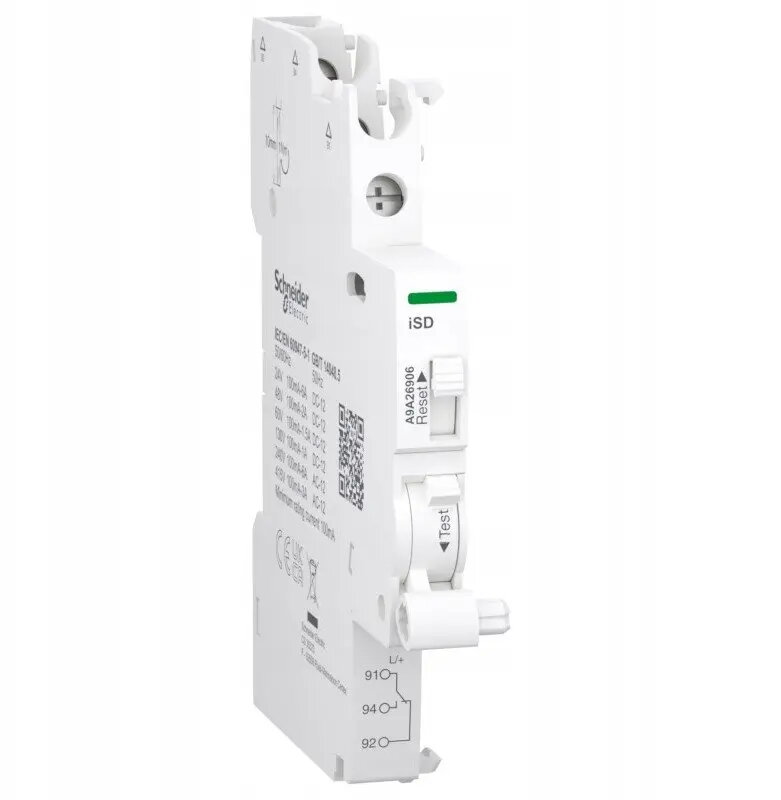
Schneider Electric Kontakt alarm iSD 1OC 100mA is an alarm contact module with a single open-collector output rated for 100 mA. Designed to provide a dry-contact-style signal, this module integrates into alarm, monitoring and control systems to drive external indicators, relays with low current coils, or PLC/automation inputs. Its compact functionality suits security panels, building automation installations and industrial control cabinets where a low-current alarm output is required.
Advantages
The module offers a simple, single-channel open-collector output that delivers a reliable 100 mA switching capability for signaling and interfacing. Its design facilitates direct connection to TTL-compatible inputs or to external devices via a pull-up resistor, enabling flexible integration into existing systems. Built to Schneider Electric standards, the unit provides predictable behaviour for alarm signaling and minimizes the need for additional interface electronics for low-current loads.
Suitable for
- Security alarm panels and intruder detection systems
- Building automation interfaces and fault signaling
- Industrial control cabinets for status indication to PLCs
- Small external indicators, buzzers or low-current relays (with appropriate pull-up)
- Integration where a dry-contact-like low-current output is required
When it may not be suitable
This module is not intended for driving high-current loads directly; its 100 mA open-collector output limits direct connection to larger relays, motors or lamps. Where galvanic isolation or higher switching current is required, an intermediate relay, optocoupler or driver stage should be used. The device provides a low-current signaling function rather than full power switching or voltage isolation.
Key specifications
- Output type: single open-collector (NPN/OC) output
- Maximum output current: 100 mA
- Function: dry-contact-style alarm signaling for external devices and logic inputs
- Typical applications: alarm signaling, status output to PLCs, building automation interfaces
- Mounting: panel or DIN-rail compatible modules (refer to system documentation for exact mounting)
How to use
Connect the open-collector output to the external device input or PLC using an appropriate pull-up resistor or supply voltage on the input side, observing polarity and input voltage limits of the receiving device. Ensure the receiving input is compatible with open-collector interfaces or add an interface stage (relay or optocoupler) for incompatible inputs or higher currents. Follow standard wiring practices: switch off power before wiring, use correct wire gauges, and verify connections against system diagrams. After wiring, test the alarm output with known signals and measure voltage/current to confirm correct operation.
What to consider before purchase
- Confirm the receiving device accepts open-collector or dry-contact-style inputs and the required pull-up voltage
- Verify that 100 mA maximum switching current is sufficient for the intended load or plan for an external driver
- Check mounting compatibility with your enclosure or panel and any required accessories for installation
- Assess whether galvanic isolation or higher voltage/current ratings are needed for your application
Usage recommendations
Use the module as a low-current signaling interface: pair it with appropriate pull-up resistors and, where necessary, an intermediate relay or optocoupler to protect the module and to drive higher-current devices. Verify wiring and test outputs under expected operating conditions to ensure reliable alarm signalling.