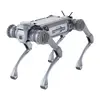
The Unitree B2 quadruped robotic platform is an advanced industrial walking robot designed to operate in demanding conditions. Combining high dynamic motion with robust construction, the Unitree B2 serves as a versatile mobile robotic platform for research, industrial inspection, education, and light commercial use. Featuring four-legged locomotion, autonomous and remote operation options, and modular mounting points for sensors and accessories, it delivers exceptional performance, reliability, and durability for real-world applications.
Advantages
The Unitree B2 stands out with its impressive top speed of up to 6 m/s, allowing it to move quickly across vast areas and respond efficiently to changing conditions. Equipped with high-performance M107 joint modules generating torque of around 360 N-m, it ensures smooth movement, precise motion control, and high stability. Its advanced terrain adaptation enables it to handle slopes up to 45°, stairs with step heights of 20 to 25 cm, and obstacles up to 40 cm high. The robot also supports dynamic jumps and features a high payload capacity of up to 120 kg in static mode and over 40 kg while moving.
Built with an IP67 protection class, the Unitree B2 resists dust and water and operates reliably within a temperature range of -20°C to 55°C. Its integrated 32-beam automotive-grade LiDAR sensor, depth cameras, and high-resolution optical cameras provide accurate spatial orientation and mapping capabilities. Powered by a high-capacity 45 Ah 58-volt battery, it delivers an operational runtime of up to 4 to 6 hours.
Suitable for
- Energy infrastructure inspections and industrial site monitoring
- Rescue operations and field patrols in hazardous environments
- Logistical tasks and payload transport in difficult terrain
- Research, testing gait algorithms, and onboard payload integration
- Educational purposes and advanced robotics development
When it may not be suitable
The Unitree B2 may not be suitable for narrow indoor spaces with very tight turning radiuses where a quadruped robot of this physical size cannot maneuver safely. It is also not intended for casual consumer entertainment or simple domestic tasks due to its heavy-duty industrial design and technical complexity.
Key specifications
- Top speed up to 6 m/s
- Total weight approximately 60 kg including battery
- Static payload capacity up to 120 kg
- Moving payload capacity over 40 kg
- Operating time up to 4 to 6 hours
- IP67 dust and water protection rating
- Operating temperature range from -20°C to 55°C
- Battery capacity of 45 Ah and 58 V
- Sensors include 3D LiDAR, depth cameras, and optical cameras
- Standard configuration processors include Intel Core i5 and Intel Core i7
How to use
Operating the Unitree B2 requires familiarization with its remote control interfaces, autonomous navigation software, and safety protocols. Before deployment, ensure the battery is fully charged and securely installed using the plug-in design. Power on the system and establish connection through the available external interfaces such as Ethernet or USB. Configure the desired operation mode, whether remote-controlled or autonomous, utilizing the onboard sensors and LiDAR for spatial awareness. Monitor the robot's status, terrain feedback, and battery levels continuously during operation to ensure safe and efficient task execution.
What to consider before purchase
- Verify that the operational environment matches the IP67 rating and temperature limits of -20°C to 55°C
- Assess the required payload and ensure it does not exceed 120 kg statically or 40 kg dynamically
- Consider the physical dimensions and weight of approximately 60 kg for transport and deployment logistics
- Review software development requirements and sensor configurations for your specific use case
- Evaluate power supply needs, battery runtime, and potential need for optional autonomous charging systems
Usage recommendations: Always conduct a pre-operation inspection of the joints, sensors, and battery connections before deploying the Unitree B2 in the field. Adhere strictly to the specified load limits and environmental temperature ranges to maximize the lifespan of the mechanical and electrical components. Regular maintenance of the sealing and sensory equipment is recommended to maintain optimal performance in dusty or wet conditions.