-
Power consumption (typical):
Amount of power consumed by this model, often expressed in watts (W). Typical values that manufacturers give are power consumption when off, standby/suspended mode, typical use, maximum usage.
-
50 W
-
Package dimensions (WxDxH):
-
240 x 205 x 63
-
Signal-to-Noise Ratio (SNR):
This is the ratio of signal intensity to noise intensity.
-
98 dB
-
Connectivity technology:
The technology that enables connectivity of the device, e.g. wired or wireless.
-
Wired
-
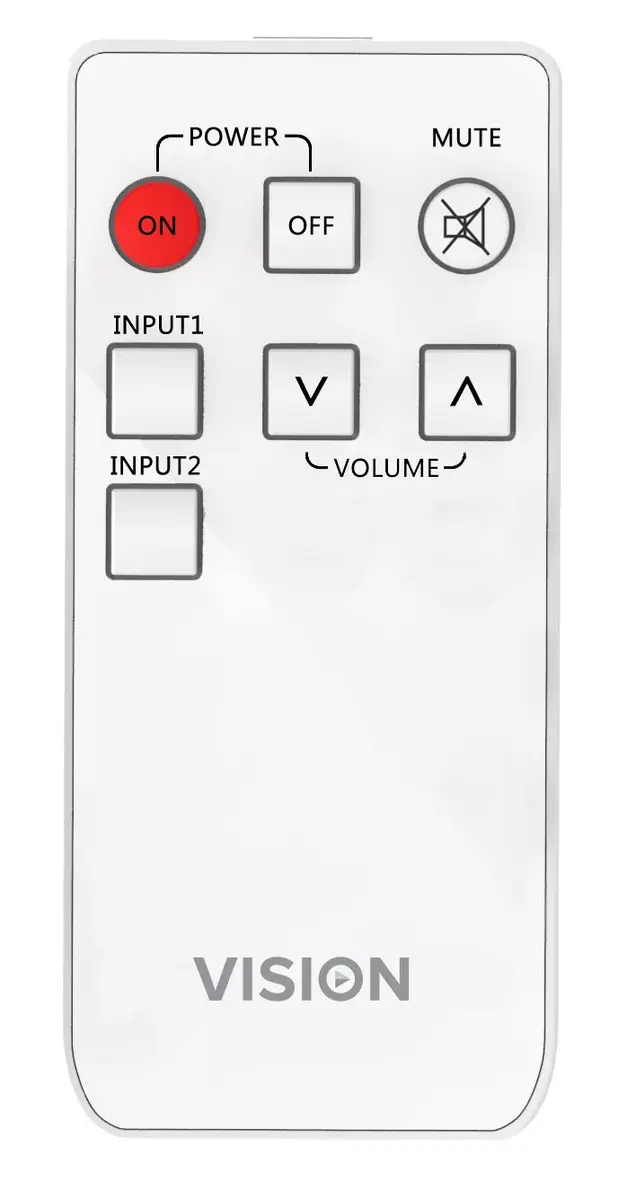
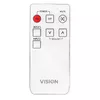
Remote control included:
Component of an electronics device, most commonly a television set, DVD player and home theater systems originally used for operating the device wirelessly from a short line-of-sight distance.
-
Yes
-
RMS rated power:
RMS (Root mean square) is a measure of the continuous power required by a device, in particular audio amplifiers and loudspeakers.
-
50 W
-
Audio output channels:
An audio output channel is an electric circuit which acts as a path for a signal produced by a device. A device may have several audio output channels.
-
2.0
-
DC-in jack:
The socket/plug where the DC electricity supply connects to the device.
-
Yes
-
Total Harmonic Distortion (THD):
Total harmonic distortion is a measure of non-linear harmonic
distortion and is given in %. Non-linear harmonic distortions are
signals which were not present in the original before the signal was
converted by the headphones. These unwanted signals are caused by the
diaphragm, whose movements do not precisely move in time with the
electric signals that cause it to move. Unfortunately, this is a
feature of all electroacoustic transducers. Although it cannot be
completely eliminated, suitable steps can be taken to minimise it.
However, the user is not interested in why this distortion takes place
but in how great the level of distortion must be for it to become
perceptible. According to the findings of several research projects, a
total harmonic distortion of 1% in the frequency range of 100 to 2000
Hz is imperceptible. Below 100 Hz, the perceptibility threshold lies
at 10%.
-
1 %
-
Purpose:
What the product is used for.
-
Home
-
Input sensitivity:
-
500 mV
-
Audio (L/R) in:
The two sockets (ports) for receiving left audio signal (white cable) and right audio signal (red cable).
-
2
-
Audio (L/R) out:
The two sockets (ports) for transmitting left audio signal (white cable) and right audio signal (red cable).
-
2
-
Frequency range:
The lowest and the hightest frequencies that can be inputted/produced.
-
80 - 22000
-
AC input frequency:
-
50 - 60
-
AC input voltage:
The voltage of the AC electricity that is inputted into the product.
-
100-240
-
RMS power output per channel (8 Ohm):
-
25 W
-
Peak power per channel:
The maximum power (usually measued in watts) that can be transmitted through a channel.
-
25 W
-
Amplifier class:
An electronic amplifier, amplifier, or (informally) amp is an electronic device that increases the power of a signal. It does this by taking energy from a power supply and controlling the output to match the input signal shape but with a larger amplitude. Power amplifier circuits (output stages) are classified as A, B, A/B and C for analog designs, and class D and E for switching designs based on the proportion of each input cycle (conduction angle), during which an amplifying device is passing current.
-
D
-
DC input voltage:
-
12