JBL speakers and headphones for pure and deep sound!

{{ totalProductsCount }}
In cart {{totalProductsCount}} item(s)
In cart {{totalProductsCount}} item(s)
Total:
{{sum | formatAmount}}
Your cart is empty
What TV to buy for watching football, hockey or other sports events
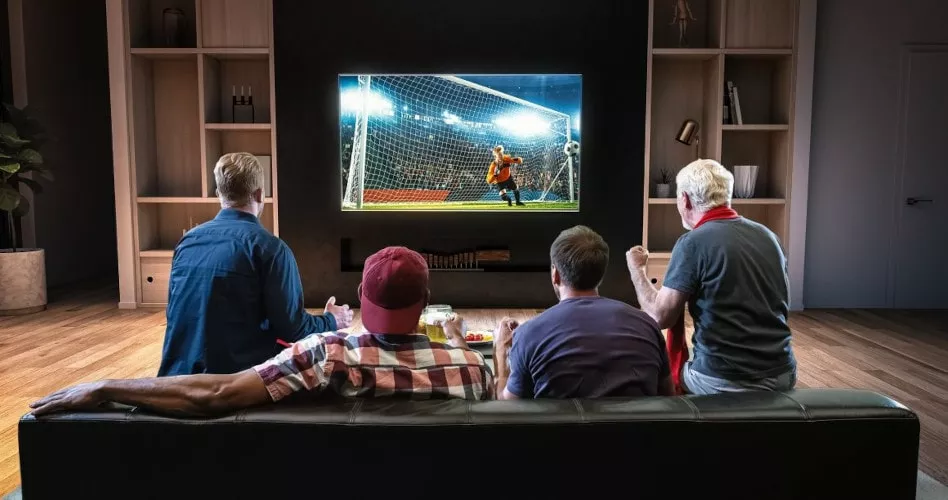
Many sports fans dream of a TV that would emphasize the image during broadcasts and allow you to fully enjoy it. However, to choose the best TV for watching football, hockey, boxing or any other sport, you must first pay attention to its specifications. In this article you will find a list of specifications that are worth paying attention to if you plan to use the TV to watch sports broadcasts.
Screen size
Over the years, this characteristic has not lost its relevance. The larger the screen, the more spectacular the viewing effect can be. However, it is important to consider that even though a large screen size allows you to comfortably watch TV from a greater distance, as the size increases, the minimum distance for comfortable viewing also increases. Below you will find the size of the screen and its minimum comfortable viewing distance.
32` - 1,5 м
40` - 1,6 м
42` - 17 м
47` - 19 м
50` - 2 м
55` - 2,2 м
60` - 2,4 м
65` - 2,6 м.
Accordingly, if you are going to buy a TV with a 32 inch screen, then keep in mind that it will be more comfortable for you to watch it at a distance of 1.5 meters.
Screen resolution
Truth be told, this specification is not particularly important if you buy a TV to watch on a daily basis. For most broadcasts, the resolution is not higher than 1920x1080, that is, no more than FullHD, and, as practice shows, almost all the products on the market meet this criterion. However, if you plan to spend an evening or two watching spectacular movies, pay attention to TVs with 4K resolutions. Also, streaming platforms such as Netflix, Youtube and others, have libraries with materials in 4K resolution. So why not treat yourself to a spectacular movie and a colorful picture?
Screen technology
This is the most important question, the answer to which may affect your choice of the TV. Now, the three most popular technologies on the market are: LCD TVs, OLED TVs or QLED TVs from Samsung. The choice of display technology affects the contrast of the screen and, as a result, how the TV will behave in bright light. It is worth noting right away that OLED TVs are much better able to cope with glare and sunlight, however, they are usually more expensive than liquid crystal alternatives. Another advantage is that the OLED TV has a wider viewing range, which can be a good argument if the TV is purchased for use in a pub or bar. QNED and QLED technologies are modifications of LCD TVs, which were developed to compensate for the disadvantages of liquid crystal technology. In part, they were successful, but it is believed that OLED technology still surpasses them.
Display dynamic scenes
It's no secret that dynamic scenes are what cause anxiety and a surge of adrenaline when watching sports events, and it is important that at such moments a TV shows its performance. We can give a couple of tips on this: • It is worth choosing a TV with Motion Rate, Clear Rate and similar technologies. These technologies smooth out movement, making shots more natural • It is worth paying attention to the screens refresh rate. And here, as a rule, OLED TVs again surpass LCD TVs, since they have a refresh rate that is 2 times higher (the refresh rate of OLED TVs is 100 Hz). • OLED TVs are more expensive. It's not pleasant. • Transmissions in Europe usually take place at a frequency of 50 Hz, which neutralizes the advantages of OLED in the case of watching them (for games or watching movies, OLED screens are still better) Based on what was previously mentioned, we can conclude that the embedded screen technologies will be more important than the screen refresh rate, and it is on them that you should focus.
Manufacturer
When choosing a TV, you may face the question: Should I buy a Samsung TV, an LG TV or choose another brand? It is worth noting right away that Samsung, LG and Sony are companies with many innovations and developments in the field of TV production, so their reliability is usually beyond doubt.
Conclusion: before deciding which TV to buy to watch sports broadcasts, you need to understand where the TV will be mounted (or standing), at what time of day it will most often be used, as well as what additional tasks it will perform (for example, playing games using a console). Based on this, you need to select the required screen size, its display type and make a purchase based on these criteria.
Fast shipping
New Arrival
Get it Today
Bestseller
Fast shipping
New Arrival

Get it Today
Bestseller
Get it Today